












































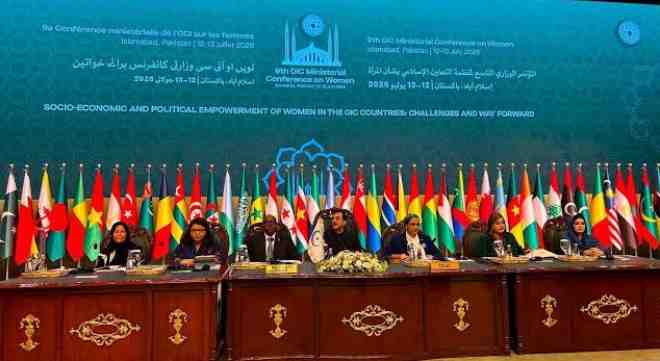
ISLAMABAD (MNN); Pakistan on Monday reaffirmed its commitment to advancing women’s rights and gender equality, with senior government leaders urging collective efforts to ensure women’s full participation in social, economic and political life during the second and concluding day of the Organisation of Islamic Cooperation (OIC) 9th Ministerial Conference on Women in Islamabad.

Addressing delegates from the 57-member OIC as conference chair, Federal Minister for Law and Human Rights Azam Nazeer Tarar said meaningful and lasting progress could only be achieved through the active participation of both women and men in promoting equality and shared responsibility.
“Women alone cannot bring about lasting change. Sustainable progress requires the active engagement of men and boys as partners in building a society based on equality, respect and mutual responsibility,” Tarar said.
He emphasized that Pakistan considers women’s empowerment a constitutional obligation, a national priority and a principle rooted in Islamic values. He highlighted the government’s continued efforts to strengthen legal, policy and institutional frameworks aimed at expanding women’s rights, leadership opportunities and economic participation.
The minister said initiatives under the National Gender Policy Framework, Vision 2025 and the Prime Minister’s Women Empowerment Package were helping increase women’s leadership, financial inclusion, entrepreneurship, access to justice, digital connectivity and safer workplaces.
Referring to Pakistan’s role as chair of the OIC ministerial conference, Tarar said the country viewed the responsibility not as an honour but as an opportunity to promote dialogue, build consensus and convert shared commitments into practical measures benefiting women across the Muslim world.
He stressed that the conference’s success would ultimately be judged not by its declarations but by the concrete opportunities created for women after participating countries returned home.
Highlighting women’s growing contributions across OIC member states, Tarar said women were leading businesses, strengthening institutions, advancing scientific research, serving in public office and supporting humanitarian and peace-building efforts. However, he acknowledged that millions of women and girls continued to face social, economic and legal barriers limiting their full participation in national development.
“Our responsibility is not merely to recognise these challenges but to remove the obstacles that prevent women from realising their full potential,” he said, adding that no nation could achieve its true potential while half of its population remained deprived of equal opportunities.
The minister also urged stronger cooperation among OIC member states through the sharing of successful experiences, institutional partnerships and joint initiatives to accelerate women’s empowerment.
Speaking about women affected by wars and humanitarian crises, Tarar paid tribute to the courage and resilience of women in the occupied Palestinian territories, Gaza, Afghanistan and Indian Illegally Occupied Jammu and Kashmir (IIOJK). He stressed that empowerment also meant ensuring protection, dignity and hope for women living under conflict and displacement.
He further highlighted the growing importance of digital innovation and artificial intelligence (AI), saying these technologies should expand women’s access to education, healthcare, entrepreneurship and financial services. At the same time, he warned that without inclusive policies, technological advancement could deepen existing inequalities and exclusion.
Addressing the conference, Senate Chairman Yousaf Raza Gilani said no country could achieve sustainable development while excluding half of its human resources from leadership and decision-making.
He paid tribute to former Prime Minister Benazir Bhutto as the first woman prime minister of the Muslim world and praised Nobel Peace Prize laureate Malala Yousafzai as a global symbol of women’s empowerment.
Gilani reaffirmed Pakistan’s commitment to promoting women’s education, employment and digital inclusion, while highlighting the Benazir Income Support Programme (BISP) as a successful initiative reducing poverty and improving girls’ access to education.
He also noted that constitutional measures, including reserved seats, had significantly increased women’s representation in parliament, judiciary, diplomacy, civil services, media and business sectors.
The Senate chairman identified gender-based violence as one of the greatest obstacles to women’s empowerment, stressing that equality and development could not flourish where discrimination and violence continued to exist.
Punjab Chief Minister Maryam Nawaz, addressing the conference, said women should not merely benefit from development programmes but play an active role in shaping national progress.
She highlighted several provincial initiatives, including scholarship and laptop schemes, under which nearly 60 per cent of beneficiaries are young women. She maintained that women do not need favours when equal opportunities are available, saying talent should never be restricted by quotas or limitations.
Maryam also highlighted Punjab’s “Apni Chhat Apna Ghar” housing scheme and “Apna Khet Apna Rozgar” programme, saying both initiatives were expanding economic opportunities and improving the quality of life for thousands of families.
She described digital education as a key driver of empowerment, saying access to laptops enables women to connect with educational opportunities, digital libraries and the modern economy.
Federal Minister for Information Technology and Telecommunication Shaza Fatima Khawaja also underlined the transformative role of digital technology in empowering women.
She said digital infrastructure enables women to access education, healthcare, government services, financial assistance and employment opportunities more efficiently while allowing home-based entrepreneurs to connect with wider markets.
However, the minister cautioned that technology could also widen inequality if women lacked access to mobile devices, internet services, digital identification or protection from online harassment.
Calling for inclusive digital reforms, Shaza Fatima stressed that Pakistan’s responsibility was to ensure that successful women become the norm rather than isolated examples, enabling future generations to participate equally in the country’s economic and social development.