
























































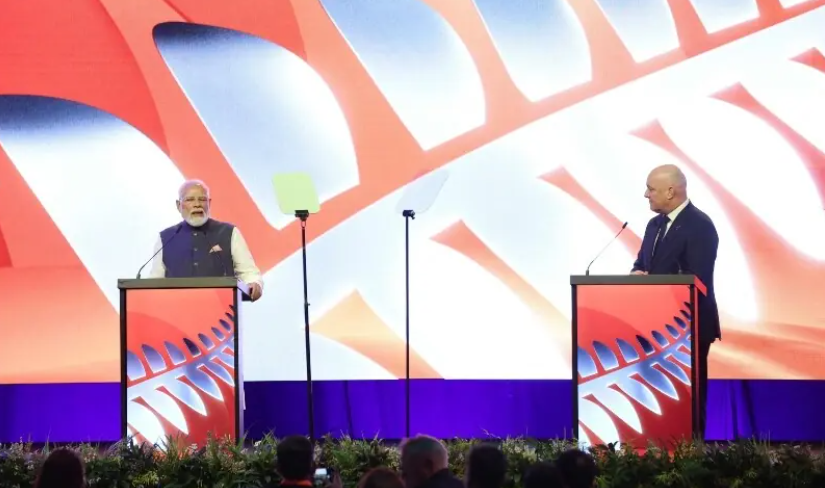
New Zealand and India announced a new “strategic partnership” on Saturday, expanding cooperation in defence, security, trade and other areas during Indian Prime Minister Narendra Modi’s landmark visit to the country.

New Zealand Prime Minister Christopher Luxon welcomed Modi with a traditional Maori ceremony and a guard of honour, as both leaders sought to deepen bilateral ties following the signing of a free trade agreement in April, which Luxon has described as a major economic opportunity.
Modi’s visit, part of a July 6-11 regional tour that also included Indonesia and Australia, came shortly after China conducted a ballistic missile test in the Pacific Ocean, raising concerns across the region.
The visit marked the first trip by an Indian prime minister to New Zealand in four decades, highlighting India’s increasing engagement with the Pacific region amid China’s growing diplomatic and military presence.
Modi called the new strategic partnership a “milestone” that would bring greater confidence and momentum to relations between the two countries.
“Our firm belief in democratic values makes us natural partners,” he said.
Under the agreement, New Zealand and India will strengthen defence cooperation, including naval exercises, while also expanding collaboration in trade, diplomacy, culture, sports and science. The two nations said they share a commitment to a “free, open, peaceful and prosperous Indo-Pacific”.
Luxon said the two sides had discussed China’s missile test during their talks but avoided commenting on whether closer ties with India were intended to counter Beijing’s regional influence.
“We are a small trading nation. We are a maritime nation. We need to have as many relationships as we possibly can with partners around the world that are like-minded, and some of those are around defence, and some of those around trade, some around both,” he said.
He added that New Zealand supported a growing “multi-lattice” network of defence and trade partnerships in the region, saying: “That’s how we drive prosperity through security.”
Debate over trade deal and immigration
A major event during Modi’s visit is expected to be his appearance before thousands of members of New Zealand’s Indian community at Auckland’s Spark Arena. The country’s Indian diaspora numbers around 300,000 people.
The visit followed Modi’s appearance at a similar community gathering in Melbourne, Australia, which attracted nearly 30,000 supporters.
Luxon, who is preparing for New Zealand’s November general elections, has promoted the economic benefits of the India trade agreement, which still requires parliamentary approval.
However, the deal has faced criticism from some groups over provisions that would make it easier for Indian students and workers to access visas and immigration pathways.
Members of the populist New Zealand First party, part of Luxon’s coalition government, have opposed parts of the agreement.
“I don’t care how much criticism we get, I am just never going to agree with a butter chicken tsunami coming to New Zealand,” government minister Shane Jones said during a radio interview.
An Indian community representative criticised Jones’ remarks as “outright racism”.
Controversial remarks spark condemnation
The visit also triggered controversy after evangelical preacher Brian Tamaki made remarks targeting religious communities in India and called for retaliatory actions in New Zealand.
“Let’s purge New Zealand of Hindus, Sikhs and Muslims,” Tamaki said on Instagram.
“While we’re at it, if they’re burning churches down, why don’t we burn mosques and their temples down? Tit for tat,” he added.
The comments were condemned by New Zealand’s race relations commissioner as “utterly appalling”.
Despite criticism surrounding the trade deal and public debate, Luxon continued to support Modi’s visit, highlighting India’s status as one of the world’s largest economies and its potential for future growth.
“That’s just a huge opportunity for New Zealand to get in on the ground floor of what will be a very exciting next 50 years of growth in India,” he said.