








































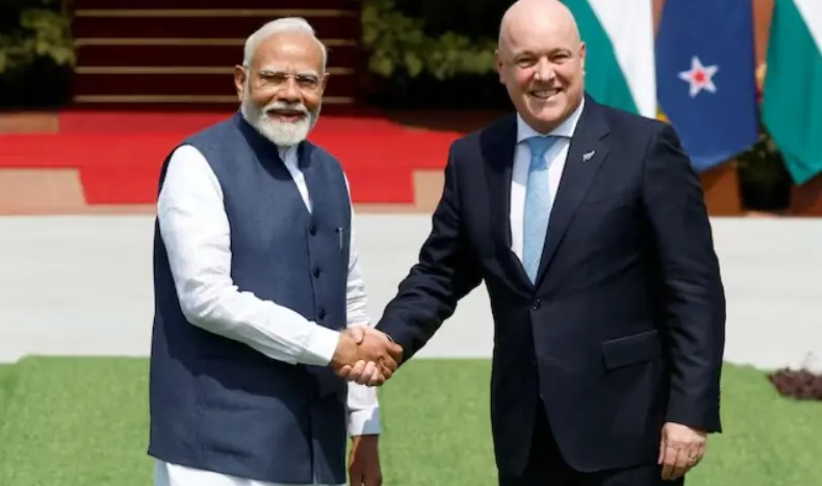
Indian Prime Minister Narendra Modi arrived in New Zealand on Friday, promoting a recently signed free trade agreement that has faced criticism despite expectations that it will boost employment, investment and economic growth.

Trade, tourism and sports cooperation are among the key topics expected to be discussed during Modi’s visit. However, recent anti-migrant remarks and tensions surrounding immigration have raised concerns over whether the controversy could overshadow the trip to a country known for its multicultural values.
New Zealand Prime Minister Christopher Luxon had welcomed the free trade agreement signed in April with India, describing it as a major opportunity that could expand exports and create jobs.
The agreement is expected to receive approval from New Zealand’s parliament, but some members of Luxon’s coalition government have objected to provisions related to migration and visa arrangements.
New Zealand First Party lawmakers criticised parts of the deal, with government minister Shane Jones saying, “I don’t care how much criticism we get, I am just never going to agree with a butter chicken tsunami coming to New Zealand.”
An Indian community representative accused Jones of making remarks that amounted to “outright racism”.
Controversy also emerged after evangelical preacher Brian Tamaki criticised Modi’s visit and accused India of targeting Christians. He later made comments calling for the removal of Hindus, Sikhs and Muslims from New Zealand.
“Let’s purge New Zealand of Hindus, Sikhs and Muslims,” Tamaki said on Instagram.
“While we’re at it, if they’re burning churches down, why don’t we burn mosques and their temples down? Tit for tat,” he said, remarks that were condemned by New Zealand’s race relations commissioner as “utterly appalling”.
Concerns over rising discrimination
Earlier this year, Indigenous Maori activist Che Wilson faced criticism over a cultural “haka” performance that allegedly included mocking references targeting an Indian-born New Zealand lawmaker.
Massey University anthropologist Sita Venkateswar said Modi’s visit came at a time when members of the Indian community in New Zealand were being unfairly targeted.
“A ‘butter chicken tsunami’, slurs set to a haka, graffiti on a school wall – South Asians are already the most frequent targets of racially motivated incidents in our data,” she told AFP.
“That is real and it is wrong.”
Modi’s visit to New Zealand is scheduled to last just over a day, as part of his July 6-11 international tour, which has also included stops in Indonesia and Australia.
During his visit, Modi will attend an official ceremony at Government House and participate in business and sports events in Auckland. It marks the first visit by an Indian prime minister to New Zealand in four decades.
The highlight of the trip is expected to be Modi’s appearance at a community gathering of around 10,000 members of the Indian diaspora at Auckland’s Spark Arena.
Despite recent criticism, Luxon has continued to highlight the positive relationship between the two countries and welcomed Modi’s visit to a nation with an Indian-origin population of around 300,000.
“This visit is about celebrating a winning partnership between New Zealand and India — one that delivers for our people and supports greater prosperity and security for both our countries,” Luxon said.