






















































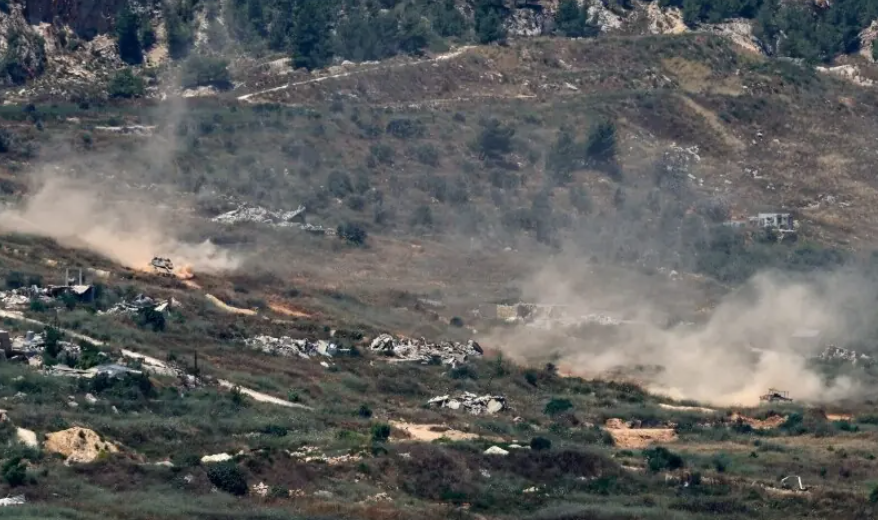
Israeli forces carried out fresh drone and air strikes in southern Lebanon on Saturday, just one day after Israel and Lebanon signed a US-brokered trilateral framework agreement aimed at securing long-term peace.

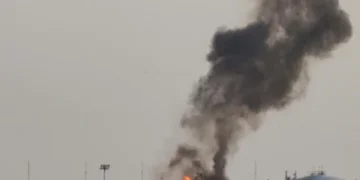
According to Lebanon’s National News Agency (NNA), Israeli warplanes struck an unidentified target in Nabatieh al-Fawqa at around 6:30pm local time. Lebanon’s health ministry said the attack killed one person and injured two others.
Earlier in the day, Israeli drones carried out four strikes targeting the town square and the Al-Manzala neighbourhood. The Israeli military said the attacks targeted suspected Hezbollah members operating in the Nabatieh area.
An Israeli military spokeswoman said the strike targeted “suspected terrorists who posed a threat to IDF soldiers” in southern Lebanon.
Israeli Defence Minister Israel Katz warned Iran against attempting to disrupt the newly signed agreement, saying Israel would respond decisively to any such move.
“If Iran tries to attack Israel to prevent the implementation of the agreement, we will act against it with great force,” Katz said in a video statement.
He added that the agreement had dealt a “strategic blow to the Iranian axis” and confirmed that Israeli troops had been instructed to prepare for an extended deployment inside the so-called security zone in southern Lebanon.
“The prime minister and I have instructed the IDF to prepare for an extended stay in the security zone,” Katz said, referring to an area extending up to 10 kilometres into Lebanese territory.
Meanwhile, Hezbollah leader Naim Qassem rejected the framework agreement, calling it invalid and urging Lebanon to instead implement the Islamabad memorandum of understanding reached between Iran and the United States.
“The framework agreement in Washington is humiliating, shameful, and a surrender of sovereignty. This agreement is null and void, and the provisions of the Iranian-American [Islamabad] memorandum of understanding must be implemented,” Qassem said.
He accused Lebanese authorities of “legitimising” Israeli occupation through what he described as a “grave blunder”.
The agreement, signed in Washington on Friday after five rounds of negotiations, outlines a phased plan for Lebanese troops to assume control of two areas currently occupied by Israeli forces. It also establishes a broader framework for restoring Lebanese state authority across the country through the verified disarmament of non-state armed groups, particularly Hezbollah.
Under the agreement, Israeli forces would gradually withdraw from Lebanese territory once the disarmament process is independently verified.
The framework has received broad international support. European Commission President Ursula von der Leyen described it as a “critical step” toward reducing tensions in the Middle East.
“This is a critical step away from escalation. Because there can be no peace in the Middle East with Lebanon in flames,” she said.
She stressed that “Key next steps are the disarmament of non-state groups and preserving Lebanese sovereignty and territorial integrity,” adding that the European Union remains committed to supporting regional stability and humanitarian assistance.
Germany, the United Arab Emirates, Italy and Jordan also welcomed the agreement and expressed support for continued efforts to achieve lasting peace in the region.