














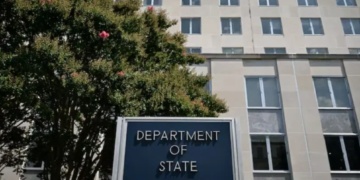




















ABU DHABI/KUWAIT CITY: US Secretary of State Marco Rubio on Wednesday reassured leaders in the United Arab Emirates and Kuwait of Washington’s commitment to Gulf security as he began a regional tour aimed at strengthening ties and addressing concerns surrounding the recently signed US-Iran agreement.

The visit marks the first trip to the Middle East by a senior American official since the signing of the memorandum of understanding between Washington and Tehran last week.
Rubio’s mission is focused on reassuring key Gulf allies about the agreement, which does not directly address several longstanding regional concerns, including Iran’s ballistic missile programme. Tehran maintains that it targeted only certain US military assets in the Gulf during the conflict and disputes responsibility for some attacks.
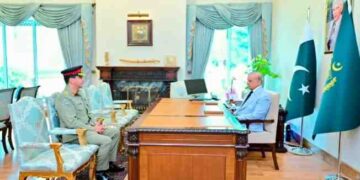
After arriving in Abu Dhabi on Tuesday evening, Rubio held private discussions with UAE President Sheikh Mohamed bin Zayed Al Nahyan on Wednesday before travelling onward to Kuwait. His regional tour will conclude in Bahrain, where he is scheduled to attend a Gulf Cooperation Council (GCC) meeting on Thursday.
According to US State Department spokesperson Tommy Pigott, Rubio and the UAE president discussed President Donald Trump’s memorandum of understanding with Iran, efforts to ensure secure navigation through the Strait of Hormuz, and broader regional stability.
The secretary of state also thanked the UAE for its support and resilience during the conflict and reaffirmed Washington’s commitment to the country’s security.
Rubio strongly rejected the idea of imposing transit charges on vessels passing through the Strait of Hormuz after Iran and Oman indicated they were considering charging fees for ships using the strategic waterway.
“It’s an international waterway. No country is allowed to charge tolls or fees on an international waterway. That’s existing international law,” he said upon arriving in Abu Dhabi.
During his stay in the UAE, Rubio participated in a working lunch with Sheikh Mohamed and senior Emirati officials, including National Security Adviser Sheikh Tahnoun bin Zayed Al Nahyan and Foreign Minister Sheikh Abdullah bin Zayed Al Nahyan.
Asked whether he intended to address concerns among Gulf allies regarding the agreement with Iran, Rubio replied: “That most certainly will come up in these discussions.”
He added that discussions would also cover broader regional issues not included in the memorandum of understanding.
Although Rubio is leading the regional outreach effort, recent Iran-related negotiations have largely been handled by US Vice President JD Vance, who participated in talks with Iranian representatives in Switzerland over the weekend.
Observers are closely watching Rubio’s remarks throughout the trip, given his previous reputation as a strong critic of Iran and the scepticism expressed by some Republican lawmakers who believe the agreement grants excessive concessions to Tehran.
The diplomatic mission presents a delicate challenge for Rubio, who must defend an agreement strongly supported by President Trump while simultaneously addressing reservations among Gulf allies.
The US-Iran memorandum signed last week contains 14 points outlining a framework for ending the conflict. One unresolved issue concerns Iran’s stockpile of uranium enriched to 60 per cent purity, which is close to weapons-grade levels.
Regional allies are also concerned that a proposed $300 billion reconstruction package could allow Tehran to rebuild and strengthen its military capabilities.
Additionally, the agreement does not address Iran’s ballistic missile programme, a major concern for Gulf states that came under missile and drone attacks during the conflict.
Iran, meanwhile, has argued that Gulf countries provided logistical support to the US-Israeli military campaign while hosting American military bases involved in the war effort.
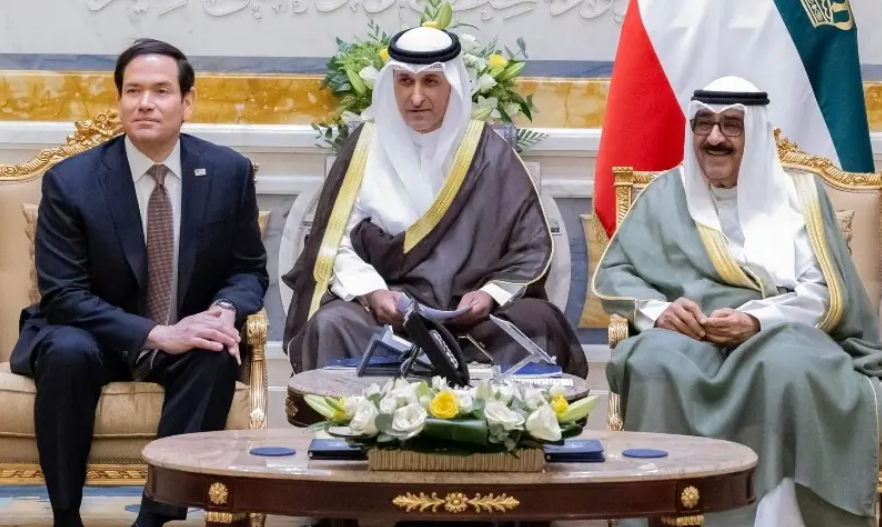
In Kuwait, Rubio met Emir Sheikh Mishal Al Ahmad Al Jaber Al Sabah and reaffirmed Washington’s commitment to regional security.
Prior to the meeting, he attended a flag-raising ceremony at the US embassy to mark the resumption of normal operations following an Iranian strike.
“Kuwait is an indispensable partner for regional security and stability,” Rubio wrote on social media, adding that the United States looked forward to expanding cooperation with the Gulf state.
Following his visit to Kuwait, Rubio is scheduled to travel to Bahrain for the GCC meeting.
The Gulf region, which hosts several major American military facilities, was heavily affected by Iranian retaliation following US-Israeli military action. The UAE reportedly faced more than 2,800 missile and drone attacks during the conflict, the highest number recorded by any country in the region, while Kuwait and Bahrain also experienced significant strikes relative to their size.