









































































BEIJING (MNN); China has achieved a major milestone in its space programme by successfully testing an experimental sea-based rocket recovery system, marking the country’s first successful retrieval of an orbital-class launch vehicle and bringing it closer to developing reusable rocket technology.

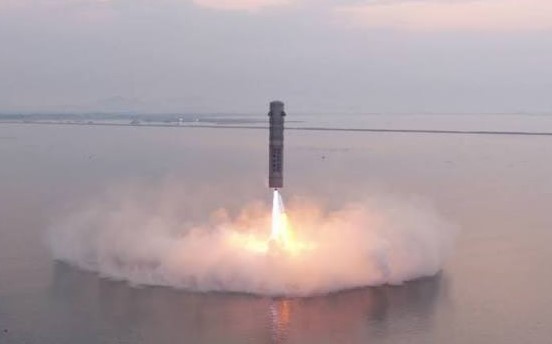
According to Chinese state media, the Long March 10B rocket lifted off from the Hainan Commercial Space Launch Site in southern China at 12:15 p.m. local time (9:15 a.m. Pakistan Standard Time) on Friday. After completing its mission and separating from the upper stage approximately six minutes after launch, the rocket’s booster returned vertically and was successfully recovered on an offshore platform using an innovative net-based capture system.
The mission also successfully placed a satellite into its designated orbit, demonstrating the rocket’s operational capability while validating the new recovery technology.
The successful recovery represents China’s first retrieval of an orbital-class rocket booster, a significant step towards reducing launch costs through reusable launch systems and strengthening the country’s rapidly expanding commercial space programme.
News of the successful test boosted investor confidence, with shares of several Chinese aerospace companies, including China Spacesat and China Satellite Communications, rising to their daily trading limits.
The Long March 10B, developed by the China Academy of Launch Vehicle Technology (CALT), has frequently been compared with SpaceX’s Falcon 9 due to its similar medium-lift capabilities. Designed primarily for commercial space missions, the rocket can carry payloads of more than 16 metric tonnes into low-Earth orbit.
Unlike Falcon 9, which lands autonomously on deployable landing legs either on a ground-based landing pad or autonomous drone ship, the Long March 10B employs an alternative recovery method. The rocket is equipped with four specially designed landing hooks that allow the returning booster to be captured by a large net installed on an offshore recovery platform.
CALT expert Chen Muye said the net-based recovery system simplifies the rocket’s onboard structure, reduces overall vehicle weight and increases payload capacity. He added that the system is more adaptable to landing deviations because the coordinated net mechanism provides a larger recovery window than conventional landing methods.
Reusable rocket technology has become one of the most competitive areas of the global space industry. SpaceX first successfully landed an orbital-class Falcon 9 booster in December 2015, revolutionising commercial spaceflight by enabling repeated use of rocket boosters. Blue Origin later achieved a similar milestone with its New Glenn rocket in November 2025.
Today, SpaceX launches Falcon 9 missions approximately 150 times annually, with many booster stages being reused dozens of times, significantly lowering launch costs and increasing operational efficiency.
China has spent nearly a decade developing reusable rocket technologies, progressing from early low-altitude hovering tests to full-scale orbital booster recovery experiments. Officials believe reusable launch systems will play a vital role in reducing costs for China’s expanding satellite constellations and future deep-space missions.
Chinese private aerospace companies are also accelerating efforts to develop reusable launch vehicles amid growing international competition. To support innovation, Chinese authorities have relaxed initial public offering (IPO) regulations for companies working on reusable rocket technologies, making it easier for them to secure investment.
Previous recovery attempts by private company LandSpace and the state-owned China Aerospace Science and Technology Corporation (CASC) were unable to complete the critical final stage of safely recovering their rocket boosters.
The Long March 10B is part of China’s broader Long March 10 launch vehicle family, which is being developed to support the country’s ambitious crewed lunar programme planned before 2030. Engineers believe data collected from the latest recovery mission will help validate technologies required for future lunar exploration.
Chinese state broadcaster CCTV reported that the recovered booster is expected to be refurbished and reused for another launch before the end of this year, underscoring China’s determination to establish a fully operational reusable rocket programme and strengthen its position in the global space industry.