



































SEOUL: South Korea’s foreign and unification ministers have publicly disagreed over how the government should engage with North Korea, highlighting internal differences within President Lee Jae Myung’s administration as Seoul attempts to restart dialogue with Pyongyang.

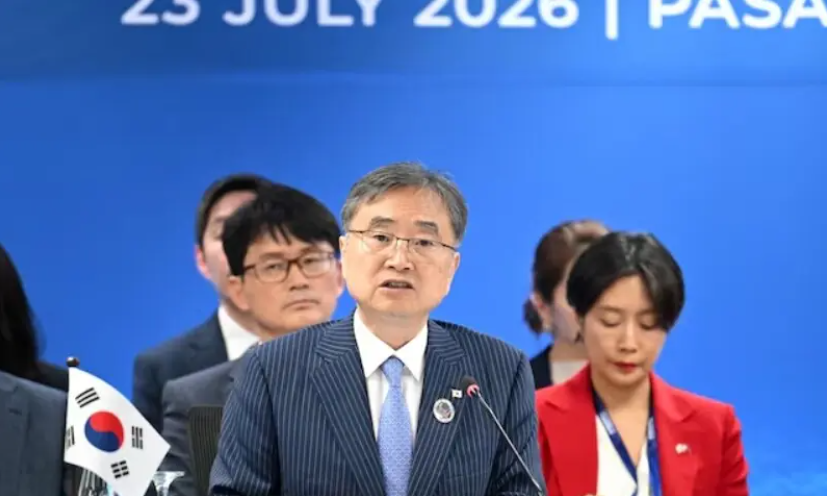
Foreign Minister Cho Hyun criticised proposals presented by Unification Minister Chung Dong-young at a policy meeting with Lee on Wednesday, describing them as “idealistic” and saying they had not received sufficient support from other government ministries.
“Since minister Chung was speaking in idealistic terms, I would ask you to discount those remarks somewhat,” Cho told reporters.
Chung responded the following day, defending his approach and saying that ideals were necessary “to change reality”.
Among Chung’s proposals was the creation of four-party talks involving South Korea, North Korea, the United States and China, which he presented as a major initiative for the second half of the year.
Cho argued that the proposal had not been adequately discussed within the government and lacked the necessary consensus.
The public disagreement comes as Seoul attempts to encourage Pyongyang to respond to a series of conciliatory measures introduced since Lee took office.
Lee’s government has moved away from a “denuclearisation-first” strategy towards a “peace-first” approach. Seoul has also encouraged Washington to pursue talks with North Korean leader Kim Jong Un in an effort to revive diplomatic engagement.
The Foreign and Unification ministries said on Friday that they would continue coordinating their policies but declined to comment further. The presidential Blue House also said it had no immediate response.
Dispute raises concerns over policy consistency
Analysts said North Korea would likely monitor the disagreement closely, warning that visible divisions within Seoul could make efforts to rebuild relations more difficult.
The dispute “exposed internal differences and weakening policy momentum surrounding North Korea policy”, said Lim Eul-chul, a professor at Kyungnam University.
“Internal division and conflict would reinforce North Korea’s perception that even if meaningful agreements are reached, they could easily be reversed within South Korea.”
Relations between the two Koreas have deteriorated significantly since the Covid-19 pandemic. In 2024, Kim announced that North Korea would abandon efforts towards reunification and subsequently dismantled joint inter-Korean projects located on its territory.
Since then, dialogue between the two sides has largely stopped, while stricter border controls in North Korea have resulted in a sharp decline in defections.
Only 63 North Koreans entered South Korea during the first half of this year, compared with 1,047 in 2019.
Seoul has also withdrawn measures that Pyongyang could perceive as provocative, including loudspeaker broadcasts directed towards North Korea.
Human rights groups criticise Seoul’s approach
Some human rights organisations have criticised Lee’s policy shift, contrasting it with the more pressure-oriented approach of his conservative predecessor.
Although South Korea co-sponsored a UN resolution addressing North Korea’s human rights situation last year, activists argue that Lee’s administration has reduced attention to the issue in an effort to avoid further tensions with Pyongyang.
Measures such as certain human rights reports and broadcasts have reportedly been suspended.
Kim Tae-Hoon, former president of the advocacy group PSCORE, said the organisation had experienced a decline in donations following the policy shift.
“It’s been very, very difficult,” he said.