






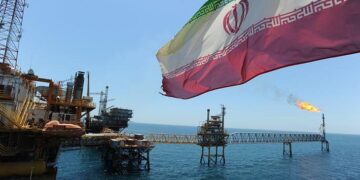










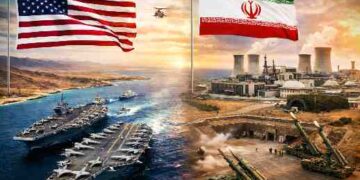














































Iran’s Islamic Revolutionary Guard Corps (IRGC) has issued a warning to shut down “all other export corridors that benefit the US and its allies,” according to Iranian media reports on Wednesday. This development follows Tehran’s closure of the Strait of Hormuz and Washington’s subsequent reinstatement of a naval blockade on Iranian ports.

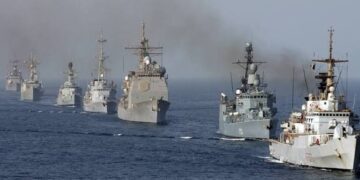
State news agency IRNA reported that the IRGC accused the renewed US blockade of cutting off vital oil and gas supplies to the global market, including “America’s economic rivals.” In response, the elite military force warned that other maritime transit routes favoring US and allied interests could also be targeted.
“Regional energy exports are either shared by all or denied to all,” the IRGC asserted in its official statement, declaring that the Strait of Hormuz will remain closed until “the end of America’s evils.”
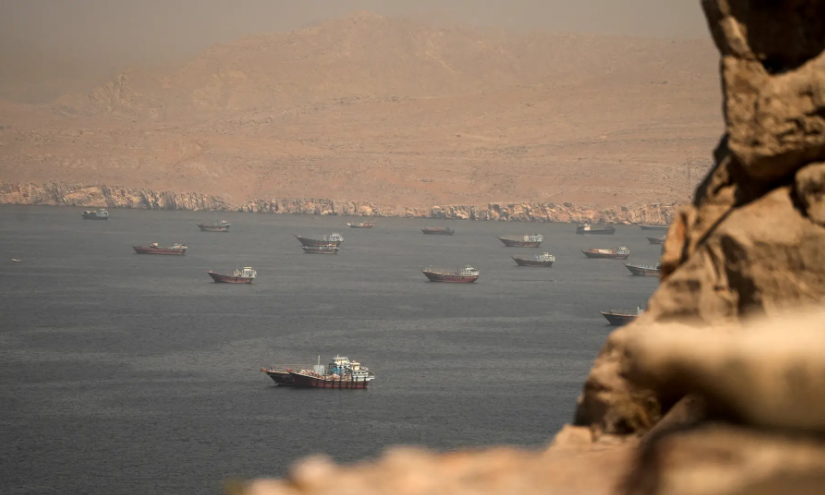
The Strait of Hormuz, a crucial shipping lane that handles a fifth of the world’s daily oil and gas trade during peacetime, has become the flashpoint of an escalating conflict involving the US, Israel, and Iran. This geopolitical standoff has severely rattled the Middle East and triggered a surge in global energy prices.
Security analysts suggest Iran may also look to leverage Houthi forces in Yemen to choke off the Bab-el-Mandeb strait at the mouth of the Red Sea. Such a move would open a secondary front against Washington, placing two of the planet’s most critical maritime energy choke points at immediate risk.
The narrow Bab-el-Mandeb passage connects the Red Sea to the Gulf of Aden, acting as a pipeline for Saudi Arabian oil exports and a significant portion of international shipping. The Houthis have previously demonstrated their ability to disrupt this corridor; following Israel’s military offensive in Gaza in October 2023, the group launched numerous strikes against Red Sea commercial shipping under the banner of supporting Palestinians.
Severe Exchanges of Fire Across the Region
This latest warning to global shipping follows an announcement by the US military that it had initiated a new campaign of airstrikes designed “to continue degrading Iranian capabilities used to attack commercial shipping in the Strait of Hormuz.” The US alleges that Iranian forces attacked seven commercial vessels over the past week, leaving nearly a dozen crew members dead, missing, or injured.
The US Central Command confirmed a massive seven-hour wave of strikes late Tuesday, targeting dozens of military assets near the Strait of Hormuz and along Iran’s coastline.
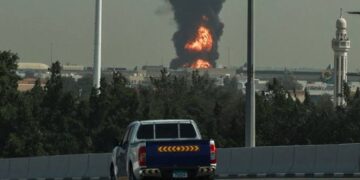
Iranian state broadcaster IRIB and other official media reported explosions near the port city of Bandar Abbas, Qeshm Island, Bandar Imam Khomeini, and near Sirik in southern Iran. Additionally, a wheat storage facility in the southwestern city of Hoveyzeh was reportedly struck by US projectiles. No immediate casualties were reported by Iranian media.
In immediate retaliation for the strikes, air raid sirens sounded in Bahrain, while air defenses in Jordan and Kuwait engaged incoming drone and missile salvos.
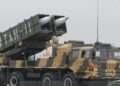
According to IRNA, the IRGC claimed credit for a drone strike on a Jordanian military base that hosts American combat aircraft, as well as strikes on US military targets in Bahrain and Kuwait. The IRGC stated it successfully targeted command-and-control centers, logistics hubs, fuel depots, and military assets belonging to the US Fifth Fleet in Bahrain.
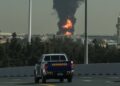
Furthermore, the IRGC claimed to have set fire to and destroyed a US logistics facility in Kuwait’s Mina Abdullah, and launched airstrikes on the Azraq airbase in Jordan. Kuwait’s state news agency confirmed that emergency forces successfully controlled a fire at a targeted site, though it did not explicitly confirm if it was the facility identified by the IRGC.
Peace Deal in Jeopardy
The renewed hostilities have fractured a delicate truce negotiated in June, which had temporarily cooled months of devastating combat. According to an AFP tally based on official Iranian announcements, US strikes over the past week have killed at least 28 people inside Iran.
The military escalation comes as US President Donald Trump warned he would widen the scope of attacks next week to target Iranian power plants and bridges if Tehran refuses to negotiate. “Next week it gets really bad for them,” Trump said during a Fox News interview on Tuesday night.
The escalation occurred just hours after President Trump walked back a proposed 20 percent transit fee on vessels navigating the Strait of Hormuz. Tehran continues to maintain that it holds jurisdiction over the strategic shipping channel, which was open to free transit before the outbreak of US-Israeli hostilities in late February. Recently, Iran has intercepted vessels in the strait, claiming they were using unauthorized routes.
Iranian Deputy Foreign Minister Kazem Gharibabadi warned that Washington’s decision to reinstate the naval blockade “has, in a way, dismantled the Islamabad memorandum,” referring to the interim ceasefire agreement brokered last month to suspend hostilities and open a path toward diplomatic negotiations.