



















































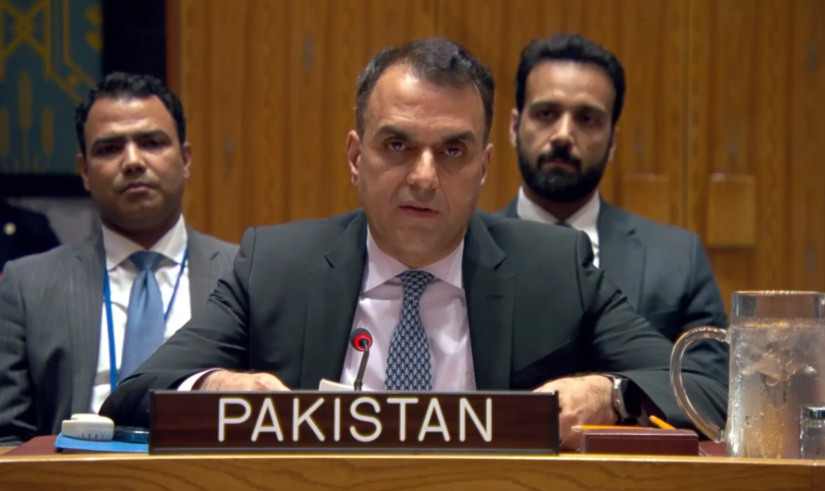
Pakistan on Monday expressed solidarity with Saudi Arabia during an emergency United Nations Security Council briefing on Yemen, reaffirming its support for the kingdom’s security, sovereignty and territorial integrity while urging all parties to resolve disputes through dialogue and diplomacy.

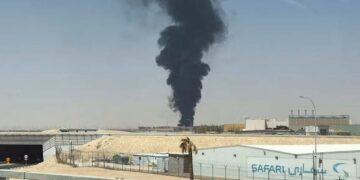
The UNSC meeting was held after Yemen’s government carried out an attack on Sanaa’s international airport, saying it aimed to stop an Iranian aircraft from landing after a Houthi delegation refused to use a Yemen flag carrier flight while returning from Tehran after attending the funeral of assassinated Iranian Supreme Leader Ayatollah Khamenei.
Hours later, Saudi Arabia announced that it had intercepted ballistic missiles launched by the Houthis towards the country’s southern region.
The escalation marked the most serious confrontation between Yemen’s government and the Houthis in years, with the group accusing Saudi Arabia of risking the collapse of a UN-backed truce that has remained in place since 2022.
Addressing the Security Council briefing, Pakistan’s deputy permanent representative to the UN, Ambassador Usman Jadoon, condemned the missile attacks against Saudi Arabia and voiced Islamabad’s support for the kingdom.
“We express our full solidarity with the brotherly kingdom and reaffirm our steadfast support for its security, sovereignty, and territorial integrity,” Jadoon said.
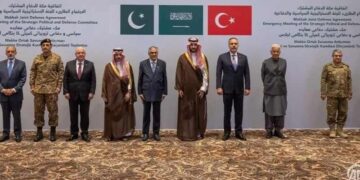
Pakistan and Saudi Arabia have maintained long-standing defence and security relations, with bilateral cooperation remaining a key part of Islamabad’s regional policy. In September 2025, both countries signed a “Strategic Mutual Defence Agreement” in Riyadh, under which an attack on either country would be considered an act of aggression against both.
At the UN forum, Pakistan highlighted three main priorities: safeguarding Saudi Arabia’s security, respecting Yemen’s sovereignty, and achieving an inclusive political solution to the conflict.
“We also reaffirm our unwavering commitment to the sovereignty, independence, unity and territorial integrity of Yemen, consistent with the purposes and principles of the UN Charter and international law,” Ambassador Jadoon said.
Islamabad called on all sides to avoid further escalation and pursue diplomatic efforts to reduce tensions.
“At a time when the region continues to face heightened tensions and multiple interconnected crises, we call on the parties concerned to resolve differences through dialogue, diplomacy and a steadfast commitment to de-escalation,” he said.
Pakistan stressed that sustainable peace in Yemen could only be achieved through a political process led by Yemenis and supported by the United Nations.
“A comprehensive, inclusive and sustainable peace can only be achieved through a Yemeni-led and Yemeni-owned political process, facilitated by the UN, which addresses the legitimate aspirations and concerns of all Yemenis,” Jadoon stated.
The ambassador also referred to a prisoner exchange agreement reached earlier this year as an example of progress through negotiations. The deal, agreed in May, saw both sides commit to exchanging more than 1,600 prisoners.
Pakistan also drew attention to the humanitarian crisis in Yemen, warning that continued conflict has caused widespread suffering, displacement, economic difficulties, food insecurity and damage to essential services.
“The Yemeni people have endured years of conflict, displacement, economic hardship, food insecurity and the collapse of essential services. Any further escalation risks undermining prospects for peace and deepening the suffering of civilians,” Jadoon said.
Islamabad further condemned the detention of UN officials, humanitarian workers and diplomatic personnel by the Houthis, along with the seizure of UN facilities and property.
“Pakistan reiterates its strong condemnation of the continued arbitrary detention of UN, humanitarian personnel and diplomatic staff, as well as the unlawful seizure of UN premises and assets by Houthis,” Jadoon said.
Pakistan urged the immediate and unconditional release of all detained personnel and called for respect for the privileges and protections granted to UN staff and facilities.
Concluding its statement, Islamabad reaffirmed its commitment to diplomacy, dialogue and regional stability, urging all parties to maintain communication channels and avoid steps that could further worsen tensions.