










































































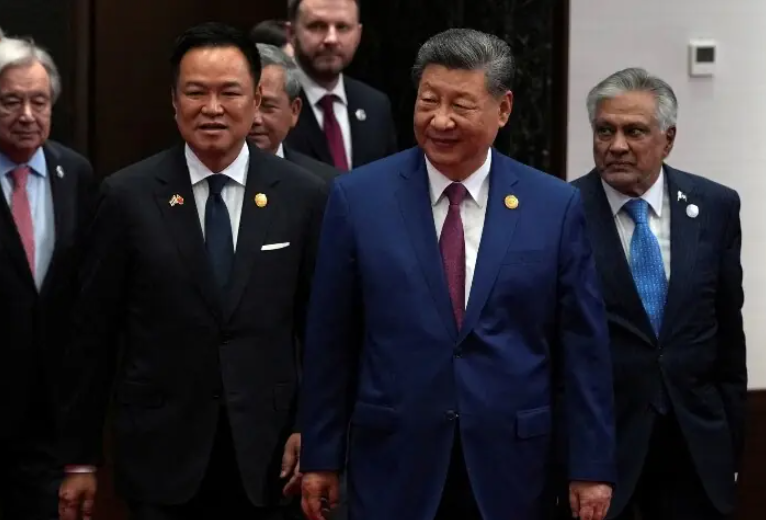
SHANGHAI: Chinese President Xi Jinping on Friday presented China as the driving force behind a new global artificial intelligence (AI) order, using the World Artificial Intelligence Conference (WAIC) in Shanghai to advocate for open-source AI and position Beijing as an alternative to US-led efforts to shape global AI governance.

Addressing the opening ceremony, Xi urged countries to “seize the rare and historic opportunity” presented by open-source AI and pledged Chinese support to help developing nations strengthen their AI capabilities. He also warned against “new historical injustices” arising from unequal access to advanced technologies.
Xi’s remarks outlined China’s most comprehensive vision to date for global AI governance, portraying its open-source AI models as a public good while seeking a leading role in setting international standards for the rapidly evolving technology.
Comparing AI’s transformative potential to the invention of the steam engine and electricity, Xi said China was prepared to share AI expertise and technology with countries across the Global South while leading efforts to establish international rules for AI development.
Although he did not directly mention the United States, the speech positioned China’s AI coalition as an alternative to Washington’s “Pax Silica” initiative aimed at securing global AI and critical mineral supply chains.
His comments came as Chinese open-weight AI models continue to gain momentum against proprietary systems developed by US firms, including OpenAI and Anthropic. On the same day, Beijing-based startup Moonshot AI introduced Kimi K3, which it described as the world’s largest open AI model by parameter count.
Xi also stressed that AI systems must remain under human oversight and called for countries to establish early-warning and emergency-response mechanisms to address AI-related risks.
He further urged safeguards against loss-of-control scenarios involving autonomous AI systems, warning of the dangers posed by technologies that could evade human supervision.
China seeks global leadership in AI
Xi described the newly established World Artificial Intelligence Cooperation Organisation (WAICO) as “a milestone in the history of world AI development”, saying it reflected the Global South’s demand for a stronger voice in shaping AI governance.
He announced that China would provide AI training programmes and establish AI cooperation centres with BRICS, ASEAN, Latin American and African Union countries, further expanding Beijing’s AI diplomacy among developing nations.
Commenting on Xi’s speech, George Chen, Chair in Digital Practice at consultancy The Asia Group, said: “Xi’s message is clear: China is not going to follow anyone on both AI technology and standards. Instead, China is going to lead the world in both aspects.”
He added: “Xi’s message is a statement but can be also viewed as a warning — China will not let anyone tell China what to do with AI.”
The July 17–20 conference comes ahead of the first government-level AI talks between China and the United States under President Donald Trump’s administration, placing greater international attention on Beijing’s efforts to influence the future direction of AI governance.
Pakistan joins WAICO as founding member
Pakistan officially became a founding member of the World Artificial Intelligence Cooperation Organisation (WAICO) on Thursday after Deputy Prime Minister and Foreign Minister Ishaq Dar signed the founding agreement in Shanghai.
According to the Foreign Office, Pakistan’s membership reflects its commitment to promoting international AI cooperation, particularly from the perspective of the Global South.
Dar also attended the opening ceremony of the World Artificial Intelligence Conference alongside the Pakistani delegation on Friday.
In a statement, the Foreign Office said: “Pakistan supports inclusive and equitable global AI governance, wider access to emerging technologies, capacity-building for developing countries, and enhanced international cooperation to bridge the digital divide and ensure that the benefits of artificial intelligence are shared by all.”