














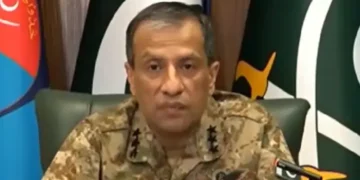





































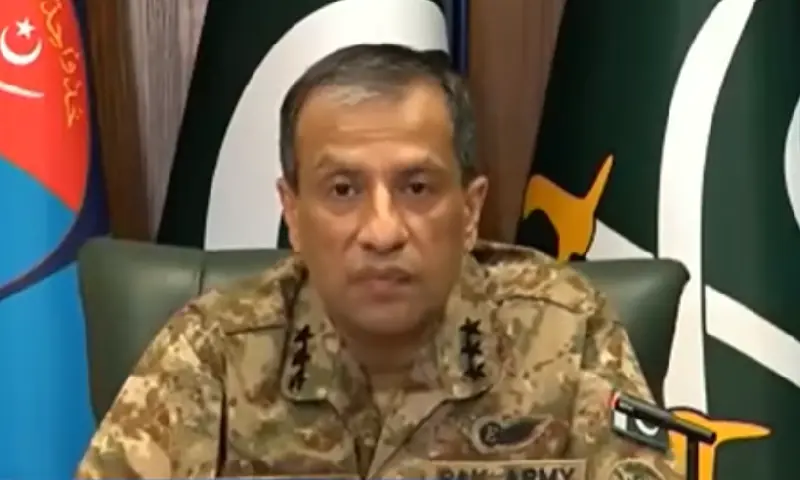
ISLAMABAD (MNN); Inter-Services Public Relations (ISPR) Director General Lieutenant General Ahmed Sharif Chaudhry has said that the Makkah Defence Alliance between Pakistan, Saudi Arabia and Turkiye is purely defensive and carries no “regional aspirations”, describing it as a framework for collective deterrence.

Speaking in an interview with Tom Burges Watson on Al Arabiya English’s programme Global News Today, Lt Gen Chaudhry said the agreement formalised Pakistan’s decades-old relationships with Saudi Arabia and Turkiye in the areas of collective defence and deterrence.
Asked whether the pact represented defensive cooperation or the beginning of a wider strategic alliance, he said its purpose was defensive.
“It is defensive. There’s nothing aggressive. There are no regional aspirations. It is collective deterrence,” he said, adding that the agreement was complementary rather than competitive with other international relationships.
He explained that Pakistan, Saudi Arabia and Turkiye maintained independent relations with other countries, blocs and alliances, and the new defence arrangement did not seek to replace or compete with those ties.
Mutual Defence Commitment
Asked whether the agreement contained a mutual defence obligation, the ISPR chief said the publicly released text clearly set out the principle.
Regarding how the three countries would respond if one member came under attack, Lt Gen Chaudhry said the operational details of defence commitments were not normally made public.
He said decisions concerning “how” such commitments would be implemented remained a matter for the three countries and were subject to operational and security considerations.
Alliance Does Not Compete With China Ties
Asked whether the alliance could compete with Pakistan’s relationship with China, Lt Gen Chaudhry said it complemented Islamabad-Beijing ties.
He said Pakistan’s relationships with Saudi Arabia and Turkiye were historic and had not emerged suddenly, adding that China and the wider international community understood the nature of those relationships.
According to him, the three countries viewed the agreement as defensive and aimed at promoting stability and peace in the region. He also noted that Pakistan, Saudi Arabia and Turkiye all maintained strong relations with China.
Possible Expansion
On whether the alliance could become part of a wider Muslim-world security structure, Lt Gen Chaudhry said the agreement did not define itself as a Muslim alliance.
He described it instead as an arrangement focused on regional stability and said it was not intended to be a club restricted to Muslim countries.
He added that the three founding countries could potentially include other willing partners that shared commitments to regional peace, stability, security, non-aggression, non-interference and collective deterrence, but decisions regarding expansion would rest with their respective leaderships.
The joint defence pact was signed on August 7 and states that an attack on one member would be treated as an attack on all. At its inaugural meeting in Istanbul on August 31, the three countries decided that Pakistan would initially host the alliance’s secretariat for three years.
Pakistan’s Mediation Between US and Iran
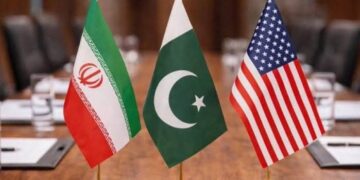
Asked whether the new defence arrangement could complicate Pakistan’s efforts to mediate between the United States and Iran, Lt Gen Chaudhry rejected the suggestion.
He said the alliance was a formalisation of Pakistan’s longstanding strategic relationships with Saudi Arabia and Turkiye and remained defensive in character.
Asked why Pakistan was seeking to mediate in the Middle East conflict, he replied that the objective was “regional peace”.
He said Pakistan had a “unique position” because of its policy of alignment and engagement with countries around the world, allowing it to act as what he termed an “objective arbiter of peace and an honest broker of peace”.
Lt Gen Chaudhry said an important principle of mediation was maintaining objectivity and neutrality. Pakistan’s political and military leadership, he added, was engaging with all sides in an effort to encourage a negotiated rather than military resolution.
He also stressed that a peaceful, negotiated outcome was preferable and argued that those capable of mediating objectively and sincerely should continue their efforts.
Confidence Over Border Security
Asked whether Pakistan was concerned about the conflict spreading towards its western borders, Lt Gen Chaudhry said Pakistan remained confident in its ability to protect its borders, territorial integrity and sovereignty.
He acknowledged that conflicts could have wider regional consequences, saying the effects were being felt internationally, but maintained that Pakistan was prepared to deal with threats arising from the situation.
He said Pakistan’s interest in mediation was rooted in its desire for regional peace and stability, which he described as essential for development, prosperity and the welfare of people in Pakistan and the wider region.
Prospects of Dialogue With India
Discussing the May conflict between Pakistan and India, Lt Gen Chaudhry said the episode demonstrated the risks associated with military confrontation between two nuclear-armed neighbouring states.
He said Pakistan believed in “peace on equal terms” and maintained that any engagement with India should respect the sovereignty and integrity of both countries.
Asked whether India had drawn lessons from the conflict, he said that was for the Indian side to determine, while Pakistan’s responsibility was to continue conveying what it viewed as the lessons of the confrontation.
He also criticised what he described as a “hubristic mindset” and a highly politicised military environment in India, while referring to Pakistan’s concerns regarding developments in Kashmir and the treatment of minorities.
Lt Gen Chaudhry said Pakistan had demonstrated its capability and resolve to control escalation during the May conflict.
At the same time, he said there were realistic prospects for restoring sustained military-to-military communication.
He noted that communication between the directors general of military operations had remained effective during and after the May conflict.
“Communication is always good. We must communicate, we must engage, but that engagement has to be done on equal terms while respecting each other’s integrity and sovereignty,” he said.
On broader political dialogue, he said the decision rested with the political leadership, but stressed that engagement should take place on equal terms.
Afghanistan: Right of Self-Defence
On Pakistan’s objectives regarding Afghanistan, Lt Gen Chaudhry said the military did not have a separate end state from the political leadership.
He said Pakistan’s fundamental objective was to ensure that Afghanistan did not interfere in Pakistan or allow terrorism to emanate from its territory.
Asked what options Pakistan considered legitimate if diplomatic efforts failed to prevent cross-border attacks, he cited Article 51 of the United Nations Charter, which recognises the right of self-defence.
He said the Pakistani state had an obligation to protect the lives, honour and property of its citizens and that “all that is necessary” would be done.
Counter-Terrorism Operations
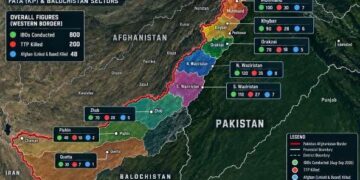
The ISPR chief described Pakistan’s counter-terrorism campaign as the “only successful counter-terrorism campaign in the world”, arguing that Pakistan had served as a bulwark against terrorism emanating from Afghanistan.
He said approximately 42,000 intelligence-based operations had been conducted during the current year, with around 2,100 terrorists killed, according to figures cited during the interview.
Balochistan: ‘There’s Just Terrorism’
On Balochistan, Lt Gen Chaudhry rejected the characterisation of the security situation as an insurgency, saying, “There’s just terrorism.”
He said security forces had strategic and tactical clarity on the issue.
According to figures he cited, more than 32,000 of the 42,000 intelligence-based operations had been conducted in Balochistan.
He said security forces were targeting what he described as “so-called proxies” associated with Balochistan while stressing that the government, people of the province and military understood the response to terrorism as combining action against militants with engagement with the people of Balochistan.