



























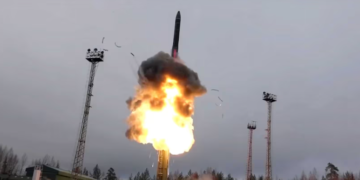




























North Korea said on Monday that the United States had not changed its hostile policy and vowed to continue expanding its nuclear capabilities, rejecting Washington’s repeated demands for denuclearisation.

A North Korean Foreign Ministry spokesperson, quoted by state media KCNA, accused the United States of maintaining a confrontational approach through its calls for the “complete denuclearisation” of North Korea, criticism of its human rights record and planned military exercises with South Korea and Japan.
“The Trump administration has thus fully reconfirmed its invariable hostile policy to wantonly violate the sovereignty, political system and security interests of the DPRK (Democratic People’s Republic of Korea),” the spokesperson said.
The official described North Korea’s nuclear weapons as “an absolute guarantee for defending its sovereignty” and said the country’s nuclear status would not be weakened by continued US demands for denuclearisation.
The spokesperson also said expecting tensions in the region to ease was “pointless”, while stressing that there was “no change” in Pyongyang’s policy toward Washington.
The statement followed US President Donald Trump’s decision earlier this month to significantly scale back the annual Ulchi Freedom Shield military exercises with South Korea. Trump cited his “very good relationship” with North Korean leader Kim Jong Un and argued that the drills were expensive and conveyed an unnecessarily hostile message to Pyongyang.
Trump has also expressed interest in holding another summit with Kim. The two leaders met three times between 2018 and 2019.
Despite the reduction in the exercises, Kim Yo Jong, the North Korean leader’s sister, said the drills remained provocative and aggressive even with their reduced scale and duration.
Meanwhile, the United States, South Korea and Japan are scheduled to conduct the Freedom Edge exercise from September 7 to 11. The drill is aimed at strengthening coordination against nuclear and missile threats.
North Korea has repeatedly condemned the trilateral military exercise, arguing that it poses a threat to regional security.