








































































Rescue teams in southern Japan continued a desperate search for survivors on Wednesday after a powerful 7.1-magnitude earthquake struck Kumamoto Prefecture, killing at least 13 people, damaging infrastructure, cutting electricity to thousands of homes and triggering large-scale evacuations.

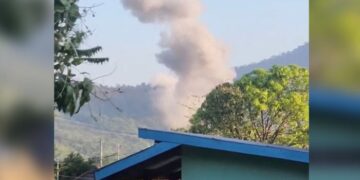
Emergency crews rescued eight people from the rubble of a partially collapsed Aeon shopping mall near Kumamoto City, where an apparent explosion occurred roughly an hour after the earthquake. Three of those rescued later died.
According to Aeon, four employees at the mall were still missing after safety checks covering about 2,700 staff members. Customers had already been evacuated immediately after the initial quake.
“Even now, there are people waiting to be rescued, and this is a race against time. We will marshal all available resources on the ground to save and rescue as many people as possible,” Prime Minister Sanae Takaichi told reporters in Tokyo.
Authorities are investigating whether a gas leak caused the explosion at the shopping centre. Chief Cabinet Secretary Minoru Kihara said rescuers detected the smell of gas inside the building, though the exact cause has yet to be determined.
Firefighters, police officers and around 170 members of Japan’s Self-Defense Forces concentrated rescue efforts in parts of the mall where cries for help had been reported. More than 4,500 military personnel have been deployed across the disaster zone to assist with rescue and recovery operations.
Elsewhere, seven people remain missing after a chimney collapsed at a Nippon Paper Industries factory, while four others sustained serious injuries, according to local officials. Hospitals across the region have also admitted dozens of injured residents.
Officials ordered around 260,000 people across Kumamoto Prefecture to evacuate to designated shelters. Police received 386 emergency calls following the quake, many reporting collapsed buildings and people trapped beneath debris.
The earthquake struck with its epicentre about 20 kilometres south of Kumamoto City, the largest city on Kyushu island, home to roughly 700,000 residents.
Yatsushiro City, one of the hardest-hit areas, suffered widespread structural damage, with collapsed buildings, damaged rooftops and severely cracked roads. A section of a bridge also fell into the Kumagawa River, attracting residents assessing the destruction.
Authorities have warned residents to remain alert for additional strong aftershocks over the coming week and cautioned about an increased risk of landslides in affected areas.
With more than 36,000 households still without electricity as temperatures reached around 34°C, officials also urged residents to take precautions against heatstroke.
Some healthcare facilities struggled to cope with the emergency. A hospital in Uki City said a power outage had severely disrupted operations.
“It’s become like a field hospital,” the head of the administrative department told NHK.
Another hospital in the city suspended new admissions after treating 86 injured people, including three in critical condition.
Several passengers aboard high-speed trains were also injured when the quake struck, prompting operators to suspend bullet train services as a precaution.
The collapse of the Aeon mall, the prefecture’s largest shopping centre with around 200 stores, became the focal point of rescue efforts. Images from the scene showed one side of the building ripped open, exposing steel beams and scattering debris across the parking area.
The disaster also disrupted industrial production. Renesas Electronics, Sony, Tokyo Electron and Honda temporarily halted operations at nearby facilities. Toyota Motor suspended production at three factories outside Kumamoto through Friday due to disruptions affecting suppliers.
Taiwan Semiconductor Manufacturing Company (TSMC) evacuated workers from its Kumamoto plant immediately after the earthquake but later resumed operations on Tuesday evening.
Japan, located along the seismically active Pacific “Ring of Fire,” experiences around 20 per cent of the world’s earthquakes measuring magnitude 6.0 or higher.
The latest quake struck a region still marked by memories of the devastating 2016 Kumamoto earthquake, which claimed 275 lives, injured more than 2,700 people and caused extensive damage to buildings, including Kumamoto Castle. Tuesday’s earthquake also damaged several historic sites, including shrines with heavy tiled roofs and a 17th-century tea house.