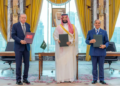
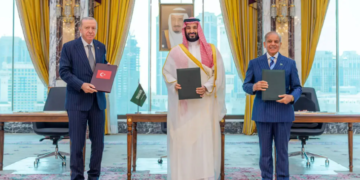
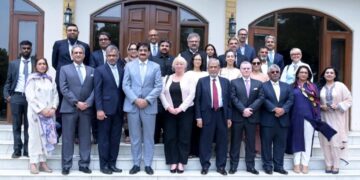











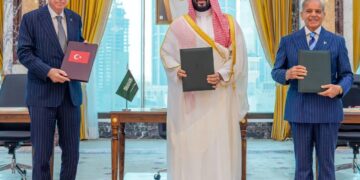

























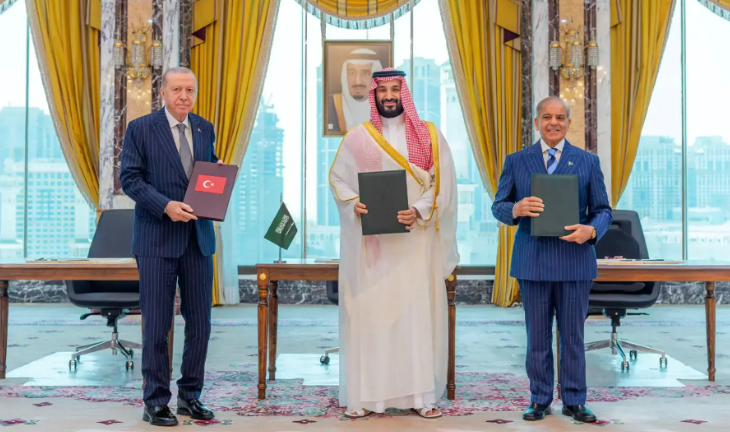
Turkish President Recep Tayyip Erdogan said on Wednesday that he hoped additional countries would join the defence agreement signed last week by Turkiye, Saudi Arabia and Pakistan, describing it as a step towards strengthening regional security and stability.

“Our vision for it is not limited to the three countries,” Erdogan said, adding, “Rather we aspire for it to grow, and perhaps appropriate conditions will emerge one day for all countries of the region to gather under its umbrella.”
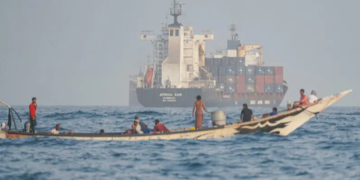
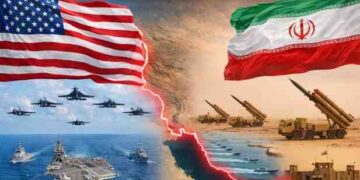
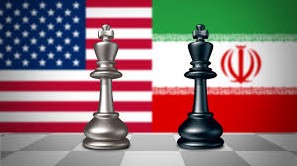
The Makkah Joint Defence Agreement was signed on August 7 as the Middle East continues to face the fallout from the five-month US-Iran war, which has affected regional security and disrupted shipping routes through the Strait of Hormuz and the Red Sea.
Turkish Foreign Minister Hakan Fidan said on Saturday that Ankara expected Egypt to join the agreement at a later stage, with only “a few technical issues” reportedly remaining. Egypt has yet to publicly confirm whether it intends to become part of the pact. Fidan is due to visit Cairo on Thursday and Friday.
The agreement includes a Nato-style provision under which an attack on one member would be considered an attack on all. Although Turkiye and Egypt maintain close military ties, Cairo has not indicated that it plans to sign the new security pact.
Erdogan said the agreement reflected changing circumstances in the Middle East, with regional countries seeking greater responsibility for their own security.
“Regional issues should be resolved by regional actors, and with this action, we consider that we have taken a first step toward achieving that goal,” he said.
“Resolving regional issues must be carried out away from formulas imposed from the outside. We know very well that solutions imported from abroad only bring disasters.”
The 57-member Organisation of Islamic Cooperation has described the agreement as an “important strategic step”. Kuwait, Bahrain and Somalia have also welcomed the pact, while Iran has responded positively, emphasising its support for “security mechanisms based on cooperation between regional countries”.
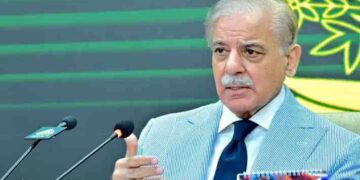
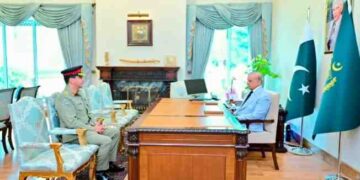
Prime Minister Shehbaz Sharif has stressed that the agreement is “entirely for defensive purposes” and is intended to “promote peace, progress, and prosperity in the region”.
The agreement builds on a Strategic Mutual Defence Agreement signed by Pakistan and Saudi Arabia in Riyadh last September, under which an attack on either country would be treated as an act of aggression against both.
Earlier this year, Turkish officials indicated that Ankara was interested in joining the existing Pakistan-Saudi defence arrangement. Defence Production Minister Raza Hayat Harraj said in January that a draft agreement had been prepared following months of negotiations.
Meanwhile, Erdogan also accused Israeli Prime Minister Benjamin Netanyahu’s government of attempting to “remove Palestine” from the international agenda.
“The aim of the Netanyahu government is to remove Palestine from the common agenda of humanity by profiting from chaos and new conflicts in the region,” Erdogan said during a joint news conference with Palestinian President Mahmoud Abbas.
“No matter what they do, they will not succeed. The Palestinian cause will continue to grow in people’s hearts as they try to destroy it,” he added, reaffirming Turkiye’s support for the establishment of a Palestinian state.
Abbas, who was visiting Ankara, also welcomed the defence agreement between Turkiye, Saudi Arabia and Pakistan, describing it as “of utmost importance” and expressing hope that it would contribute to greater security and stability across the region.