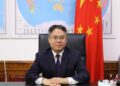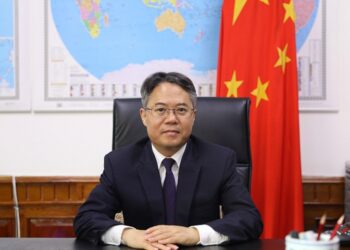


















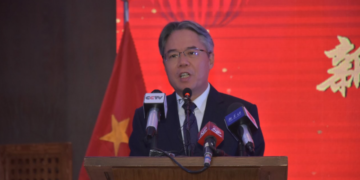










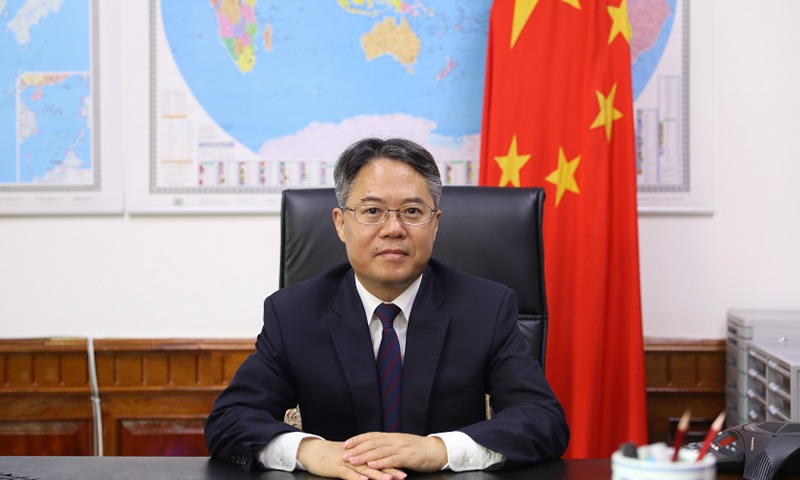
Chinese Ambassador to Pakistan Jiang Zaidong said China and Pakistan were ready to further deepen their “ironclad friendship” and all-round cooperation, focusing on strategic mutual trust, practical cooperation, people’s livelihoods, security and international coordination.

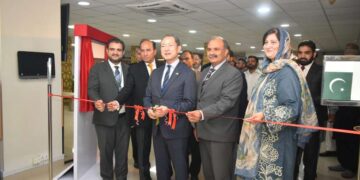
Addressing a reception celebrating the 77th anniversary of the founding of the People’s Republic of China, the ambassador welcomed Prime Minister Shehbaz Sharif, Speaker Ayaz Sadiq, Deputy Prime Minister and Foreign Minister Ishaq Dar and other distinguished guests.
He expressed appreciation to all those who had supported China’s development and actively contributed to China-Pakistan friendship.
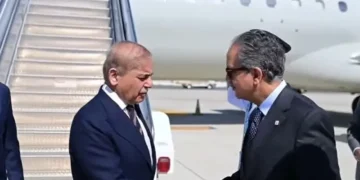
Ambassador Jiang particularly appreciated Prime Minister Shehbaz for attending the reception after returning to Pakistan early Wednesday following his foreign visit. He said the premier’s participation despite fatigue demonstrated his high regard for China-Pakistan relations and profound friendship with the Chinese people.
The ambassador said that over the past 77 years, under the leadership of the Communist Party of China, the Chinese people had achieved a historic leap “from standing up and growing rich to becoming strong.”
He said that since the 18th National Congress of the CPC, China had won the battle against poverty, built a moderately prosperous society in all respects, and achieved rapid economic growth and enduring social stability.
Jiang said the 15th Five-Year Plan had made a good start, with China’s GDP growing by 4.7 percent year-on-year in the first half of the year.
He said the economic increment reached 3.6 trillion yuan, the highest for the same period in the past five years, reflecting both a reasonable increase in economic output and an improvement in quality.
He highlighted China’s progress in energy transition, saying renewable energy accounted for 41.2 percent of the country’s electricity generation in the first half of the year, crossing 40 percent for the first time.
He said China’s infrastructure network had also been further strengthened, with 109 major projects under the 15th Five-Year Plan being advanced steadily.
The ambassador said the Pinglu Canal, the first canal coordinated at the national level since the founding of New China to link a river system with the sea, was completed and opened to navigation on September 16.
He said the canal shortened the voyage for goods from southwest China to the sea by 560 kilometres and would save more than 5 billion yuan in transport costs annually.
Jiang said emerging industries were also booming, with exports of electric vehicles, lithium-ion batteries and photovoltaic products, described as the “new trio”, reaching 819.664 billion yuan in the first half of the year, up 46.1 percent year-on-year.
He said artificial intelligence, robots and innovative drugs, described as the “new trio”, were becoming new drivers of China’s foreign trade and global development.
The ambassador said China would continue to provide more opportunities to the world through the achievements of Chinese modernisation.
On global issues, he said China had consistently supported the vision of a community with a shared future for humanity and promoted the Global Development Initiative (GDI), Global Security Initiative (GSI), Global Civilization Initiative (GCI) and Global Governance Initiative (GGI).
He said this year marked the fifth anniversary of the GDI, under which more than 130 countries and international organisations had supported the initiative and participated in cooperation.
Nearly 100 countries, regions and international organisations had signed cooperation documents with China, while 88 countries had joined the Group of Friends of the GDI, he added.
Jiang said China had carried out more than 2,000 cooperation projects with various parties, benefiting people in more than 120 countries.
He said China had also established a global development fund pool and, together with Chinese and foreign financial institutions, set up a $14 billion special fund for the GDI.
“China has trained more than 200,000 people in various fields for developing countries,” he said.
Turning to Pakistan-China relations, Ambassador Jiang said China and Pakistan were “all-weather strategic cooperative partners and ironclad brothers.”
He said that under the leadership of Prime Minister Shehbaz, Pakistan’s economy had demonstrated growing resilience and vitality.
By mid-September, Pakistan’s foreign exchange reserves had risen to a new high in nearly five years, covering more than three months of imports, he said.
Since August, the current account deficit had dropped to $98 million, down 70 percent year-on-year, while foreign direct investment had grown by 80 percent year-on-year.
He said services exports and IT exports had increased by 29 percent and 17 percent, respectively, while business registrations had risen by 45 percent year-on-year.
In the first two months of the current fiscal year, remittances reached $7.3 billion, up 17 percent year-on-year, he added.
The ambassador said Pakistan was playing an increasingly important role on the international stage through its principled position, global vision and diplomatic efforts.
He said Pakistan had served as the rotating president of the UN Security Council, actively engaged in mediation, promoted the resolution of hotspot issues and advocated multilateralism and international cooperation.
He said Pakistan had also formally assumed the rotating presidency of the Shanghai Cooperation Organisation (SCO), which would provide further space for enhancing its international influence and contribute to regional stability and prosperity.
Jiang recalled Prime Minister Shehbaz’s address to the General Debate of the 81st Session of the UN General Assembly on September 25, saying the premier had firmly defended Pakistan’s national interests and elaborated the country’s position on major international and regional issues.
“This year marks the 75th anniversary of the establishment of diplomatic relations between China and Pakistan,” he said, adding that the past 75 years had proved that the two countries were friends who had shared weal and woe and brothers through thick and thin.
He said the two countries had maintained frequent high-level communication since the beginning of this year.
On May 21, President Xi Jinping and President Asif Ali Zardari exchanged congratulatory messages on the anniversary of diplomatic relations, while on May 26, President Xi met Prime Minister Shehbaz during his official visit to China.
The leaders reached new important consensus on deepening the China-Pakistan All-Weather Strategic Cooperative Partnership, providing guidance for the development of bilateral relations, he added.
During his visit to China, Prime Minister Shehbaz also attended a reception marking the 75th anniversary of China-Pakistan diplomatic relations, where the two countries issued a joint statement outlining a comprehensive blueprint for building an even closer China-Pakistan community with a shared future in the new era.
Ambassador Jiang said Prime Minister Shehbaz had always attached great importance to practical cooperation between China and Pakistan, particularly agricultural cooperation.
He said the prime minister had personally promoted the dispatch of 1,000 Pakistani agricultural professionals to China for advanced studies.
According to China Customs statistics, bilateral trade reached $16.44 billion from January to July, up 13.4 percent year-on-year.
China’s exports to Pakistan grew by 9.8 percent, while imports from Pakistan increased by 45.7 percent year-on-year, he said.
From January to August, bilateral agricultural trade stood at around $830 million, up 45 percent year-on-year.
China’s imports from Pakistan reached $530 million, an increase of 63 percent year-on-year, while Pakistan recorded an agricultural trade surplus of $230 million with China, marking a 200.6 percent year-on-year increase.
Pakistan exported 373 million kilograms of rice to China during the period, with exports valued at $127 million, increasing by 245.7 percent and 186.9 percent year-on-year, respectively.
According to State Bank of Pakistan statistics, China continued to rank first in investment in Pakistan from January to August, with China, including Hong Kong, accounting for 60.7 percent of total foreign investment attracted by Pakistan.
The ambassador said China-Pakistan international coordination had also operated at a high level.
He said Deputy Prime Minister and Foreign Minister Ishaq Dar held talks in Beijing with Chinese Foreign Minister Wang Yi in March, and the two sides jointly issued a five-point initiative on restoring peace and stability in the Gulf and the Middle East.
In September, Prime Minister Shehbaz attended the high-level event on the Global Development Initiative hosted by China in New York.
Jiang said the two countries were now ready to further deepen their cooperation in five key areas.
First, he said, China would consolidate strategic mutual trust and firmly support each other by implementing the consensus reached between President Xi Jinping and Pakistani leaders and making progress on the Action Plan on Building an Even Closer China-Pakistan Community with a Shared Future in the New Era.
Second, China would deepen practical cooperation and pursue mutual benefit, focusing on industry, agriculture and mining, firmly advancing the high-quality development of CPEC 2.0 and accelerating an upgraded version of the China-Pakistan Free Trade Agreement.
Third, he said, China would respond to people’s livelihood needs and strengthen public support by carrying out more “small and beautiful” livelihood projects.
These included speeding up the construction of 100 clean water stations, upgrading 1,000 smart classrooms and distributing 100,000 school kits in Balochistan.
He said cooperation would also be strengthened in health, education, climate change and other fields, alongside greater exchanges among universities, think tanks, youth and women.
Fourth, China would step up security cooperation, deepen defence, security and counter-terrorism cooperation, resolutely combat terrorism in all its forms and provide a solid guarantee for development and regional stability.
Fifth, China would maintain close international coordination and safeguard fairness and justice by upholding the authority of the United Nations, strengthening communication and coordination on international and regional hotspot issues, and jointly safeguarding the legitimate rights and interests of Global South countries.
“In short, we are ready to work hand in hand with Pakistan to accelerate the building of an even closer China-Pakistan community with a shared future in the new era,” Ambassador Jiang said.
He said the two countries would work to bring more benefits to their peoples, set an example for building a neighbourhood community with a shared future and contribute to building a community with a shared future for humanity.
He concluded by extending congratulations on the 77th anniversary of the founding of the People’s Republic of China and expressing the hope that China and Pakistan would enjoy prosperity, while their friendship would be passed on from generation to generation and remain evergreen.