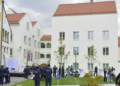




















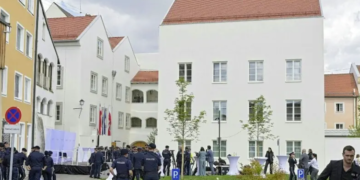










































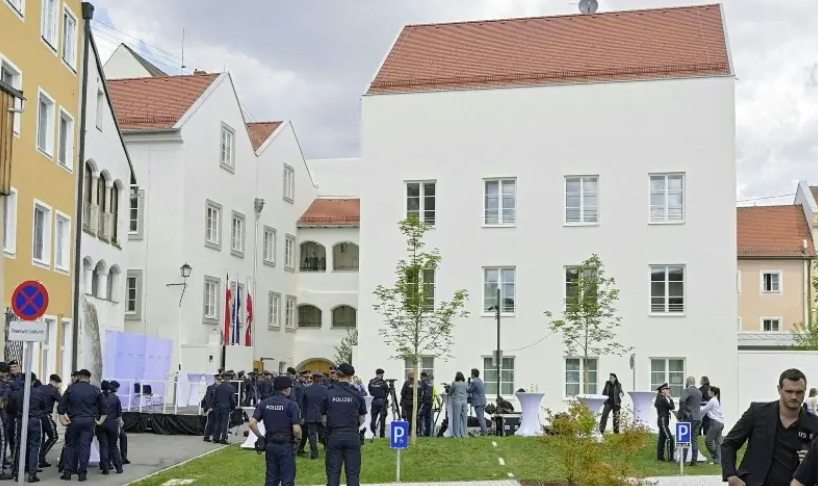
BRAUNAU AM INN, Austria: Austria officially opened a police station in the house where Adolf Hitler was born on Wednesday, aiming to discourage far-right extremists from treating the site as a place of pilgrimage while reaffirming the country’s commitment to confronting its Nazi past.

The inauguration ceremony in the town of Braunau am Inn was attended by Interior Minister Gerhard Karner and local officials, who described the conversion as a symbol of democracy and the rule of law.
Mayor Johannes Waidbacher said the transformation demonstrated that the community was “confronting its history” and taking responsibility for the legacy associated with the site.
The decision follows years of debate over the future of the 17th-century building, which critics said had become a destination for neo-Nazis. After a €20 million renovation that finished three years behind schedule, the building has been extensively redesigned and now serves as a local police station.
Karner said the former birthplace of the Nazi dictator would now stand as “a place of democracy, of the rule of law, of security, of freedom, and of human dignity.”
A memorial stone outside the building bearing the inscription “For Peace, Freedom and Democracy. Never Again Fascism. Millions of Dead Warn.” has been retained to preserve the historical context.
The house, where Hitler was born on April 20, 1889, had been leased by the Austrian state since 1972 and previously housed a centre for people with disabilities. Austria expropriated the property in 2016 after its owner opposed redevelopment plans, with the country’s Supreme Court later approving its purchase.
Historians had opposed demolishing the building, arguing that Austria should acknowledge its role in Nazi crimes rather than erase the site. An expert commission ultimately recommended converting it into a police station to prevent any glorification of Nazism.
However, some historians and memorial groups questioned whether the move would achieve its intended goal.
Robert Eiter, spokesperson for the Mauthausen Committee Austria, said the renovation would not stop extremists from visiting the town, arguing that “humanity will not forget where the worst mass murderer in history was born.”
Florian Kotanko of Braunau’s Association for Contemporary History also said the controversy was unlikely to end, noting that the town would always be linked internationally with Hitler’s birthplace despite the building’s new purpose.
Austria has long faced criticism over its handling of its Nazi-era history. Following Nazi Germany’s annexation of Austria in 1938, around 65,000 Austrian Jews were killed and another 130,000 were forced into exile during the Holocaust.