










































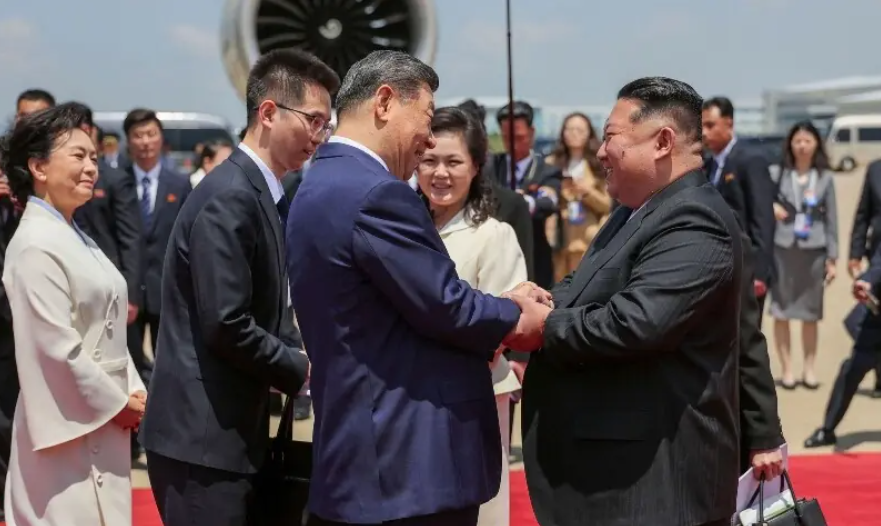
Chinese President Xi Jinping concluded his first visit to North Korea in seven years on Tuesday, describing the trip as a step toward strengthening mutual understanding and clarifying the future direction of bilateral relations, according to Chinese state media.

During a summit in Pyongyang, Xi and North Korean leader Kim Jong Un agreed to broaden cooperation across political, economic and cultural sectors, opening what North Korea’s state news agency described as a new chapter in relations between the two countries.
Addressing a farewell luncheon before departing, Xi said: “The mutual understanding between China and North Korea has become deeper and more comprehensive, and the direction of future development has become clearer and more defined.”
Television footage showed Kim waving as Xi’s aircraft departed Pyongyang, following a send-off attended by large crowds lining the route to the airport, waving flags and chanting slogans celebrating friendship between the two nations.
Earlier in the day, the two leaders planted a fir tree at a political training institution for party officials, which Chinese media said symbolised an enduring friendship. Xi also visited the Sino-Korean Friendship Tower, a monument dedicated to Chinese soldiers who died during the Korean War.
According to North Korea’s official news agency, both leaders agreed to enhance strategic communication through more frequent high-level exchanges.
Kim also reiterated support for the “One China principle,” under which Beijing maintains that Taiwan and mainland China belong to a single country despite their separate administrations.
China considers Taiwan part of its territory and has not ruled out the use of force to bring the island under its control, a position rejected by Taipei.
Analysts see differing priorities
Despite the positive tone of the visit, analysts noted differences in how the two countries portrayed the summit.
Chinese media highlighted practical cooperation, including trade, agriculture, transportation links and diplomatic exchanges. In contrast, North Korean coverage focused on the relationship as a partnership between equals and emphasised political solidarity.
According to Lim Eul-chul of Kyungnam University, Pyongyang stressed national dignity and the countries’ special relationship, while Beijing focused on state-to-state cooperation and its broader international initiatives.
Hong Min of the Korea Institute for National Unification said: “North Korea removed elements that could make it look like a subordinate, dependent or beneficiary party, and rewrote the relationship as one between equals.”
He added: “It amplified signals of solidarity, such as anti-US and Taiwan-related messages, while erasing signals of dependence or subordination.”
As North Korea’s largest trading partner, China is seen as a key economic lifeline for Pyongyang, and observers had expected trade and tourism cooperation to feature prominently during the visit.
Focus on friendship, not nuclear talks
Xi and Chinese First Lady Peng Liyuan attended a cultural performance alongside Kim and his wife, Ri Sol Ju. The event featured Chinese and North Korean patriotic songs celebrating the friendship between the two nations.
At a banquet marking the 65th anniversary of the China-North Korea friendship treaty, Xi reportedly said bilateral relations had reached a “new historical starting point.”
Chinese media also reported that Xi reaffirmed Beijing’s commitment to protecting shared interests.
Notably, North Korean reports made no mention of discussions regarding Pyongyang’s nuclear weapons programme or relations with the United States.
Analysts suggested the omission reflected Beijing’s desire to frame the visit around bilateral ties rather than regional security issues.
Ja Ian Chong of the National University of Singapore said the absence of such topics indicated a focus on neighbourly cooperation rather than broader geopolitical concerns.
During his first term, US President Donald Trump met Kim three times in an unprecedented diplomatic effort that ultimately collapsed over disagreements regarding North Korea’s nuclear programme.
Trump has since indicated he remains open to restarting negotiations with Pyongyang.
However, Leif-Eric Easley of Ewha Womans University argued that Xi’s visit was unlikely to pave the way for renewed talks, stating: “It is doubtful that Xi will serve as a catalyst for US-North Korea talks.”