































































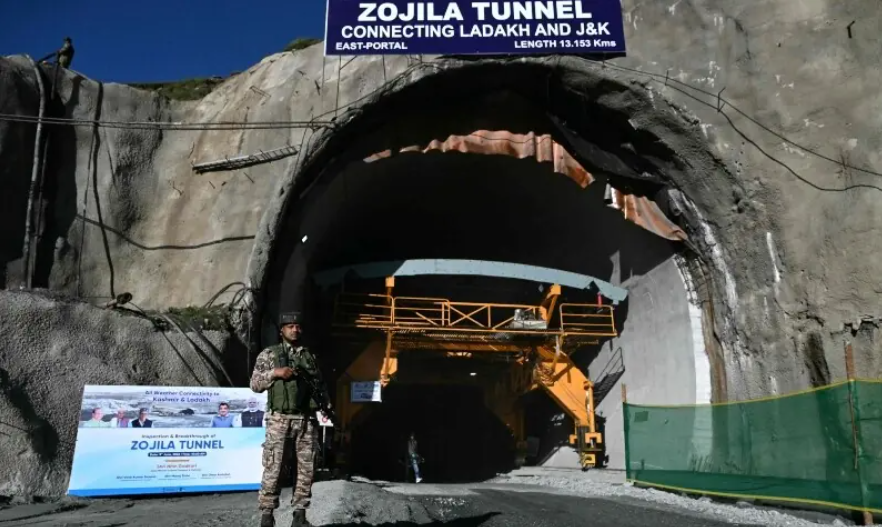
Indian engineers on Tuesday completed excavation through the final rock section of the strategically important Zojila Tunnel in the Himalayas, marking a major step toward ensuring year-round access to the Ladakh region near the Chinese border.

India and China remain strategic competitors despite improved relations following a deadly border clash in 2020. The two countries continue to dispute sections of their 3,500-kilometre frontier.
The tunnel is part of a broader infrastructure programme aimed at strengthening transport links through roads and railways, enabling the movement of trade, military personnel and supplies throughout the year between India’s lowland regions and high-altitude frontier areas.
Speaking at the breakthrough ceremony, Indian Roads Minister Nitin Gadkari said: “This is not just a tunnel but a lifeline.”
The project is designed to improve connectivity between Srinagar and Leh, two key cities currently separated by heavy snowfall during winter months.
The 13.14-kilometre Zojila Tunnel passes beneath the 3,528-metre-high Zojila Pass and will provide an alternative route when snowfall makes travel impossible.
More than 3,000 workers have been involved in constructing the tunnel since work began in 2020. On Tuesday, engineers connected excavation work from both ends after blasting through the final rock barrier, creating what will become India’s longest road tunnel.
Project engineer Manmohan Singh said: “We have worked for this tunnel day and night in challenging weather conditions, and completed it without any accident.”
The tunnel is one component of a larger infrastructure network that also includes the 6.5-kilometre Sonamarg Tunnel. Together, the projects form part of a $712 million connectivity initiative expected to be completed by 2028.
India has also invested heavily in rail infrastructure in the region. A $3.9 billion railway line now links the plains with Indian-administered Kashmir, including the construction of the Chenab Rail Bridge, the world’s highest railway arch bridge.
Prime Minister Narendra Modi inaugurated the railway route in June 2025.
The 272-kilometre line begins in Udhampur, home to the Indian Army’s northern command headquarters, and extends through Srinagar.
The development comes amid the longstanding dispute over the Himalayan region of Kashmir, which has been divided between India and Pakistan since 1947, with both countries continuing to claim the territory in full.