









































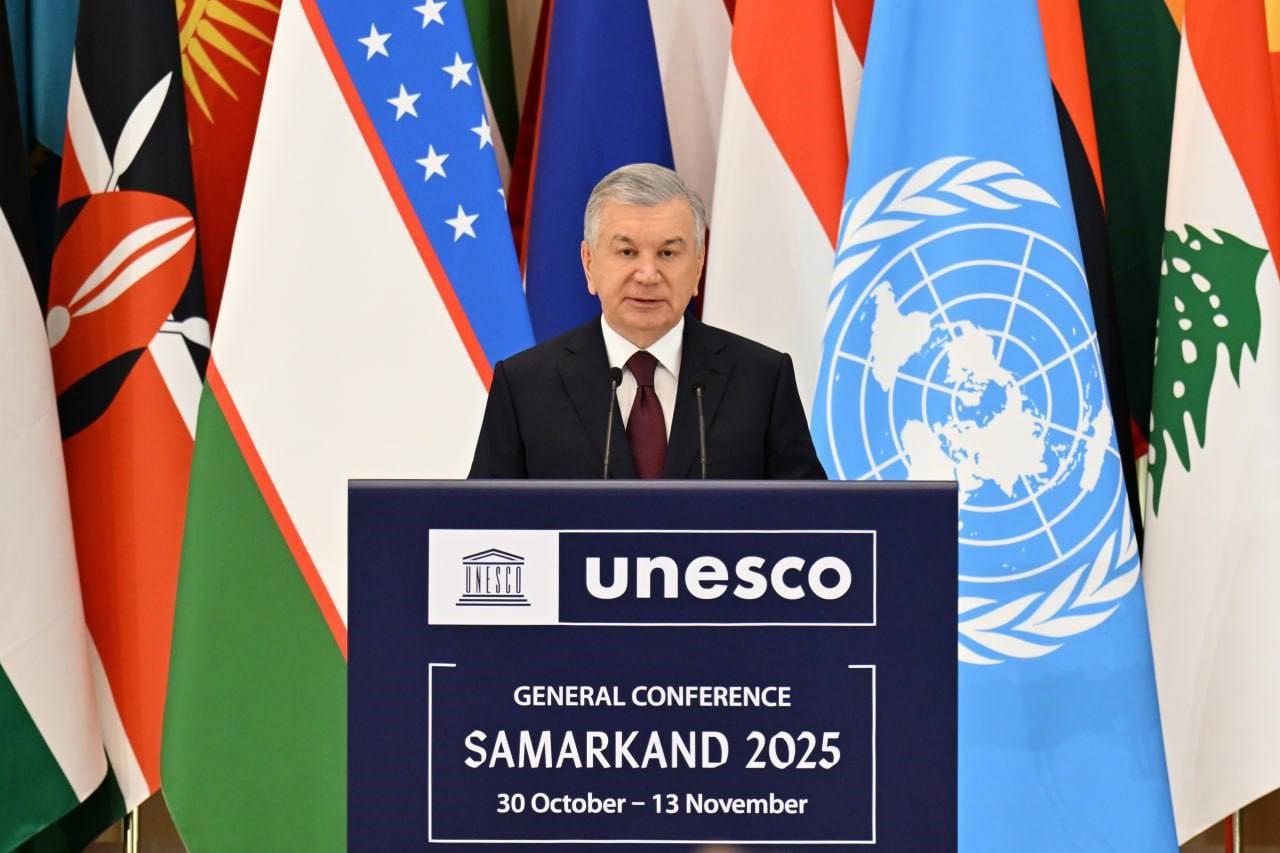
Web Desk; At the opening of the 43rd session of the UNESCO General Conference in Samarkand, Shavkat Mirziyoyev, President of the Republic of Uzbekistan, offered warm greetings to participating delegates and underscored the significance of the historic event. He noted that it was a privilege that the gathering is being held outside UNESCO’s Paris headquarters for the first time in 40 years and that Uzbekistan—the land located at the crossroads of ancient civilizations—is honoured to host it.

President Mirziyoyev extended his sincere thanks to UNESCO’s Director-General, the heads of state of Serbia and Slovakia, and to all the delegations for their trust in Uzbekistan’s ongoing reforms and its readiness to engage more deeply with UNESCO’s mission. He pointed out that UNESCO, now celebrating its 80th anniversary, has become a leading global institution promoting education, science, culture, and international cooperation—playing an ever more vital role in preserving peoples’ identities, cultural heritage and advancing inter-faith dialogue.
Welcoming delegates to Samarkand—an ancient yet youthful city which served as a centre of science, literature and culture—he highlighted how this city, under the observatory of Mirzo Ulugbek, produced a map of celestial bodies that later paved the way for scholars like Copernicus and Kepler. He described Samarkand as a “precious pearl” on the Great Silk Road and a home of peace and friendship among nations.
In today’s rapidly changing world, the President noted, global consensus and multilateral humanitarian cooperation are increasingly under strain. Geopolitical tensions, armed conflicts, damage to cultural heritage and widening inequalities in access to knowledge and technology pose serious challenges. These conditions demand that UNESCO’s objectives be pursued with renewed urgency and unity. Uzbekistan declares readiness to act as a bridge of harmony between East and West, North and South, offering itself as an open platform for dialogue and cooperation.
He then reviewed Uzbekistan’s achievements as a full UNESCO member: the implementation of a five-year cooperation programme to 2027; international celebrations of Uzbek scholars like Abu Rayhan Beruni, Ahmad Fergani and others; inclusion of the ancient cities of Khiva, Bukhara, Shahrisabz and Samarkand on the UNESCO World Heritage List; recognition of natural sites such as the Western Tien Shan and Turan deserts; and formal listing of intangible cultural heritage elements including the Navruz celebration, traditional weaving and musical forms. Uzbekistan also regularly hosts international festivals under UNESCO’s auspices.
Looking ahead, President Mirziyoyev presented proposals across five key areas:
- Inclusive education and broad integration of artificial intelligence—proposing a “UNESCO Platform for the Development of Inclusive Education for Children with Special Needs”, a world summit on vocational education and a “School of Artificial Intelligence” pilot project in Uzbekistan.
- Preservation of intangible cultural heritage—suggesting the declaration of 19 November as “International Day of Documentary Heritage”, and creating an International Institute for Digital Heritage under UNESCO.
- Women’s leadership—highlighting that globally women remain under-represented in science, culture and education leadership; proposing a “UNESCO Academy on Women’s Leadership” and a global forum of women leaders in Samarkand.
- Combating the climate crisis—introducing a “UNESCO Ecological Capital” initiative for environmentally responsible cities, and supporting a resolution to safeguard cultural heritage amid globalization and climate change, including an international symposium in Khiva.
- Promoting media and information literacy to counter misinformation—offering an International Festival of Children’s Cultural Content and a comprehensive UNESCO strategy on media and information literacy; further, by promoting universal human values such as tolerance and mutual understanding and leveraging Uzbekistan’s Islamic Civilization Centre and other research centres to combat radicalism and Islamophobia.
In conclusion, he expressed confidence that the “Spirit of Samarkand”, drawing on UNESCO’s enduring values, will unite global cooperation and open new vistas for development, and he wished the General Conference productive work and new achievements.