
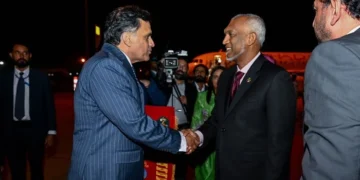



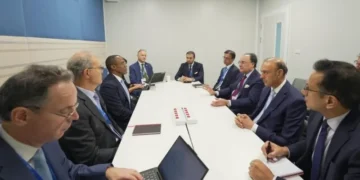













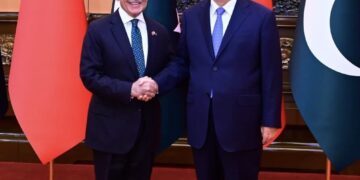




















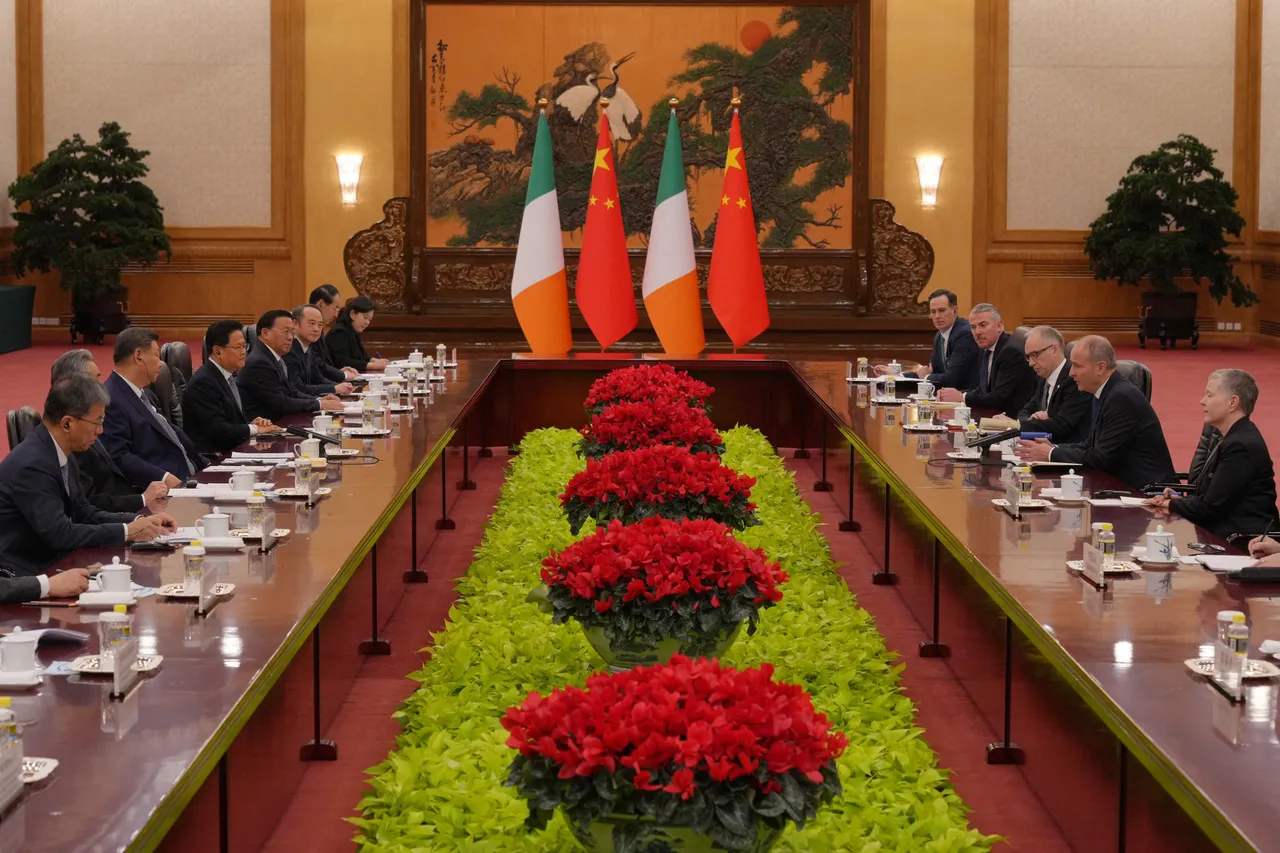
In a recent development, China has shown interest in fostering its bilateral relations and enhancing collaboration across multiple fields with Ireland, viewing it as a gateway to unlocking opportunities to mend its relations with the European Union. In his opening remarks at a meeting with Prime Minister Micheál Martin at the Great Hall of the People in Beijing, Xi Jinping said that “China is willing to strengthen economic and trade cooperation with Ireland, share opportunities, and pursue common development,” state news agency Xinhua reported. Irish Taoiseach Micheál Martin also praised China’s contribution to the United Nations, particularly its peacekeeping efforts, while reaffirming Ireland’s commitment to fully liberalizing its trade.

Amid ongoing tensions between the EU and China, Martin’s visit holds significant importance. Trade disputes remain a major point of contention between China and the EU. In 2025, Beijing imposed provisional tariffs of up to 42.7 percent on dairy products imported from the EU. China’s Ministry of Commerce justified these measures by arguing that EU subsidies had negatively impacted China’s domestic dairy industry. These tariffs are widely viewed as retaliatory measures following the EU’s imposition of duties on Chinese electric vehicles.
Despite this backdrop, China’s invitation and Ireland’s acceptance are widely perceived as an intelligent move by Beijing to engage individual EU member states in an effort to repair strained relations with Brussels. By strengthening bilateral ties, China aims to use economic interdependence to ease political friction with the EU. Beijing has expressed interest in expanding cooperation with Ireland in areas such as artificial intelligence, the digital economy, pharmaceuticals, and tourism, reflecting its broader commitment to multilateral engagement.
For Ireland, the visit is equally significant, opening opportunities to safeguard its economic interests and promote open trade. Prime Minister Martin acknowledged China’s international role in global affairs, reflecting Dublin’s longstanding policy of global interdependence. He stated, “In the modern world, engagement is still key, irrespective of the particular policy decisions or initiatives that are taken from time to time by individual countries. Ireland has always been international since our independence.”
Ireland is a major supplier of beef and dairy products and possesses expertise in agrifood, information, and technology sectors, while China offers a vast market economy and a comprehensive industrial supply chain. The visit is expected to create new opportunities for bilateral trade and investment. At the same time, experts maintain that Ireland’s pursuit of closer trade ties with China does not undermine the EU’s collective position. Ireland has a tradition of neutrality within the EU and often plays a coordinating role, enabled by its openness, symbolic diplomatic engagement with China, and strong economic interdependence with global markets.
Public support for closer ties between China and the European Union has also grown in recent years. The European Tech Insights 2025 survey, conducted by IE University’s Center for the Governance of Change in Spain, found that 29 percent of Europeans now prefer closer alignment with China, compared to 14 percent in 2023. This shift comes at a time when Europe faces a 15 percent tariff on many of its goods entering the United States, alongside energy insecurity and policy disagreements. U.S.–EU relations have also encountered new friction over strict export controls on technology and disagreements regarding defense spending.
As the EU views China’s dairy tariffs as a form of aggressive protectionism, Beijing has leveraged the situation to expand its trade and diplomatic engagement with Europe. China has also increased trade with Ireland. While European attention has traditionally focused on Germany, China’s expanding bilateral trade—expected to exceed €185.9 billion (approximately $219.2 billion) by the end of 2025—underscores the growing importance Beijing places on relations with Ireland, as reflected in Martin’s visit.
Nevertheless, deep disagreements between China and Europe over human rights, governance, and economic models continue to limit the scope of their engagement. Global developments—including recent U.S. strikes on Venezuela, the Russia–Ukraine war, and the broader realignment of international alliances—further complicate the situation. Ultimately, while China’s strategy of engaging Europe through bilateral partnerships may help ease tensions in the short term, lasting improvement in China–EU relations will depend on Beijing’s ability to address Europe’s structural concerns rather than relying solely on diplomatic outreach.
The author is a multimedia journalist and digital strategist associated with Diplomatic Affairs, covering geopolitics, conflict, and human rights. Her work blends investigative reporting with data-driven storytelling, uncovering voices from regions often ignored by mainstream media. She can be reached at aleezashaikh92@gmail.com.
Disclaimer: “The views and opinions expressed in this article are solely those of the author and do not necessarily reflect the official policy of any organization”.