















































































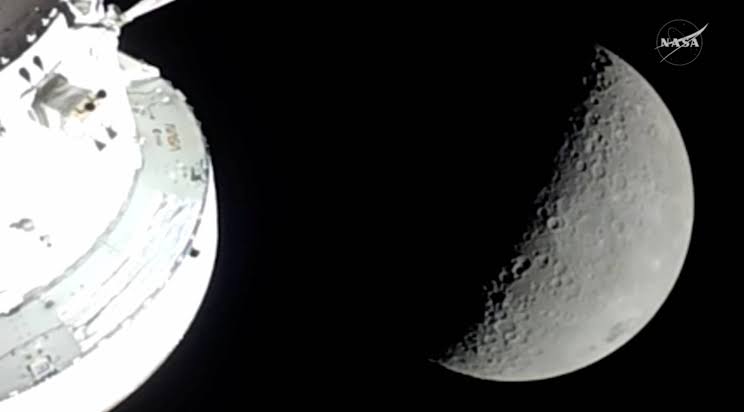
Astronauts aboard Artemis II have made history by traveling farther from Earth than any humans before, marking a major milestone in modern space exploration. The four-member crew journeyed to a record distance of over 252,000 miles (around 406,000 km) during a dramatic flyby of the Moon’s far side—an area never visible from Earth. This momentous achievement surpasses the previous record set during the Apollo 13 mission more than five decades ago.

As their Orion spacecraft swept behind the Moon, the astronauts conducted a six-hour observation of the shadowed lunar hemisphere. During this time, they witnessed rare “impact flashes”—brief bursts of light caused by meteors striking the Moon’s heavily cratered surface. Scientists at NASA closely monitored these observations in real time from mission control in Houston.
The flyby brought the crew within approximately 4,000 miles of the lunar surface, offering unprecedented views of terrain that only a handful of humans—those from the Apollo era—have ever seen directly. The mission serves as a crucial step in NASA’s long-term goal of returning humans to the Moon and establishing a sustained presence there, with future ambitions extending toward Mars exploration.
The Artemis II crew includes American astronauts Reid Wiseman, Victor Glover, and Christina Koch, along with Canadian astronaut Jeremy Hansen. During their journey, the astronauts also proposed names for previously unnamed lunar features. One crater was suggested to be called “Integrity,” after their spacecraft, while another was proposed in honor of Wiseman’s late wife, symbolizing a deeply personal tribute during the mission. As the spacecraft moved behind the Moon, communication with Earth was temporarily lost for about 40 minutes—a planned blackout caused by the Moon blocking signals to NASA’s Deep Space Network.
Despite the isolation, the crew remained focused and composed. Following the successful flyby, Donald Trump congratulated the astronauts, praising their achievement as a moment that inspired not only the United States but the entire world.
One of the most striking experiences, according to astronaut Christina Koch, was seeing Earth reappear on the horizon after emerging from the Moon’s far side—a powerful reminder of humanity’s place in the universe.
The Artemis II mission represents a new chapter in space exploration, building on the legacy of the Apollo missions and paving the way for humanity’s return to the lunar surface in the coming years.