















































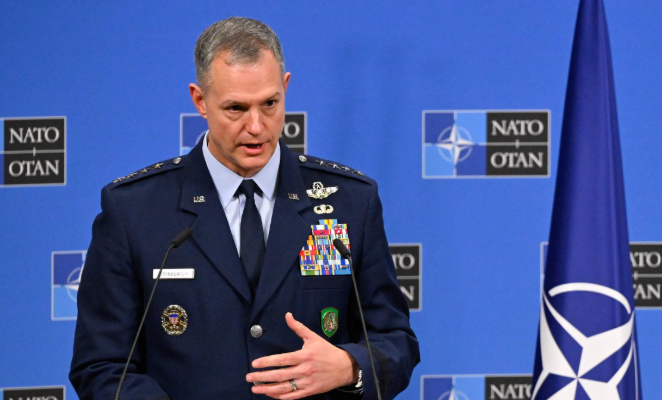
BRUSSELS: Nato’s top military commander said on Tuesday that the alliance was considering how it could help secure the Strait of Hormuz, although no formal planning had begun yet.

US General Alexus G Grynkewich, Nato’s Supreme Allied Commander Europe, told reporters in Brussels that discussions remained at an early stage and would depend on political approval from member states.
“Am I thinking about it? Absolutely. But there’s no planning yet until the political decision is taken,” Grynkewich said.
The comments came as tensions continue to rise in the Middle East following the closure of the strategically vital Strait of Hormuz during the ongoing Iran conflict.
US President Donald Trump has criticised European Nato allies over their response to the crisis, increasing pressure on the alliance to consider a broader role in ensuring maritime security in the region.
European countries led by Britain and France are reportedly exploring options to help reopen and secure the waterway if hostilities ease.
Grynkewich said several Nato members, including Belgium, France, Germany, Italy and the United Kingdom, had already deployed naval assets to the region.
“We all agree it’s in our interest to ensure freedom of navigation in international waters,” he said.
Despite discussions, diplomats within Nato have downplayed the likelihood of a major alliance-led operation because of differing views among member states. However, Nato could still support missions led by countries such as France or Britain if such operations move forward.
The disruption in the Strait of Hormuz has significantly affected global energy markets and raised economic concerns across Europe due to rising oil and gas prices.
Separately, Grynkewich confirmed that the United States would continue reducing troop levels in Europe, although the process would take place gradually over several years.
The Trump administration recently announced plans to withdraw around 5,000 troops from Germany and cancel the deployment of long-range Tomahawk missiles there.
European officials were reportedly surprised by both the timing of the decision and suggestions by US officials linking the move to criticism from German Chancellor Friedrich Merz over Washington’s Iran strategy.
Grynkewich said the troop reduction would not weaken Nato’s defence plans and described it as part of a broader strategy in which European allies would assume greater responsibility for conventional defence.
“As the European pillar of the alliance gets stronger, this allows the US to reduce its presence in Europe and limit itself to providing only those critical capabilities that allies cannot yet provide,” he said.
He added that further withdrawals were expected over time as European military capabilities expand.
Nato currently relies heavily on the United States for critical defence infrastructure, including satellite intelligence, strategic bombers, communications systems and nuclear deterrence capabilities.