






















































Nepal’s disaster authority said on Friday that 1,924 people remain missing following devastating floods that killed at least 579 people across the country two days earlier.

The missing include 517 foreign nationals and 933 workers at hydropower projects located along rivers hit by a massive surge of water on Wednesday morning, according to the National Disaster Risk Reduction and Management Authority.
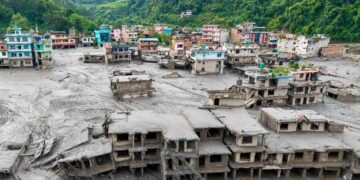
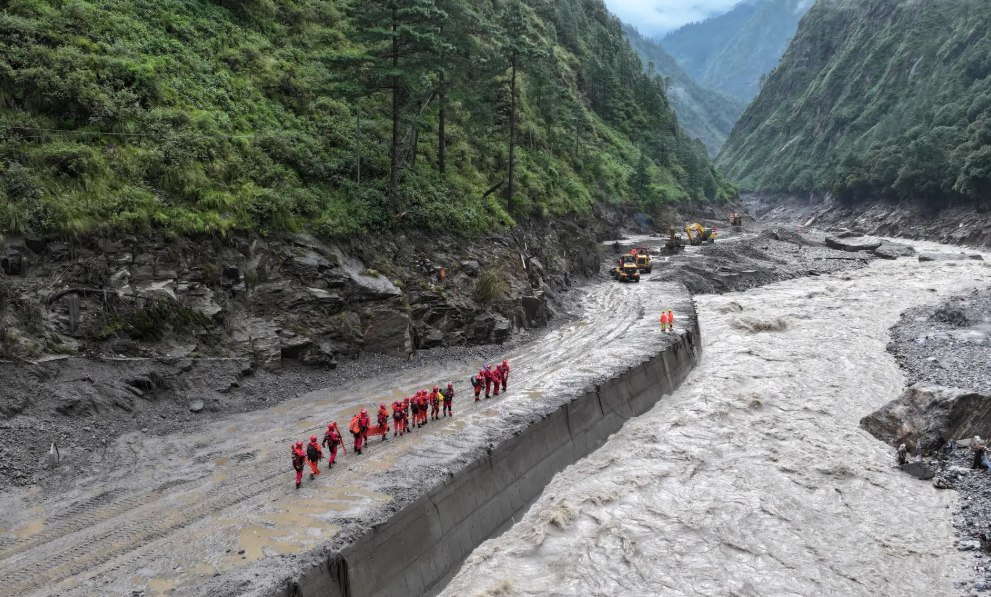
Rescue teams used heavy machinery to clear mud and debris from badly affected towns as hopes of finding survivors diminished. Officials were also working to prevent further flooding.
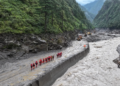
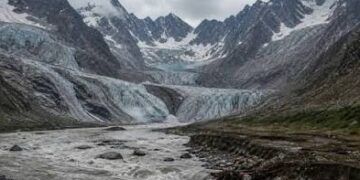
The flash floods swept through villages and valleys, destroying roads, bridges and power stations along a route connecting Kathmandu with Lhasa in Tibet that is frequently used by trekkers and pilgrims.
Helicopters were deployed to search for survivors and deliver emergency supplies to thousands of people cut off in remote towns and valleys. Emergency teams, including sniffer-dog units, also recovered dozens of bodies carried downstream.
India’s foreign ministry said around 320 Indian nationals remained missing after the disaster. At least 400 others were stranded but safe on the Chinese side of the border, while another 96 had entered Nepal by land.
Dibga Tamang was among the final people rescued from the badly affected town of Rasuwa on Thursday. She was airlifted with three others to an army camp in Nuwakot.
“All of our people have gone. They are dead,” Tamang said. “I have no one left waiting for me. Everything and everyone is gone. The end.”
Risk of another disaster
The huge volume of water and debris has created fears of another major disaster.
Nepal’s disaster management authority warned that a lake created by debris blocking the Bhotekoshi River was rising and could potentially burst. Across the border, Chinese authorities said about three million cubic metres of water — roughly equivalent to 1,200 Olympic-sized swimming pools — was expected to enter an already dammed lake over the following three days.
Chinese state media, citing the water resources ministry, reported that there was a significant risk the lake could breach, with peak water flow expected around September 1.
China deployed an eight-member engineering team to conduct aerial surveys and create 3D models of the barrier lake, although difficult terrain made access challenging.
Engineer Chen Hanxiao told CCTV that the glacier collapse had created isolated and steep cliffs around the lake. He said one possible method of reducing the threat would be to excavate a drainage channel through a lower section of the dam, with its size determined by calculations of water flow and the rate at which the lake was filling.
The team planned to continue monitoring the lake, gather data from its floor and track weather conditions.
Nepali Army searches for trapped workers
Nepali Army teams were searching for more than 100 people believed to be trapped inside a hydropower tunnel, while India offered to deploy a specialised rescue team.
India has experience conducting complex Himalayan tunnel rescues, including the use of specialised “rat-hole” miners. Families of those trapped remained anxiously awaiting information.
“I have not heard from him since I spoke to him at 7am that day. We have not had any news about them either, if they are being rescued or not,” Sita Adhikari, whose husband was inside the tunnel, told reporters.
“We will have hope as long as we have our breath… We need them to be rescued as soon as possible,” she said.
Two army helicopters were dispatched to the Trishuli 3A hydropower project in the mountainous Rasuwa district.
“Our focus is on search and rescue of people… some people are trapped in the tunnel of Trishuli 3A hydropower project,” Nepal Army spokesman Raja Ram Basnet told AFP. “Two helicopters have been dispatched, but it is challenging because it is tough to even locate the entry points of the tunnel.”
Chinese rescuers reach worst-hit area
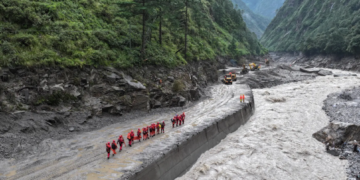
Chinese rescue workers reached the main site of a deadly mudslide near the Tibet-Nepal border on Friday to search for hundreds of people still missing.
Two days after Gyirong, a major border trade hub, was struck by a massive flow of mud and debris, a 21-member rescue team became the first to reach the area on Friday afternoon, according to state news agency Xinhua.
Chinese President Xi Jinping chaired a meeting with senior officials on the rescue response as the death toll in Tibet rose to five, with 558 people still reported missing.
“There are still many hidden dangers of glaciers, ice lakes and geological disasters in the surrounding area, and rescue is facing great difficulties,” Xinhua reported officials as saying.
A large lake that formed upstream after the mudslide raised fears of further flooding. Chinese state media later said the threat was “gradually decreasing” and that rescue efforts were “proceeding in an orderly manner”.
CCTV reported that water was “flowing out naturally, with the outflow discharge exceeding the inflow discharge”. It said the lake level had fallen by around 10 metres compared with the early morning of August 27, reducing the risk.
It remained unclear whether this lake was the same body of water that Nepalese authorities said had been created by a debris blockage and later burst.
Authorities were housing relatives of missing people in the affected area while they waited for information. CCTV reported that 499 Chinese nationals and 555 foreigners had been evacuated from the disaster zone by Friday.
Rescue teams were using drones, 3D modelling, thermal imaging and manual searches to locate missing people.
Xi also offered China’s assistance to Nepal in its rescue efforts.
“China is willing to actively assist Nepal in its rescue efforts and provide support and aid to the best of its ability,” Xi said, according to CCTV.
Buildings ‘wiped out like toothpicks’
Relatives around the world continued searching for information about missing family members.
Sneha Sudhir was among 10 women whose husbands had travelled from Nepal towards Tibet’s Mount Kailash when the disaster struck. The men, all from northern Virginia, were among dozens of Americans reported missing.
“Where are they?” Sudhir said tearfully from her home in Chantilly, Virginia.
She said the women were supporting one another while contacting officials, politicians, friends and relatives in the United States and India in an effort to locate the missing men.
US President Donald Trump said the United States had offered assistance to Nepal.
“Nobody’s ever seen anything quite like that, where very powerful, strong, well-built buildings were wiped out like they were toothpicks. It’s a terrible thing. We are sending aid and we’ve spoken to the leadership and we let them know anything they want, they’ll have.”
Pakistan’s Prime Minister Shehbaz Sharif also offered “whatever possible assistance was required” during a telephone conversation with Nepal’s Prime Minister Balendra Shah.
According to the Prime Minister’s Office, Sharif said Pakistan was sending emergency relief assistance to Nepal and expressed condolences and “complete solidarity” with the Nepali leadership and people.
Ganesh Aryal, administrator of Chitwan district, said 103 bodies had been recovered from the river system in the district, around 100 kilometres from the worst-hit area of Trishuli.
With hospitals unable to accommodate all the bodies, local authorities were setting up tents and making arrangements for families to identify and collect their relatives.
Nepal’s Prime Minister Balendra Shah, who visited flood-hit Nuwakot on Thursday, said the situation remained challenging.
“All the state agencies are operating at full capacity. Our first priority now is to save the life of each citizen, search and rescue of the missing, treat the injured and provide immediate relief to the affected families,” he said.
The disaster represents a major test for Shah’s five-month-old government, although officials said Nepal had experienced personnel and systems for responding to major disasters, including the 2015 earthquake that killed nearly 9,000 people.