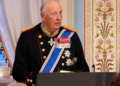






























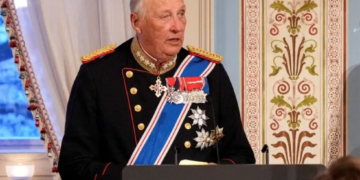




































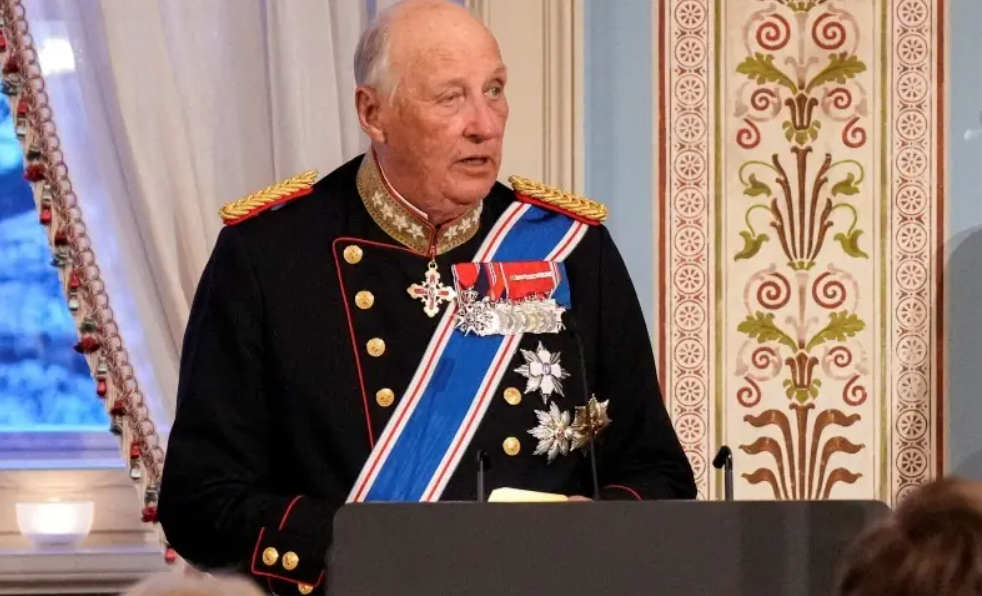
Norway’s King Harald, who spent more than three decades on the throne and became known for his reform-minded approach, has died at the age of 89, the royal palace announced on Friday.

“It is with deep sadness that we announce that His Majesty King Harald passed away today. King Harald passed away peacefully at Oslo University Hospital on Friday, August 28 at 6:35 am,” the palace said in a statement.
His 53-year-old son, Crown Prince Haakon, automatically succeeds him as Norway’s monarch.
The Norwegian royal palace in Oslo lowered its flag to half-mast following the king’s death, according to an AFP reporter at the scene.
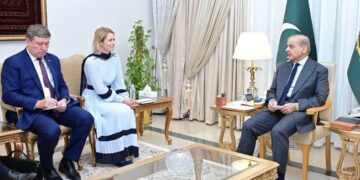
Pakistan’s Prime Minister Shehbaz Sharif expressed condolences to the Norwegian royal family on behalf of the government and people of Pakistan.
“As Norway mourns this profound loss, the people of Pakistan stand in solidarity with the bereaved family and our Norwegian friends,” he said on X.
“His majesty will be remembered for his lifetime of dedicated service to his nation. Our thoughts and prayers are with the people of Norway at this difficult time,” he added.
President Asif Ali Zardari also conveyed his sorrow and offered “heartfelt condolences to Queen Sonja, Crown Prince Haakon, the Royal Family and the people of Norway”, according to a statement from the Presidency.
He also paid tribute to King Harald’s “long and dedicated service” to Norway and his efforts to strengthen ties between Pakistan and Norway.
‘Steady and warm king’
King Harald, Europe’s longest-reigning monarch, had been receiving treatment at an Oslo hospital since August 17 after suffering from haemolytic anaemia, a condition in which red blood cells are destroyed unusually quickly and which can cause fatigue and breathing difficulties.
The royal family gathered at his bedside on Thursday after the palace announced that his condition was “extremely serious”. Queen Sonja, Haakon, Mette-Marit and their adult children spent much of the day at the hospital, with reports saying Haakon remained there overnight.
Members of the public also gathered outside the palace in central Oslo, leaving flowers and mourning the king.
Kaspara Bolstad, 24, described Harald as “a very steady and warm king”.
“I think the entire Norwegian people see him as a role model and as someone who brings people together. Whether you’re for or against the monarchy, I think he’s well-liked across the board,” she told AFP.
Magnus Skaugseth, 27, also praised the monarch’s inclusive outlook.
“He was so inclusive and committed to having values that are inclusive in the society we live in today. When there is so much division and polarisation, he was a pillar pointing in the opposite direction.”
Harald became king in 1991 and had experienced several health problems in recent years. He underwent pacemaker surgery and reduced his official duties, but repeatedly rejected the possibility of abdication, saying he had taken a lifelong oath before Norway’s parliament.
Prime Minister Jonas Gahr Store had also cancelled a planned trip to Germany on Thursday as the king’s health deteriorated.
Turbulent year for royal family
The Norwegian royal family has faced several challenges over the past year.
Harald was hospitalised in February after developing an infection and dehydration during a private trip to Tenerife with Queen Sonja. The queen, also 89, was briefly hospitalised in May because of heart problems.
Crown Princess Mette-Marit has faced scrutiny over her past association with convicted US sex offender Jeffrey Epstein. Documents released in January showed that she maintained correspondence with Epstein between 2011 and 2014, including periods of close communication.
Her son from a previous relationship, Marius Borg Hoiby, has also faced legal problems. He was sentenced in June to four years in prison over two rape convictions and 32 other charges, including violence against a former partner. He has appealed the ruling.
Mette-Marit, who suffers from a serious lung condition, underwent a lung transplant in July.
Despite the controversies surrounding the family, the Norwegian monarchy remains broadly popular, with Harald’s unifying public image and modest lifestyle contributing significantly to its support.