




































































WASHINGTON: US President Donald Trump’s Board of Peace on Monday reassured Israeli Prime Minister Benjamin Netanyahu that any Israeli withdrawal from Gaza would begin only after Hamas had fully disarmed, addressing concerns raised by Israel over the proposed ceasefire framework.

The clarification came after two members of Netanyahu’s security cabinet called for a fresh vote on the US-backed plan, following the board’s release of a document outlining a phased Israeli withdrawal from the enclave.
Netanyahu’s office said it had conveyed its objections to Washington after Trump described Hamas’s agreement to surrender its weapons to a newly formed Palestinian governing committee as a “major milestone” on Friday.
Nickolay Mladenov, the Board of Peace’s high representative for Gaza, met Netanyahu on Monday in what he acknowledged were difficult discussions.
Following the meeting, the board said both sides had reached a “common understanding of the shared objectives.”
According to a statement posted on X, Israel’s withdrawal beyond the Yellow Line — the boundary marking areas still under Hamas control — “will take place only once decommissioning [of weapons] is complete, as Hamas committed to the mediators”.
Under the proposed arrangement, Israel would continue to control significant parts of Gaza despite the phased withdrawal, in line with the Trump-brokered ceasefire reached in October.
Hamas said later on Monday that it remained committed to “what was agreed upon regarding the implementation of the second phase of the ceasefire agreement, including the commitments of all parties”.
The group added that it was “awaiting a clear and official response” from Mladenov and the mediators regarding the agreed framework, according to a statement shared on Telegram.
Israel raises objections
Israel had criticised the board’s proposal issued last Thursday, which called for a phased withdrawal from Gaza and an immediate halt to Israeli air strikes.
“Israel has conveyed its comments and concerns on the proposed framework to our American counterparts. The version that has been made public does not reflect Israel’s positions,” Prime Minister’s Office spokesman Doron Spielman told AFP before Mladenov’s meeting with Netanyahu.
Far-right Finance Minister Bezalel Smotrich argued that the published proposal was “completely different” from the version presented to the security cabinet. Along with another cabinet member, he demanded that the government “immediately” hold another vote on the Gaza plan.
Trump, however, had earlier said Israel was “very happy” with Hamas’s announcement regarding disarmament.
The disagreement highlighted growing differences between Trump and Netanyahu, who is preparing for a difficult re-election campaign in October and has repeatedly emphasised his close ties with the US president after another meeting in Washington last week.
Differences extend to Iran
Trump and Netanyahu have also differed over Iran, with the Israeli leadership remaining cautious about Trump’s diplomatic efforts to bring an end to the conflict that erupted after the two countries launched hostilities in late February.
Israeli President Isaac Herzog, whose role is largely ceremonial, welcomed the latest development, describing it as “a very positive step with the clear caveat and undertaking that Hamas must be disarmed”.
Senior Palestinian political figure Mohammad Dahlan, who has been closely involved in the Gaza initiative, initially said he had spoken with Trump’s son-in-law and adviser Jared Kushner, who told him Israel would stop military operations in Gaza from Sunday.
Dahlan later revised his statement, saying instead that Kushner was “working with the Israeli side to halt the attacks” in Gaza.
He subsequently accused Netanyahu of attempting “to obstruct the most promising opportunity to begin ending this war”.
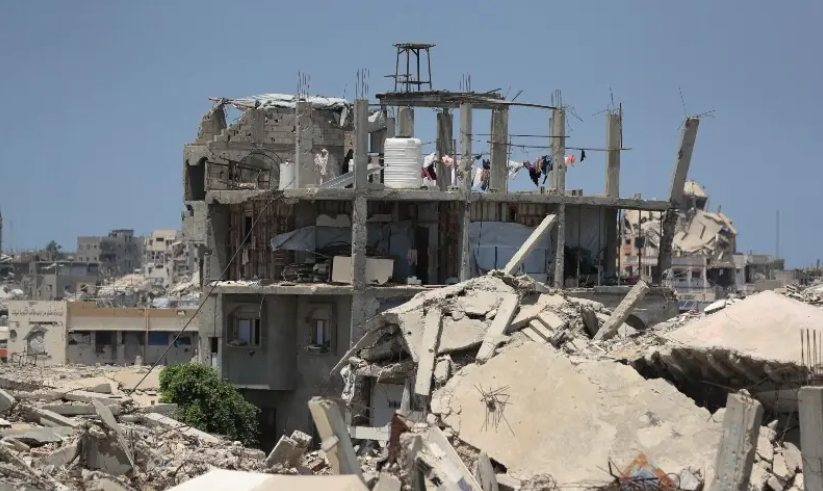
Despite diplomatic efforts, violence continued on the ground. Palestinian civil defence spokesperson Mahmoud Bassal said an Israeli strike on a vehicle west of Gaza City on Monday evening killed two Palestinians and wounded several others. The Israeli military said it had targeted two fighters.
On Sunday, Israeli attacks killed 19 Palestinians, including women and children, according to the civil defence.
Late on Monday, Qatar, Egypt and Turkey, which are mediating the Gaza truce, criticised Israel over the renewed strikes, condemning what they described as “ongoing Israeli violations in the Gaza Strip, particularly the targeting of health facilities and infrastructure, and the casualties among civilians, including women and children”.