





















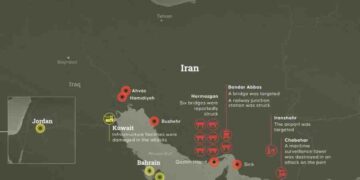






































ISLAMABAD: Pakistan on Thursday issued a stern warning to Yemen’s Houthi rebels, declaring that any attack on its maritime interests would cross a “red line” and be regarded as an attack on the country itself. Islamabad also reaffirmed its commitment to Saudi Arabia’s security and vowed to work with Riyadh to ensure the uninterrupted movement of commercial shipping through the strategic Bab el-Mandab Strait.

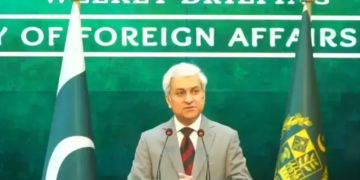
Speaking at the weekly media briefing, Foreign Office spokesperson Tahir Andrabi underscored Pakistan’s resolve to protect its national interests.
“I do not think that there is a thin line when it comes to defending our national security and our assets. This is not a thin line; this is a red line. This red line is strictly within the context of our own national security,” he said, adding that any attack against Pakistani flagged vessels or commercial ships belonging to the country “will be treated as an attack against Pakistan and will be met with a swift response in the exercise of our right to self-defence’’.
He said Pakistan’s armed forces would determine what constitutes a threat or attack through technical assessment and remain vigilant in the region.
Andrabi also reaffirmed Islamabad’s commitment to its bilateral agreements with Saudi Arabia, including the mutual defence pact signed last year under which an attack on either country is considered aggression against both.
The remarks followed a telephone conversation between Prime Minister Shehbaz Sharif and Saudi Crown Prince and Prime Minister Mohammed bin Salman, during which the premier strongly condemned Houthi attacks on Saudi oil tankers in the Red Sea.
According to a statement from the Prime Minister’s Office, Shehbaz described the attacks as unacceptable, saying they violated international law and threatened freedom of navigation, commercial shipping and regional stability.
The premier reiterated Pakistan’s unwavering support for Saudi Arabia’s security, sovereignty and territorial integrity, while assuring the crown prince that Islamabad would continue working with Riyadh and the international community to safeguard peace and ensure the uninterrupted flow of lawful maritime trade through the Red Sea, the Strait of Hormuz and surrounding waters.
Pakistan’s latest warning comes a day after the Foreign Office condemned Houthi threats against Saudi Arabia and commercial shipping following the group’s announcement on July 20 of an immediate maritime embargo on the kingdom. The Houthis said the move was in retaliation for what they described as the long-running Saudi-led blockade of ports and airports under their control, as well as a recent strike on Sana’a airport.
Pakistan pushes for Gulf de-escalation
The Foreign Office also reiterated Islamabad’s commitment to diplomatic efforts aimed at reducing tensions in the Gulf despite ongoing hostilities.
Andrabi said Pakistan continued to believe negotiations remained the best path forward and pointed to the Islamabad Memorandum of Understanding and the Pakistan-Qatar joint statement as the foundation for reviving the peace process.
“Pakistan has been advocating for peace and the necessity of giving peace a chance through diplomacy and dialogue. We believe that the best template to revert to the peace process remains the Islamabad MoU and the Joint Statement between Pakistan and Qatar, which offers a roadmap for implementing this peace process,” he said.
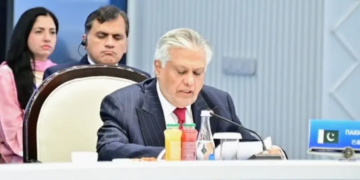
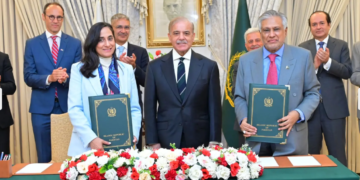
His remarks came as Deputy Prime Minister and Foreign Minister Ishaq Dar met Omani Foreign Minister Sayyid Badr Al Busaidi on the sidelines of the Asean Regional Forum in Manila. According to the Foreign Office, the two leaders discussed regional developments, expressed concern over the worsening security situation and stressed the importance of maintaining the ceasefire, respecting international law and pursuing lasting peace.
“We have not lost hope. We had not lost hope in the darkest days of this conflict cycle, when escalations mounted and there were armed attacks back and forth. Even then, we were not discouraged. We remain hopeful, however grim the situation may be on the ground. It is with the same degree of optimism that we will carry forward our advocacy for dialogue and diplomacy,” Andrabi added.
Response to EU report, Amnesty allegations
The Foreign Office also criticised the European Union’s latest assessment of Pakistan’s implementation of the Generalised Scheme of Preferences Plus (GSP+) framework, saying the report failed to fairly reflect the country’s progress.
“Nevertheless, I would be remiss if I did not express disappointment with the assessment, as the report’s overall narrative does not present a sufficiently balanced picture of Pakistan’s performance. It understates the breadth of reforms undertaken since Pakistan joined GSP Plus in 2014 and places disproportionate emphasis on the lower-than-desirable level of progress in certain areas,” Andrabi said.
He maintained that the GSP+ programme remained a cornerstone of Pakistan’s economic ties with the European Union.
The EU report acknowledged legislative reforms in areas including anti-torture measures, minority rights and labour protections, but also highlighted concerns over enforced disappearances, freedom of expression, judicial independence and labour rights. It warned that Pakistan would need to address these shortcomings to qualify under the revised GSP framework due to take effect on January 1, 2027.
Separately, the Foreign Office rejected an Amnesty International report calling for an investigation into Pakistan’s March airstrike in Kabul, describing the allegations as unsubstantiated. Islamabad instead urged the rights organisation and the broader international community to focus on what it said was the Afghan Taliban’s continued support for terrorist groups operating from Afghan territory.
Andrabi said Amnesty’s claims lacked credible evidence and called on the international community to hold the Afghan Taliban accountable for failing to meet obligations under UN Security Council resolutions, the Doha Agreement and other commitments aimed at preventing Afghan territory from being used for cross-border terrorism.
“Pakistan reserves the right to take all necessary measures to safeguard its sovereignty, territorial integrity, and the safety and security of its people,” he added.