





















































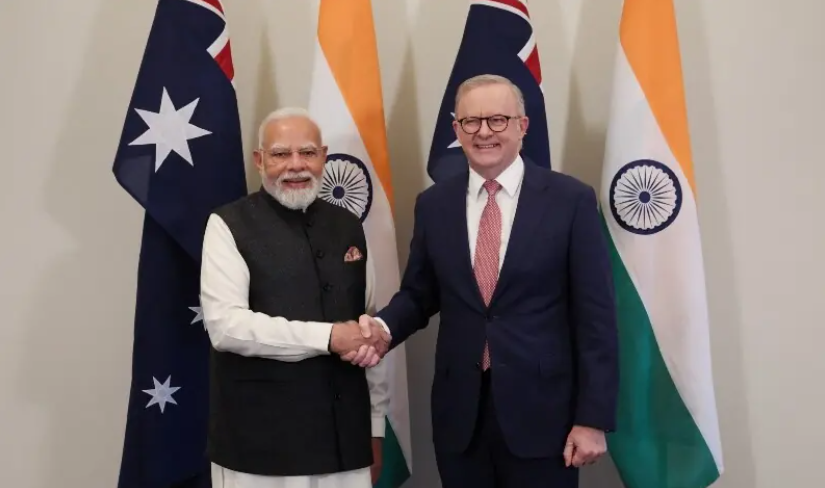
Indian Prime Minister Narendra Modi announced on Thursday that India had reached an agreement with Australia for uranium supplies, securing a key fuel source for the country’s expanding nuclear energy ambitions.

During his visit to Australia, Modi said the agreement would strengthen India’s efforts to increase nuclear power generation as the world’s most populous country faces rapidly rising electricity demand.
“We have signed an important agreement today on nuclear energy,” Modi said after talks with Australian Prime Minister Anthony Albanese.
“This will pave the way for uranium supplies from Australia to India and give our clean energy objectives fresh momentum.”
Australia holds nearly 28 per cent of the world’s known uranium resources, but exports to India have been limited due to legal restrictions and political concerns.
A joint statement said the agreement would enable long-term uranium exports to India for “exclusively peaceful purposes”. The supplies will operate under safeguards established by the International Atomic Energy Agency (IAEA).
“The arrangement facilitates Australian uranium exports to India, to help increase the share of non-fossil fuel power capacity,” Albanese told reporters.
India and Australia signed a nuclear cooperation agreement in 2015 that opened the possibility of uranium exports, but regulatory barriers meant trade remained minimal until now.
The two leaders also highlighted growing ties between their countries. Albanese praised Modi’s role in strengthening bilateral relations, saying:
“Prime Minister Modi, your leadership and your personal engagement with Australia has been absolutely central to this change,” Albanese said.
Earlier, Albanese and Modi shared a light moment as they posed for a selfie during the visit. The Australian leader has previously referred to Modi as “The Boss”, joking that the Indian prime minister could attract larger crowds than US singer Bruce Springsteen.
India’s growing diaspora in Australia has also played a role in deepening relations. According to recent statistics, people born in India have become the largest overseas-born community in Australia, surpassing those born in Britain.
“In 2014, the Indian diaspora community in Australia was relatively small,” said Teesta Prakash from the Australia India Institute.
“But in 2026, it is now the largest diaspora community within Australia. It has outstripped the British, which is a huge demographic change,” she told AFP.
Modi is expected to receive a major reception at a community rally in Melbourne later on Thursday, with organisers anticipating more than 20,000 attendees.
However, his visit has also drawn criticism from opposition groups, including those accusing his government of promoting Hindu nationalism and targeting minority communities in India.
The Australia’s Alliance Against Islamophobia announced plans to protest outside the Melbourne event, citing concerns over minority rights in India. Another demonstration opposing Indian migration to Australia is also expected.
Following his Australia visit, Modi is scheduled to travel to New Zealand.