












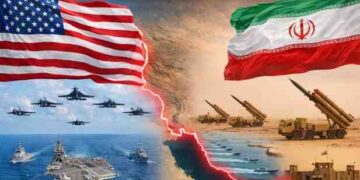
























WASHINGTON/TEHRAN: Iranian officials expressed caution over US intentions on Sunday after President Donald Trump reportedly sought additional revisions to a nearly finalised agreement, prompting Tehran to reiterate that it would only act on the basis of concrete outcomes rather than “words and promises”.

Addressing a virtual session of Iran’s parliament, Speaker Bagher Ghalibaf stressed that Tehran remained sceptical of Washington’s commitments.
“There is no trust in the enemy’s words and promises. Our only criterion is to achieve tangible results before we fulfil our commitments in return,” he said.
He further stated, “We will not approve any agreement until we are sure” that any deal safeguards the interests and rights of the Iranian people.
Iranian Foreign Minister Abbas Araghchi later confirmed that diplomatic contacts between Tehran and Washington remain active.
“We should not give importance to speculation and we can not judge the talks until we get to a clear result,” Araghchi said.
The remarks came after reports in US media suggested President Trump had requested additional amendments to strengthen aspects of the proposed agreement.
According to CNN, Trump sought “on tougher language surrounding Iran’s nuclear commitments and its pledge to reopen the Strait of Hormuz”. A foreign official familiar with the discussions reportedly told the network that the revisions were largely non-substantive and focused on securing stronger assurances from Tehran.
Meanwhile, The New York Times reported that Trump had returned a revised framework to Iran for consideration after requesting stricter terms. While details of the changes remain unclear, Axios reported that the president wanted to reinforce provisions he considered particularly important, including the handling of Iran’s nuclear material.
In an interview with Fox News, Trump said the United States was “close to a very good deal” with Iran that could bring an end to the conflict. However, he warned that rushing negotiations could undermine the outcome.
“If you’re going to be in a hurry, you’re not going to make a good deal, and slowly but surely, we’re getting, I think, what we want — and if we don’t get what we want, we’re going to end it a different way,” he said.
Trump also claimed that Iran had agreed not to pursue nuclear weapons.
“The one guarantee that I have to have is that there will be no nuclear weapons. They’ve agreed to that, and it was very interesting,” he told Lara Trump during the interview.
“We’ve actually left their military alone — people would be surprised to hear that,” Trump added, arguing that Iran’s military had not been targeted as heavily because it was viewed as “somewhat moderate” compared with other parts of the Iranian establishment.
IRGC rejects enemy calculations
Separately, a senior commander of Iran’s Islamic Revolutionary Guard Corps (IRGC) argued that Iran’s adversaries had misjudged the country’s resilience and military capabilities.
Speaking to IRNA, IRGC Deputy for Political Affairs Yadollah Javani said opponents believed they could achieve a rapid victory through military pressure, but those expectations had failed.
He stated that their objectives had included dismantling Iran’s nuclear programme, neutralising its missile capabilities and ultimately toppling the Islamic Republic. According to Javani, none of these goals were achieved, resulting instead in a shift of regional dynamics in Iran’s favour.
Javani said the United States now faced a choice between recognising the rights and conditions of the Iranian people or prolonging the conflict.
The IRGC also claimed it had intercepted and destroyed a US MQ1 drone after it entered Iranian territorial waters.
According to a statement carried by state broadcaster IRIB, the drone “attempted to carry out a hostile operation”.
“It was immediately detected and targeted by the Revolutionary Guard’s modern defence missiles and shot down,” the statement said.
Gas production resumes
Iran also announced the restoration of gas production at three offshore platforms in the South Pars gas field after earlier disruptions caused by Israeli attacks on processing facilities.
Touraj Dehqani, chief executive of Pars Oil and Gas Company, said the offshore platforms had not sustained damage. Production from the facilities is currently being redirected to alternative processing plants while repairs continue at affected sites, including the Phase 14 refinery.
Despite growing speculation that a peace agreement could eventually ease restrictions on Iranian ports, Deputy Parliament Speaker Hamid Reza Haji Babaei urged policymakers to continue planning for prolonged economic pressure.
He said future planning should assume that restrictions on Iranian ports would remain in place and should not depend on “possible partial openings by the enemy”.
“We are encircling the enemy’s economic siege, and we must vigorously pursue and activate alternative routes and land corridors,” he said.