




























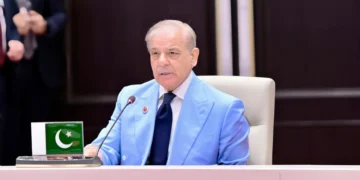










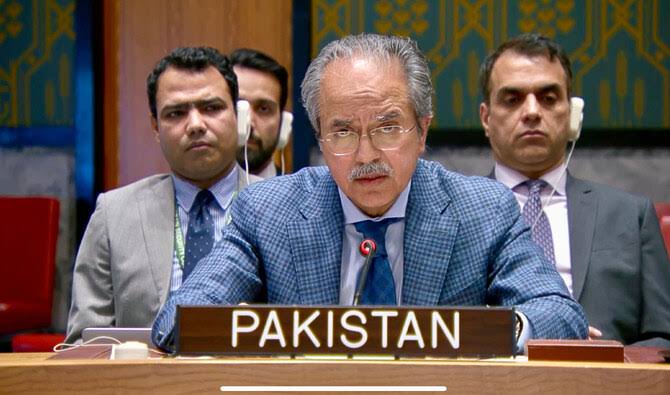
NEWYORK: Pakistan told the UN Security Council on Thursday that the breakdown of diplomacy in the Middle East has further complicated the Iranian nuclear issue, as Secretary-General António Guterres warned that the escalating crisis poses a “grave threat to international peace and security.”

Speaking at a Council briefing on the 1737 Committee, which monitors UN sanctions related to Iran’s nuclear programme, Pakistan’s Permanent Representative, Asim Iftikhar Ahmad, highlighted deep divisions within the Council over nuclear-related sanctions on Iran.“The Council remains divided on the 1737 Committee issue,”
Ambassador Ahmad said. “Unfortunately, this split is delaying the appointment of Chairs of the Subsidiary Bodies, significantly hindering their work.”He stressed that disagreements over the committee “must not be allowed to obstruct the routine functioning of the Council and its Subsidiary Bodies,” noting that the lack of agreement on a report “should have formed the basis of today’s meeting.”The 1737 Committee, established under UN Security Council Resolution 1737 in 2006, is responsible for overseeing sanctions on Iran, reviewing reports from the International Atomic Energy Agency (IAEA). The committee’s work includes reviewing compliance with the mandate, considering requests for exemptions, designating individuals and entities subject to sanctions, and reporting regularly to the Security Council.
The debate unfolded amid escalating tensions in the Middle East. In two separate tweets, Secretary-General Guterres warned that the crisis “constitutes a grave threat to international peace and security” and has already caused “immense suffering for civilians.”He cautioned that military escalation risks triggering a wider, uncontrollable conflict and urged all parties to pursue “de-escalation, dialogue and a return to serious negotiations.”UN agencies have also sounded the alarm over the humanitarian fallout.
They report that more than 1,100 children have been killed or injured, while millions face disrupted schooling and displacement.Ambassador Ahmad said recent developments — including what he described as “unprovoked and unwarranted attacks on Iran” — had “deeply impacted the context of the Iran nuclear file.”“Regrettably, the breakdown of diplomacy on the Iranian nuclear issue has further complicated an already complex matter that has been on a downward slide for the last few months,” he said.
Despite the current tensions, he emphasised that the fundamental principles of the 2015 Joint Comprehensive Plan of Action (JCPOA) and the consensus adoption of Security Council Resolution 2231 remain valid.
“The JCPOA was a unique instrument — a manifestation of dialogue, diplomacy, and pragmatism,” he said. “It charted a roadmap to address the concerns of all parties through reciprocal action, embodying peaceful resolution of disputes that is at the heart of the UN Charter.”Reiterating Pakistan’s opposition to the use of force, Ambassador Ahmad said Islamabad had “condemned all use of force, targeting of civilian infrastructure, and strikes on nuclear sites under IAEA safeguards.”
“Strikes against nuclear facilities carry huge environmental and safety risks for the local population and people all around the region,” he warned. He underscored that the IAEA’s verification mandate must not be disrupted. “The IAEA is responsible for verifying compliance with nuclear safeguards in an objective, impartial, and credible manner,” he said, adding that its verification activities in Iran should resume unimpeded.
Referring to Security Council Resolution 2788 adopted last July, which highlighted the primacy of peaceful dispute resolution, he said the Council must “urgently revive the spirit of the Charter” to break the cycle of escalation that has repeatedly engulfed the region.