










































































The government of Japan has started preparations to allow commercial flying car services carrying paying passengers as early as 2027 or 2028, according to multiple official sources.

The initial phase is expected to focus on sightseeing flights in urban areas, with plans to later expand into point-to-point transport, including routes connecting cities and airports. Passenger travel via flying cars, considered a potentially transformative development in mobility, now seems closer to becoming a reality.
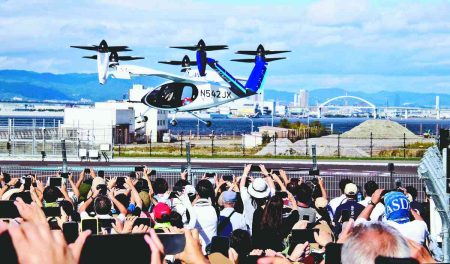
Flying cars refer to electric vehicles capable of vertical takeoff and landing. They usually accommodate a small number of passengers, operate more quietly than traditional aircraft, and require limited landing space—making them suitable for densely populated cities. These vehicles are also expected to help reduce traffic congestion and improve transport options in regional areas.
Applications for type certification under the Civil Aeronautics Law have already been submitted to Japan’s Land, Infrastructure, Transport and Tourism Ministry. This certification is necessary for mass production and includes safety and performance evaluations. Authorities believe the review process is progressing in a way that supports the launch of commercial services.
Sightseeing flights are likely to begin in waterfront areas of major cities such as Tokyo and Osaka. Within a few years, operations are expected to expand to short-distance travel and routes linking major airports like Narita and Kansai with nearby urban centers.
Industry competition is also increasing, with multiple companies advancing their flying car projects. At the Osaka-Kansai Expo last year, demonstration flights were conducted without passengers. In Tokyo, two consortiums—one including Japan Airlines and another involving Nomura Real Estate Development—have been selected for a metropolitan government project, with full-scale demonstration flights set to begin soon.
Although global regulations for flying cars are still under development, Japan has already introduced safety measures, including battery performance standards and requirements such as carrying life jackets for over-water flights. This positions the country to play a leading role in shaping future international rules.
The government is also backing the development of flying car technology. Under the administration of Sanae Takaichi, aviation and space were included among 17 priority strategic sectors announced last year.