




























































The Foreign Office (FO) on Sunday dismissed and denounced the “highly inflammatory, baseless and irresponsible” comments made by Indian External Affairs Minister Dr S Jaishankar regarding Pakistan’s armed forces, calling them “misleading”.

The FO’s response came a day after Jaishankar claimed that India’s primary issues with its neighbour arose directly from Pakistan’s military establishment.
Reacting to his assertions, the FO emphasised that Pakistan was a responsible nation and that all its institutions, including the armed forces, formed a crucial element of national security, committed to protecting the country’s sovereignty and territorial integrity.
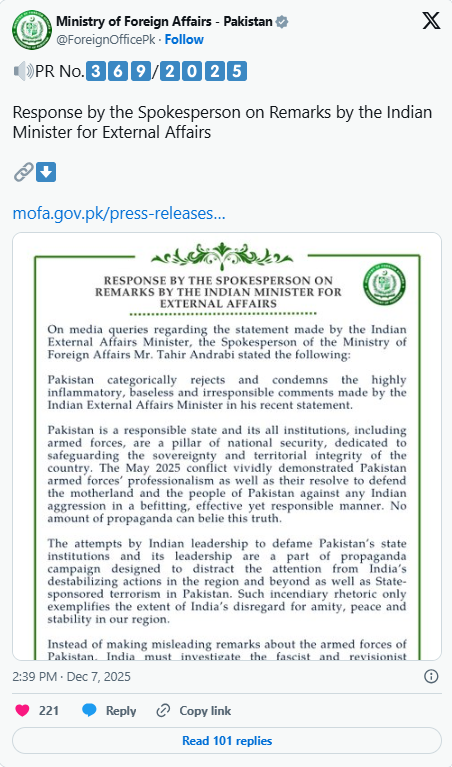
The FO statement also cited the brief four-day confrontation between India and Pakistan in May, noting that it “vividly demonstrated Pakistan armed forces’ professionalism as well as their resolve to defend the motherland and the people of Pakistan against any Indian aggression in a befitting, effective yet responsible manner”.
“No amount of propaganda can belie this truth,” the statement added.
It described efforts by Indian leaders to malign Pakistan’s state institutions and leadership as “part of a propaganda campaign designed to distract attention from India’s destabilising actions in the region and beyond, as well as state-sponsored terrorism in Pakistan”.
“Such incendiary rhetoric only exemplifies the extent of India’s disregard for amity, peace and stability in our region.”
The FO further stated that rather than making misleading accusations about Pakistan’s armed forces, “India must investigate the fascist and revisionist Hindutva ideology that has unleashed a reign of mob justice, lynchings, arbitrary detentions and demolition of properties and places of worship”.
Indian leadership and institutions had both become “hostage of this terror in the name of religion,” it said.
The statement reiterated that “Pakistan believes in co-existence, dialogue and diplomacy. However, it stands united and resolute in its intent and ability to safeguard its interests and sovereignty”.