
































































KATHMANDU (MNN); At least 95 people were killed after a massive flood and mudslide disaster struck Nepal’s border region with Tibet, while hundreds of tourists remained unaccounted for as rescue teams launched a major search operation.

A Nepal Police spokesman said that 95 deaths had so far been reported, while around 28 police personnel were also missing following the disaster.
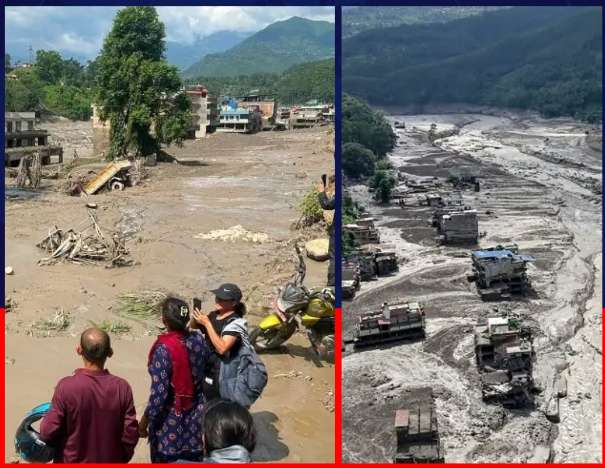
The catastrophe occurred after a powerful torrent of mud, water and debris surged through the mountainous region, sweeping away and burying homes and other structures. Rescue workers continued searching for survivors amid fears that the scale of destruction could increase.
On the Chinese side of the border, authorities reported that at least three people had died and 265 others were missing. Chinese state media said President Xi Jinping had ordered an all-out rescue operation.
It was not immediately clear whether the casualty and missing-person figures released by Nepal and China overlapped, as authorities continued to verify the extent of the disaster.
Nepalese Prime Minister Balendra Shah expressed grief over the tragedy and appealed to the nation to remain united.
In a message posted on social media, he assured the affected population that the government would use all available resources for rescue operations, medical treatment, food and shelter.
Hundreds of tourists were also reported missing or out of contact hours after the disaster. According to Nepal’s Ministry of Culture, Tourism and Civil Aviation, 403 tourists, including 341 foreigners, could not initially be contacted.
The missing included citizens of several countries, including the United States, India, Australia, Malaysia and Britain.
The Nepal Army deployed helicopters and disaster response teams to assist in rescue and relief operations, while authorities issued warnings to people living near rivers to move to safer locations.
The disaster also caused major damage to Nepal’s electricity infrastructure. The Nepal Electricity Authority said around 430 megawatts of power generation capacity, including hydropower and solar facilities, had been affected, disrupting electricity production, transmission and distribution.
A preliminary assessment by the Kathmandu-based International Centre for Integrated Mountain Development suggested that a rock-and-ice avalanche may have occurred on the Nepalese side, blocking the Lhende River and triggering a cascading flood.
Several highways in the affected region were closed because of flooding and the risk of further mudslides.
Authorities in Tibet also warned that roads in the Shigatse region remained vulnerable to landslides and were unsafe for travel.
Meanwhile, Indian Prime Minister Narendra Modi spoke with Nepalese Prime Minister Balendra Shah, expressing condolences and offering humanitarian assistance for rescue and relief operations.
India, Modi said, stood in solidarity with the people of Nepal and was ready to provide all possible assistance.
Experts have also warned of the possibility of another flood. According to an official from ICIMOD, a blockage remained upstream on a river along the Nepal-China border, raising fears of a second and potentially dangerous flood event.
The Himalayan region is particularly vulnerable to floods and landslides during the monsoon season, while scientists have warned that increasingly extreme weather events linked to climate change are adding to the risks faced by communities in South Asia.