





















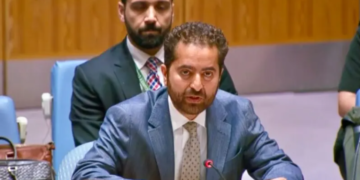


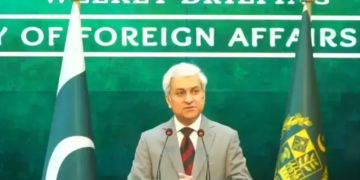

























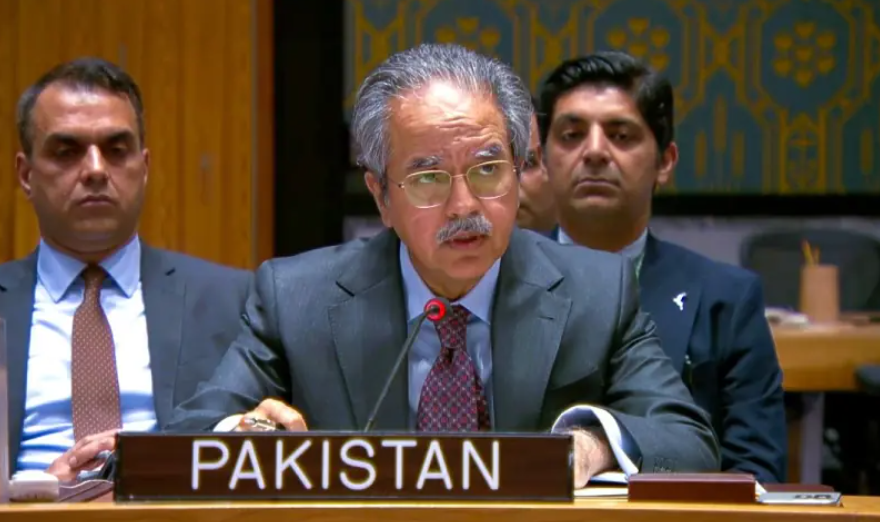
Pakistan’s Permanent Representative to the United Nations, Ambassador Asim Iftikhar Ahmad, told the UN Security Council (UNSC) that India’s engagement in Afghanistan was primarily focused on undermining Pakistan’s stability.

He made the remarks during a UNSC session on Afghanistan while responding to comments made by Afghanistan’s Permanent Representative to the UN, Nasir Ahmad Faiq.
Earlier in the meeting, Ambassador Ahmad highlighted the use of Afghan territory by terrorist groups and its consequences for Pakistan. He urged the Afghan Taliban to take effective action against militants and outlined Pakistan’s ongoing counterterrorism efforts.
Addressing Faiq’s criticism of Pakistan’s counterterrorism operations, Ahmad stated: “Pakistan’s actions, including those conducted in March, were directed solely against the terrorist and military support infrastructure that is operating from Afghanistan. And it is in no way directed against the brotherly people of Afghanistan.”
The response came months after the Afghan Taliban accused Pakistan of targeting a hospital in Kabul during strikes conducted on March 16. Islamabad rejected the allegation, insisting the operation was aimed at terrorist infrastructure and not civilian sites.
Reaffirming Pakistan’s stance, Ahmad said the strikes targeted “drone storage and technical support infrastructure and ammunition storage sites, which were being used by the Afghan Taliban regime to carry out attacks against innocent Pakistani civilians”.
He further maintained: “The strikes were precise, deliberate and professional. No hospital or drug rehabilitation centre or civilian facility was targeted by these strikes.” Referring to footage released after the operation, he added that the visible secondary explosions confirmed ammunition depots had been hit and asserted that claims to the contrary were propaganda.
The ambassador noted that discussions at the UNSC focused on three key issues: inclusive governance and human rights, including women’s rights, as well as counterterrorism. He observed that most speakers called on the Taliban to meet these commitments, except India.
Commenting on India’s statement, Ahmad said New Delhi had presented an extensive account of its development and humanitarian initiatives in Afghanistan before using the platform to criticise Pakistan.
“So to us, it is absolutely clear — India’s key aims and objectives, even though under the garb of, under the disguise of development or humanitarian assistance, its key aims and objectives in Afghanistan are solely driven by the singular goal of destabilising Pakistan,” he said.
He further alleged that India was using groups operating from Afghan territory, including the banned Tehreek-i-Taliban Pakistan (TTP) and the banned Baloch Liberation Army (BLA), to further that objective. Ahmad described the BLA as “supported and financed by India to destabilise and target Pakistan”.
‘India’s newfound love for Taliban’
The Pakistani envoy pointed out that India’s representative did not condemn either the TTP or the BLA during the session.
Referring to what he called a change in India’s policy towards Afghanistan, Ahmad remarked: “I think for some time we are amused, perhaps, to listen to India’s newfound love for the Taliban.”
He argued that this shift coincided with Pakistan’s counterterrorism operations against militant hideouts in Afghanistan, which he claimed had Indian backing.
According to Ahmad, India’s remarks at the UNSC reflected broader policies aimed at undermining Pakistan and should concern the international community. He also suggested that India was uncomfortable with Pakistan’s operations against militant infrastructure in Afghanistan.
Criticising New Delhi’s references to international law, Ahmad accused India of violating international obligations and Security Council resolutions, particularly regarding Jammu and Kashmir and the Indus Waters Treaty. He also criticised India’s conduct in sports diplomacy, saying its actions contradicted the spirit of peace and cooperation it claimed to promote.
Concluding his rebuttal, Ahmad urged India to engage in self-reflection.
“Pakistan is well aware of India’s motives and evil designs. But we will not allow them to nourish terrorists and threaten our national security,” he said.
He ended by declaring: “I would say that we have stopped them before and we will do it again, and we will do it always.”
Call for action against militants
Earlier in his address, Ahmad stressed that Pakistan expected “verifiable and non-reversible action” from the Taliban against terrorist organisations operating from Afghan territory.
“Regrettably, this demand remains unmet,” he told the Council, while expressing hope that the Taliban would cooperate with the international community to promote peace and development in Afghanistan.
He recalled that many expected Afghanistan to enter a period of stability following the Taliban’s return to power in 2021. However, he argued that terrorist groups continued to operate freely inside the country.
The ambassador said Pakistan had expected the Taliban to take decisive action against organisations such as the TTP, the BLA and its Majeed Brigade, the Islamic State-Khorasan (IS-K), and the East Turkestan Islamic Movement.
“Regrettably, they have failed to undertake action, showing complete disregard for the legitimate security concerns of Pakistan and other countries,” he said.
According to Ahmad, Pakistan has suffered heavily from attacks planned from Afghan soil. He noted that terrorist groups had gained access to sophisticated weapons, including drones, much of which originated from military equipment left behind after the withdrawal of foreign forces.
He said Pakistan recorded more than 5,300 terrorist incidents in 2025 and lost over 1,200 people to terrorism linked to Afghanistan. He also cited a May 9 TTP attack on a police post in Khyber Pakhtunkhwa that killed 15 officers, saying investigations showed it had been planned in Afghanistan.
Pakistan will respond in self-defence
Ahmad accused the Taliban of once again providing safe havens to terrorist groups and alleged that an external actor was supporting efforts to destabilise Pakistan through proxy warfare.
“Pakistan will not sit idle while suffering from terrorist acts. We will respond in self-defence, as and when needed and always in conformity with international law and International Humanitarian Law,” he said.
While acknowledging mediation efforts by countries including Qatar, Türkiye, Saudi Arabia and China, Ahmad said the Taliban’s continued refusal to publicly condemn the TTP and BLA raised serious concerns about their complicity.
He also criticised a recent UN report on Afghanistan, arguing that it failed to adequately address the terrorist threat emanating from the country and overlooked issues such as illicit financing networks, weapons accumulation and the Taliban’s governance shortcomings.
The envoy further highlighted deteriorating human rights conditions in Afghanistan, particularly restrictions on women and girls, which he described as inconsistent with both international obligations and Islamic principles.
Ahmad concluded by emphasising Pakistan’s long-standing support for Afghanistan through humanitarian assistance, trade facilitation, educational opportunities and the hosting of millions of Afghan refugees over several decades.
Reiterating Islamabad’s position, he said: “Pakistan’s demand from the Taliban is simple and clear: verifiable and non-reversible action against terrorists. Regrettably, this demand remains unmet.” He warned that while opportunities for corrective action were narrowing, there was still time for the Taliban to work with the international community to ensure peace and stability in Afghanistan.Pakistan’s Permanent Representative to the United Nations, Ambassador Asim Iftikhar Ahmad, told the UN Security Council (UNSC) that India’s engagement in Afghanistan was primarily focused on undermining Pakistan’s stability.
He made the remarks during a UNSC session on Afghanistan while responding to comments made by Afghanistan’s Permanent Representative to the UN, Nasir Ahmad Faiq.
Earlier in the meeting, Ambassador Ahmad highlighted the use of Afghan territory by terrorist groups and its consequences for Pakistan. He urged the Afghan Taliban to take effective action against militants and outlined Pakistan’s ongoing counterterrorism efforts.
Addressing Faiq’s criticism of Pakistan’s counterterrorism operations, Ahmad stated: “Pakistan’s actions, including those conducted in March, were directed solely against the terrorist and military support infrastructure that is operating from Afghanistan. And it is in no way directed against the brotherly people of Afghanistan.”
The response came months after the Afghan Taliban accused Pakistan of targeting a hospital in Kabul during strikes conducted on March 16. Islamabad rejected the allegation, insisting the operation was aimed at terrorist infrastructure and not civilian sites.
Reaffirming Pakistan’s stance, Ahmad said the strikes targeted “drone storage and technical support infrastructure and ammunition storage sites, which were being used by the Afghan Taliban regime to carry out attacks against innocent Pakistani civilians”.
He further maintained: “The strikes were precise, deliberate and professional. No hospital or drug rehabilitation centre or civilian facility was targeted by these strikes.” Referring to footage released after the operation, he added that the visible secondary explosions confirmed ammunition depots had been hit and asserted that claims to the contrary were propaganda.
The ambassador noted that discussions at the UNSC focused on three key issues: inclusive governance and human rights, including women’s rights, as well as counterterrorism. He observed that most speakers called on the Taliban to meet these commitments, except India.
Commenting on India’s statement, Ahmad said New Delhi had presented an extensive account of its development and humanitarian initiatives in Afghanistan before using the platform to criticise Pakistan.
“So to us, it is absolutely clear — India’s key aims and objectives, even though under the garb of, under the disguise of development or humanitarian assistance, its key aims and objectives in Afghanistan are solely driven by the singular goal of destabilising Pakistan,” he said.
He further alleged that India was using groups operating from Afghan territory, including the banned Tehreek-i-Taliban Pakistan (TTP) and the banned Baloch Liberation Army (BLA), to further that objective. Ahmad described the BLA as “supported and financed by India to destabilise and target Pakistan”.
‘India’s newfound love for Taliban’
The Pakistani envoy pointed out that India’s representative did not condemn either the TTP or the BLA during the session.
Referring to what he called a change in India’s policy towards Afghanistan, Ahmad remarked: “I think for some time we are amused, perhaps, to listen to India’s newfound love for the Taliban.”
He argued that this shift coincided with Pakistan’s counterterrorism operations against militant hideouts in Afghanistan, which he claimed had Indian backing.
According to Ahmad, India’s remarks at the UNSC reflected broader policies aimed at undermining Pakistan and should concern the international community. He also suggested that India was uncomfortable with Pakistan’s operations against militant infrastructure in Afghanistan.
Criticising New Delhi’s references to international law, Ahmad accused India of violating international obligations and Security Council resolutions, particularly regarding Jammu and Kashmir and the Indus Waters Treaty. He also criticised India’s conduct in sports diplomacy, saying its actions contradicted the spirit of peace and cooperation it claimed to promote.
Concluding his rebuttal, Ahmad urged India to engage in self-reflection.
“Pakistan is well aware of India’s motives and evil designs. But we will not allow them to nourish terrorists and threaten our national security,” he said.
He ended by declaring: “I would say that we have stopped them before and we will do it again, and we will do it always.”
Call for action against militants
Earlier in his address, Ahmad stressed that Pakistan expected “verifiable and non-reversible action” from the Taliban against terrorist organisations operating from Afghan territory.
“Regrettably, this demand remains unmet,” he told the Council, while expressing hope that the Taliban would cooperate with the international community to promote peace and development in Afghanistan.
He recalled that many expected Afghanistan to enter a period of stability following the Taliban’s return to power in 2021. However, he argued that terrorist groups continued to operate freely inside the country.
The ambassador said Pakistan had expected the Taliban to take decisive action against organisations such as the TTP, the BLA and its Majeed Brigade, the Islamic State-Khorasan (IS-K), and the East Turkestan Islamic Movement.
“Regrettably, they have failed to undertake action, showing complete disregard for the legitimate security concerns of Pakistan and other countries,” he said.
According to Ahmad, Pakistan has suffered heavily from attacks planned from Afghan soil. He noted that terrorist groups had gained access to sophisticated weapons, including drones, much of which originated from military equipment left behind after the withdrawal of foreign forces.
He said Pakistan recorded more than 5,300 terrorist incidents in 2025 and lost over 1,200 people to terrorism linked to Afghanistan. He also cited a May 9 TTP attack on a police post in Khyber Pakhtunkhwa that killed 15 officers, saying investigations showed it had been planned in Afghanistan.
Pakistan will respond in self-defence
Ahmad accused the Taliban of once again providing safe havens to terrorist groups and alleged that an external actor was supporting efforts to destabilise Pakistan through proxy warfare.
“Pakistan will not sit idle while suffering from terrorist acts. We will respond in self-defence, as and when needed and always in conformity with international law and International Humanitarian Law,” he said.
While acknowledging mediation efforts by countries including Qatar, Türkiye, Saudi Arabia and China, Ahmad said the Taliban’s continued refusal to publicly condemn the TTP and BLA raised serious concerns about their complicity.
He also criticised a recent UN report on Afghanistan, arguing that it failed to adequately address the terrorist threat emanating from the country and overlooked issues such as illicit financing networks, weapons accumulation and the Taliban’s governance shortcomings.
The envoy further highlighted deteriorating human rights conditions in Afghanistan, particularly restrictions on women and girls, which he described as inconsistent with both international obligations and Islamic principles.
Ahmad concluded by emphasising Pakistan’s long-standing support for Afghanistan through humanitarian assistance, trade facilitation, educational opportunities and the hosting of millions of Afghan refugees over several decades.
Reiterating Islamabad’s position, he said: “Pakistan’s demand from the Taliban is simple and clear: verifiable and non-reversible action against terrorists. Regrettably, this demand remains unmet.” He warned that while opportunities for corrective action were narrowing, there was still time for the Taliban to work with the international community to ensure peace and stability in Afghanistan.