




































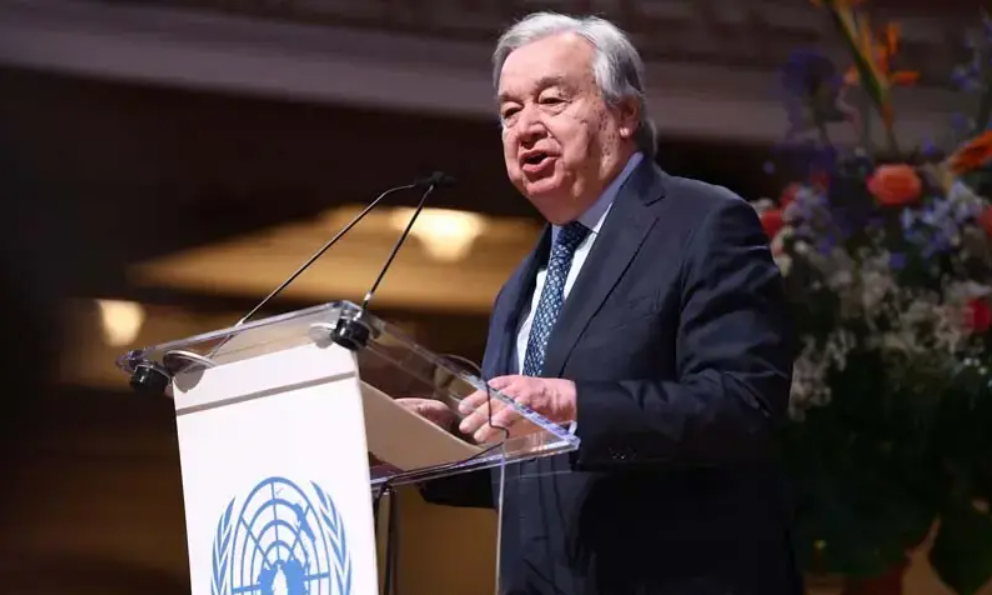
UN Secretary-General António Guterres on Monday announced that the United Nations is prepared to introduce a mechanism aimed at enabling the safe passage of fertiliser and other essential goods through the Strait of Hormuz, where maritime traffic has almost come to a halt.

The proposal, announced during a press briefing in New York, seeks to facilitate the movement of critical commodities through the strategic waterway. It was developed by a UN task force established by Guterres in March to address humanitarian concerns caused by the disruption of shipping through Hormuz.
The initiative is being led by the UN Office for Project Services (UNOPS), alongside the UN Conference on Trade and Development (UNCTAD), the International Maritime Organisation (IMO) and the International Chamber of Commerce.
Initially, the mechanism would cover fertilisers and related raw materials, with the possibility of expanding it to other essential goods. Under the plan, vessels carrying approved cargo would be registered and verified, while monitoring and deconfliction arrangements would be established in Oman.
“We have everything ready to do it,” Guterres told reporters, while stressing that the mechanism could only operate if all countries involved in the conflict agreed to it.
He said the head of UNOPS had been in “intense contacts” with the parties involved and that they had already been briefed on how the proposed system would function.
The UN initiative is designed to reduce immediate risks to shipping, make the movement of essential goods more predictable and help restore the confidence needed for diplomacy and de-escalation.
Guterres stressed that the arrangement would not grant permission to use the Strait of Hormuz or change the rights and obligations of states under international law.
“Sovereign decisions remain entirely with participating member states,” he said, adding that the UN would act as a neutral facilitator.
Responding to a question about claims by the Islamic Revolutionary Guard Corps that it controls the Strait of Hormuz, Guterres said: “Let’s be clear, our position is that freedom of navigation must be respected in all circumstances,”
He added that if freedom of navigation could not be restored immediately, the UN was prepared to facilitate the proposed mechanism, provided the states involved agreed.
Guterres also emphasised that the initiative was not intended to replace the full restoration of navigation rights or the political measures required to resolve the conflicts.
The disruption of shipping through the strait has already begun affecting global trade and food security. Maritime traffic through Hormuz has nearly stopped, while oil prices are around 33 per cent higher than at the beginning of the conflict. Global container shipping rates have risen 84 per cent compared with a year earlier, while fertiliser and other essential input costs have also increased sharply.