




















































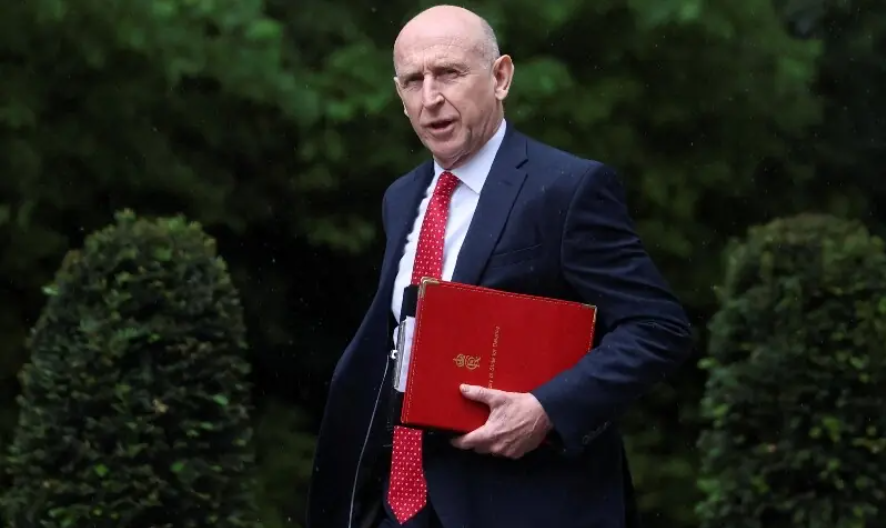
LONDON: British Defence Secretary John Healey resigned on Thursday, accusing Prime Minister Keir Starmer’s government and the Treasury of failing to allocate sufficient funding to strengthen the country’s defence capabilities amid growing global security threats.

The unexpected resignation marks a significant setback for Starmer, whose leadership is already under pressure ahead of a crucial parliamentary by-election next week.
In a strongly worded resignation letter posted on X, Healey criticised the government’s proposed Defence Investment Plan (DIP), arguing that it does not provide the armed forces with the resources required to meet current security challenges.
“You have been unable, and the Treasury has been unwilling, to commit the resources that the nation needs to defend the country at this time of rising threats,” Healey wrote.
“After explaining to you that I would not be able to accept a DIP settlement that does not give our Forces the resources they need, I am now left with no other option than to submit my resignation.”
The dispute centres on the government’s long-awaited defence funding strategy, which Starmer has pledged to unveil before the Nato summit in Turkiye scheduled to begin on July 7.
Since taking office in July 2024, Labour has promised to increase military spending in response to growing concerns over Russia and continued pressure from US President Donald Trump for Nato allies to contribute more to collective defence.
Starmer has committed to raising defence spending to 2.5 per cent of GDP from next year, increasing to 3 per cent if Labour wins the next general election expected in 2029, and eventually reaching 3.5 per cent by 2035.
However, Healey said the proposed plan would increase spending to only 2.68 per cent of GDP by 2030, falling short of what he believes is necessary to address current security risks.
According to a source close to the former defence secretary, the Treasury’s proposal also failed to provide a clear timeline for reaching the government’s 3 per cent target.
“The plan falls well short of what is required for defence and the country at this dangerous time,” Healey wrote.
“Without a DIP that meets the moment in this way, I am being forced to make decisions that would reduce the readiness of our forces and increase the risk to personnel on operations, and could make the country less safe.”
The resignation has intensified scrutiny of the government’s defence strategy and sparked concern among lawmakers.
Tan Dhesi, chairman of parliament’s defence committee, said Healey’s departure should serve as a warning to the government.
“That a defence secretary of his integrity and commitment has felt compelled to resign in response to the inadequacy of the proposed defence settlement is a grave moment,” he said.
Healey’s resignation comes at a politically sensitive time for Starmer. The prime minister is facing mounting pressure ahead of a by-election in the Makerfield constituency next week, where Greater Manchester Mayor Andy Burnham is contesting the seat.
Both Burnham and Healey have previously been mentioned as potential contenders in any future Labour leadership race, although no formal challenge to Starmer’s leadership has emerged.
The resignation is likely to deepen questions about the government’s ability to balance fiscal constraints with growing demands for increased defence spending amid an increasingly uncertain global security environment.