


























































Pakistan on Thursday cautioned that any deliberate attempt to block water crucial to its survival and development would have serious consequences, following remarks by India’s water minister suggesting that no water would be allowed to flow to Pakistan in the future.

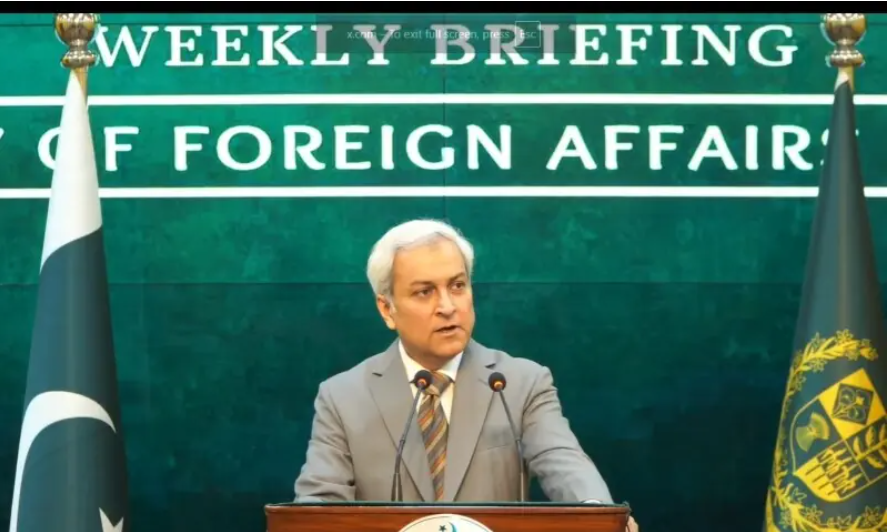
During a weekly press briefing, Foreign Office spokesperson Tahir Andrabi said, “Any such act would be treated with utmost seriousness and could possibly amount to an act of war under Article 51 of the UN Charter.”
His comments came after Indian Water Minister CR Patil told ANI that “not a single drop of water will go [to Pakistan] in the coming years,” adding that India was “actively working on it” under directives from Prime Minister Narendra Modi.
Responding to the statement, Andrabi said any effort to block or significantly reduce water essential for the livelihood, agriculture, and well-being of more than 250 million Pakistanis would be highly irresponsible. He stressed that such a move would violate international obligations governing transboundary rivers as well as bilateral agreements between the two countries.
“Pakistan firmly rejects any notion that water can be treated as a political tool or instrument of coercion or a weapon,” he said, warning that such actions could threaten regional peace and security.
Andrabi emphasized that Pakistan’s rights over its water resources were non-negotiable and that the country would use all available diplomatic, political, legal, and economic avenues to protect its interests.
“Any deliberate attempt to block water essential to Pakistan’s survival and development would constitute an extremely grave act with far-reaching consequences, as stated at the top leadership level by Pakistan,” Andrabi warned.
He also urged India to fulfill its international commitments, avoid escalating tensions, and act responsibly regarding shared water resources.
Addressing concerns over India’s expanding nuclear arsenal, Andrabi said findings in a recent Stockholm International Peace Research Institute (SIPRI) report were consistent with Pakistan’s longstanding concerns about India’s military buildup. He pointed to developments such as missile canisterisation, expansion of nuclear-capable submarines, and pursuit of longer-range missile systems, warning that such measures could undermine strategic stability in South Asia.
While reiterating that Pakistan was not seeking an arms race, Andrabi said the country remained committed to maintaining strategic stability and deterring any potential aggression.
Separately, the Foreign Office said securing the release of 11 Pakistani seafarers held hostage by pirates aboard the MT Honour 25 off Somalia remained a top priority. The crew members were taken captive after the vessel was hijacked on April 21.
“Sadly, despite our best efforts, we have not been able to secure their release,” Andrabi said, adding that Pakistan was working closely with Somali authorities and the ship’s owners to achieve their safe return.
He noted that Deputy Prime Minister and Foreign Minister Ishaq Dar had raised the matter with Somalia’s Foreign Minister Abdisalam Abdi Ali, urging swift action and improved conditions for the captives. Pakistani diplomatic missions and government agencies continue to coordinate efforts, with further meetings planned next week to advance the rescue process.
Describing the situation as complex, Andrabi explained that the hostages were being held in a semi-autonomous region of Somalia where tribal dynamics have complicated negotiations. He appealed to the families of the captives to remain patient, assuring them that the government was treating the matter as a high priority.