












































































WASHINGTON: A remarkable assemblage of fossils from China reveals that animal life diversified in Earth’s primordial seas millions of years earlier than previously known, including ancient members of a group that eventually led to vertebrates, including humans.

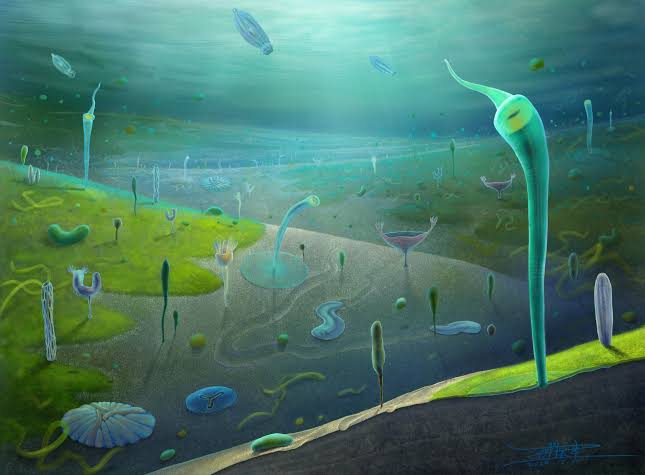
Paleontologists unearthed about 700 fossils of small soft-bodied animals that lived roughly 546 to 539 million years ago during the Ediacaran Period, showing a dramatic transformation in early animal life. Many are unusual and barely recognisable as animals.
The fossils, discovered in China’s Yunnan province, are known as the Jiangchuan Biota. Preserved as carbonaceous films, they retain anatomical details such as guts, feeding, and locomotion structures. The discovery shows rapid diversification of animal life already underway during the Ediacaran, predating the evolutionary burst of the Cambrian Period.
Researchers found evidence of animal groups previously known only from about 520 million years ago existing more than 20 million years earlier in the late Ediacaran.
During this time, Earth was emerging from a global icehouse state known as Snowball Earth, with continents in different positions and lower oxygen levels. Early animal life was beginning to appear in the seas.
Among the fossils are some of the earliest known deuterostomes — the group that includes vertebrates — along with bilaterian animals, which have bodies divisible into equal halves, a key evolutionary development.
The fossils include creatures with U-shaped bodies attached to the seafloor with tentacles for feeding, as well as a worm-like organism dubbed the “bugle worm,” featuring a body anchored to the seafloor and a reversible proboscis.
The findings highlight a transitional phase in evolution and suggest there is still much to learn about the shift from the Ediacaran to the Cambrian and the early radiation of animal life.