


















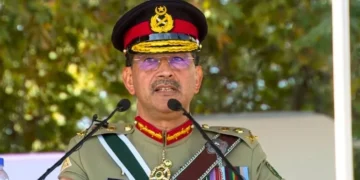





















































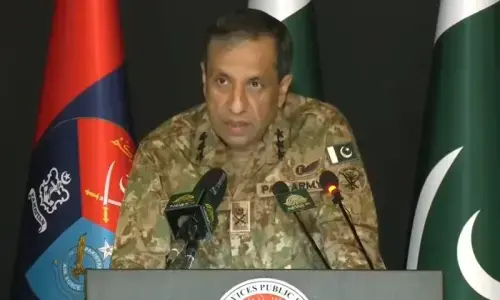
News Desk (MNN); Director General of Inter-Services Public Relations (ISPR), Ahmed Sharif Chaudhry, on Wednesday stated that a recent Pakistani strike in Kabul was aimed at an ammunition storage facility, rejecting claims of civilian targeting and emphasising that the operation was precise and intelligence-based.

Speaking on the Geo News programme “Capital Talk,” the military spokesperson explained that Operation Ghazab lil-Haq, launched last month, is not an isolated campaign but part of Pakistan’s broader and ongoing war against terrorism.
He said this conflict had been “imposed” on Pakistan by militant groups and their backers, alleging that India was involved in sponsoring terrorism and using Afghan territory as a base of operations.
The DG ISPR highlighted several incidents to support his claims, including a suicide bombing in Islamabad’s Tarlai area, where worshippers were killed during Friday prayers. He said the attacker had come from Afghanistan.
He also referred to the Wana Cadet College attack, stating that all five militants killed in that incident were Afghan nationals. “Our civilians, police, and security personnel are being targeted, and these attackers are coming from across the border,” he said.
According to Lt Gen Chaudhry, key militant leaders such as Noor Wali Mehsud, Bashir Zeb, and Gul Bahadur are being sheltered inside Afghanistan.
He stressed that Pakistan has not initiated any conflict with Afghanistan but is responding to a war forced upon it. “We have no issues with the Afghan people; they themselves are suffering under the Afghan Taliban regime,” he added.
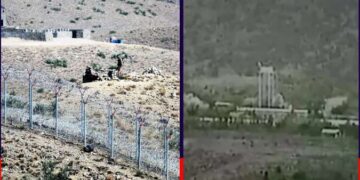
Explaining the background of the current escalation, the DG ISPR said Pakistan had targeted militant hideouts near the Pak-Afghan border last month, specifically those linked to the banned Tehreek-i-Taliban Pakistan (TTP).
In retaliation, he claimed, Afghan Taliban forces launched attacks on 53 locations inside Pakistan, including border posts. “They initiated hostilities, and we responded accordingly,” he said.
He further revealed that Pakistan carried out airstrikes on 81 locations inside Afghanistan, targeting what he described as “terrorist support infrastructure,” including command centres, ammunition depots, storage facilities, and logistical hubs used to facilitate attacks on Pakistan.
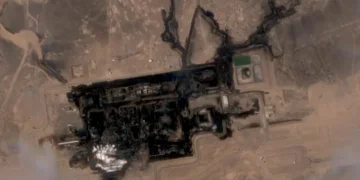
Discussing the Kabul strike in detail, the military spokesperson said intelligence reports confirmed the presence of an ammunition and drone storage facility at the site.
“When such a site is hit, secondary explosions occur due to stored munitions. That is exactly what happened,” he said, adding that visuals of the strike showed fireballs and prolonged detonations.
He claimed that old weaponry, including Scud missiles, drones, and ammunition stockpiles, were destroyed in the attack. “The evidence, including video footage and aftermath visuals, clearly shows that an ammunition depot was targeted,” he added.
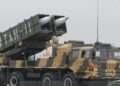
Lt Gen Chaudhry emphasised that Pakistan used precision-guided munitions (PGMs) during the strike to minimise collateral damage. “We are deliberately using advanced, targeted weapons instead of general-purpose bombs to ensure accuracy and avoid civilian harm,” he said.
Rejecting allegations by Afghan authorities regarding civilian casualties, he questioned the credibility of their claims. “Their statements lack credibility. They frequently make claims and later retract them,” he remarked.
He also dismissed assertions that a drug rehabilitation centre had been hit, arguing that it was implausible to construct such a facility adjacent to an ammunition depot.
“Would any country build a hospital or rehabilitation centre next to a weapons storage site?” he asked, suggesting that the structure was likely being used for military or militant purposes.
According to him, the site may have been used to house or train militants, including suicide bombers, or to accommodate Afghan Taliban fighters.
The DG ISPR further alleged that the Afghan Taliban regime is providing shelter to militants within state infrastructure and maintaining links with international terrorist networks.
He claimed that the group remains connected with figures such as Hamza bin Laden, and reiterated accusations that Afghanistan under Taliban control is being used to support militancy.
Referring to Osama bin Laden, who was killed in a US raid in Abbottabad in 2011, he said global concerns about terrorist networks in the region remain valid.
He reiterated that Pakistan’s actions are defensive in nature and part of a broader counterterrorism effort. “This war has been imposed on us, and we will continue to respond to protect our citizens,” he said.
In addition, Lt Gen Chaudhry claimed that Indian-made drones had recently been used by Afghan Taliban elements in attacks against Pakistan, further reinforcing allegations of external support for militancy.