





















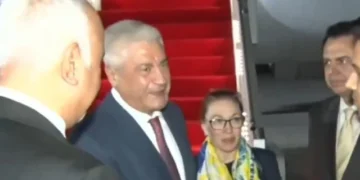


















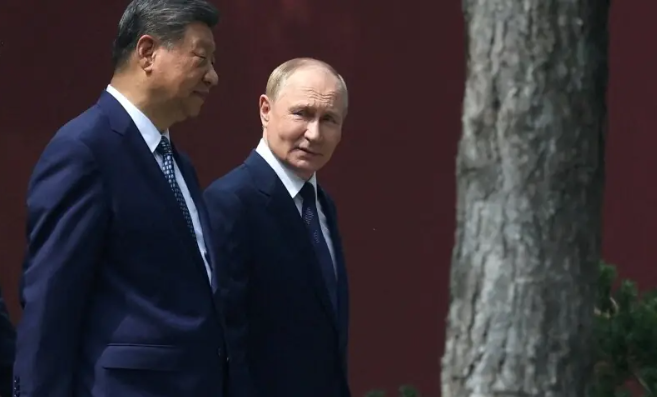
Russian President Vladimir Putin arrived in Beijing on Tuesday for talks with Chinese President Xi Jinping, aiming to highlight the strength of China-Russia relations just days after US President Donald Trump visited China.

Confirmation of Putin’s trip came shortly after Trump concluded his visit on Friday — the first by a US president to China in nearly a decade — which focused on easing tensions and stabilising relations between Washington and Beijing.
According to a Kremlin statement, Putin and Xi are expected to discuss ways to “further strengthen” their strategic partnership and “exchange views on key international and regional issues”.
Relations between Moscow and Beijing have grown significantly closer since Russia launched its invasion of Ukraine in 2022, with Putin travelling to China annually ever since.
Ahead of the visit, both leaders exchanged “congratulatory letters” on Sunday marking 30 years of strategic partnership between their countries.
Chinese state media quoted Xi as saying cooperation between the two nations had “continuously deepened and solidified”.
In a video message addressed to the Chinese public on Tuesday, Putin said ties between the countries had reached “a truly unprecedented level” and noted that “trade between Russia and China continues to grow”.
“The close strategic relationship between Russia and China plays a major, stabilising role globally. Without allying against anyone, we seek peace and universal prosperity,” Putin added, without referring to any specific country.
The two leaders are also expected to sign a joint declaration following their talks.
‘Dear, old friends’
During Putin’s previous visit to Beijing in September 2025, Xi publicly welcomed him as an “old friend” — a phrase he notably did not use for Trump during last week’s visit.
Putin, who has frequently referred to Xi as his “dear friend”, is expected to use the visit to signal that relations between Moscow and Beijing remain unaffected by renewed US-China engagement.
Patricia Kim of the Brookings Institution said the visit may not include the same grand gestures seen during Trump’s trip because “the Xi-Putin relationship does not require that kind of performative reassurance”.
She added that both countries view their partnership as “structurally stronger and more stable” than China’s relationship with the United States.
Although Beijing has repeatedly called for negotiations to end the Ukraine war, now in its fifth year, it has avoided criticising Russia’s military actions and continues to present itself as neutral.
Trump and Xi also discussed Ukraine during last week’s meeting, though no major breakthrough emerged from the talks.
“Xi will almost certainly brief Putin on his summit with Trump,” Kim said.
She added that the absence of significant outcomes from the Xi-Trump meeting likely reassured Moscow that Beijing had not reached any understanding with Washington that could damage Russian interests.
Energy and regional concerns
Putin is also expected to seek stronger Chinese support for Russian energy exports after Trump claimed during his visit that China had agreed to buy American oil to meet its “insatiable” energy demands.
With Russia heavily dependent on energy exports to China amid the Ukraine conflict, analysts believe Moscow is eager to preserve and expand that economic cooperation.
Asia Society analyst Lyle Morris said, “Putin does not want to lose that support”.
He added that Putin would likely seek clarity from Xi regarding China’s future role in the Middle East after Trump indicated Beijing could play a larger part in the region.
However, analysts suggest Russia and China may not entirely align regarding the US-Israeli conflict involving Iran.
James Char of Nanyang Technological University noted that China depends on stable international shipping routes and would prefer tensions around the Strait of Hormuz to ease quickly to protect economic activity.
Meanwhile, Moscow may view the situation differently because higher energy prices and relaxed sanctions on Russian exports have economically benefited Russia.
Following a meeting with Xi in April, Russian Foreign Minister Sergei Lavrov said Russia could “compensate” for China’s energy shortages as conflict in the Middle East disrupts global supplies.
Joseph Webster of the Atlantic Council said expanded energy cooperation would likely feature prominently in the meeting as China seeks increased Russian oil supplies.
He added that Moscow may also prefer redirecting more energy exports toward Asia as Ukraine continues targeting Russian energy infrastructure.