





















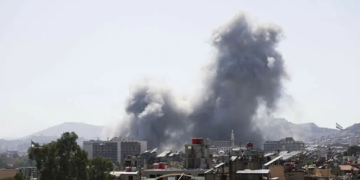






































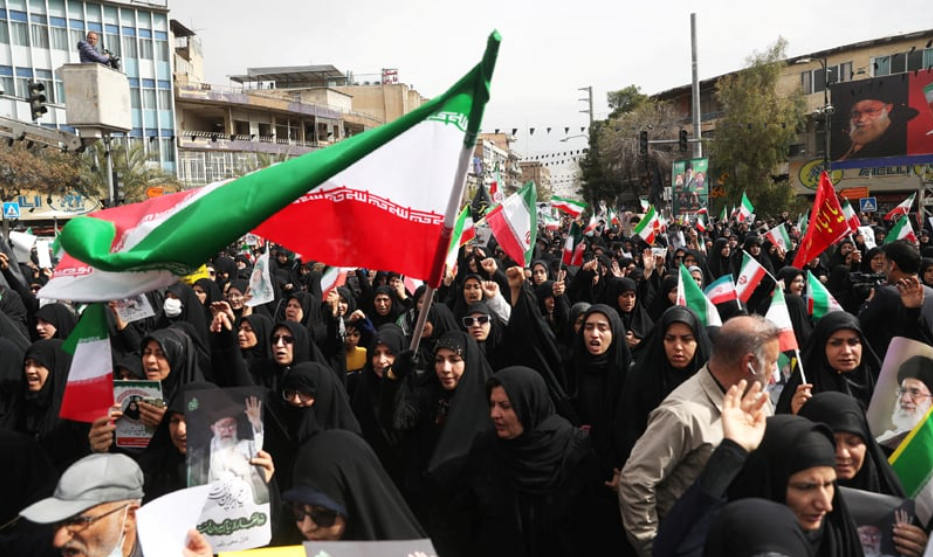
TEHRAN: The United States and Israel are facing accusations of committing “war crimes” in Iran after a series of airstrikes reportedly killed hundreds of civilians and caused widespread damage to non-military infrastructure, including a desalination plant, emergency facilities, hospitals, and schools.

The allegations intensified following a deadly strike on Sunday morning in Najafabad, where local authorities said 19 civilians were killed.
Akbar Salehi, deputy for security and law enforcement in the Isfahan Governorate, stated that fighter jets he associated with the US and Israel struck a local traffic and driving services office. According to him, a second missile hit the same location minutes later while residents and emergency responders were attempting to assist the injured.
The Iranian Red Crescent Society said it had formally requested the International Criminal Court to launch a war crimes investigation. The organisation submitted data claiming that more than 6,600 civilian structures have been damaged or destroyed since the start of the conflict.
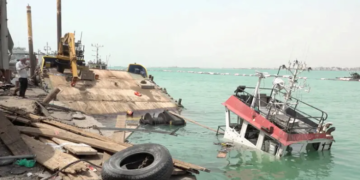
In another attack affecting critical public services, a US strike targeted a freshwater desalination plant on Qeshm Island in southern Iran, disrupting water supplies to 30 villages.
Iranian Foreign Minister Abbas Aragchi condemned the incident as a “blatant and desperate crime” directed at essential civilian infrastructure.
“The US committed a blatant and desperate crime by attacking a freshwater desalination plant on Qeshm Island,” Araqchi wrote in a post on X.
“Attacking Iran’s infrastructure is a dangerous move with grave consequences”.
‘Double-tap’ at Zibashahr Park
A separate investigation by New Lines Magazine into a March 5 airstrike on Zibashahr Park in Shiraz has raised further questions about targeting decisions.
The report, based on satellite imagery and verified video evidence, found that the strike destroyed a base for emergency medical responders located inside the park, killing about 20 people and injuring 30 others. Among those killed were three medical workers.
Satellite images indicated that a nearby military installation including a faculty linked to an Islamic Revolutionary Guard Corps unit located about 200 metres away remained undamaged.
“It’s a bit inexplicable. The only identifiable military target wasn’t struck,” Adil Haque, a professor specialising in the law of armed conflict at Rutgers University, told the publication.
Wes Bryant, a former Pentagon targeting chief, reviewed the findings and suggested that the precision of modern weapons makes such a miss unlikely.
“With those precision munitions, it’s very rare to have a miss,” Bryant said. “I’ve literally never seen one that has missed to the point of going 200 meters across the road.”
Civilian infrastructure damaged
Investigations by international media outlets and humanitarian organisations have documented damage to numerous civilian facilities.
A forensic review by CNN using satellite imagery and verified footage reported that US and Israeli strikes on military and police targets in Tehran also caused damage to at least three nearby hospitals.
Dr Pir Hossein Kolivand, president of the Iranian Red Crescent Society, provided detailed figures in a letter sent to the International Criminal Court. According to his assessment, 7,943 residential units, 1,617 commercial properties, 32 pharmaceutical and medical facilities, and 65 schools have been damaged.
In another incident, a missile struck a sports hall in Lamerd in Fars Province, killing 18 people mostly teenage girls attending a training session according to Iranian media reports.
Separately, Switzerland’s Federal Department of Foreign Affairs issued a statement expressing serious concern over the ongoing strikes in Iran. The Swiss government urged “full compliance with international law and urges de-escalation”, while updating travel advisories for its citizens in the region.