












































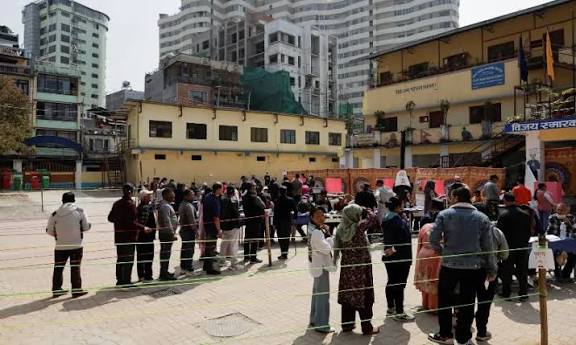
KATHMANDU: Nepal voted on Thursday for a new parliament in a high-stakes contest between the political old guard and a rising youth movement, six months after deadly anti-corruption protests forced the government from power.

Long queues formed early in the capital Kathmandu and in the eastern town of Jhapa, where two major prime ministerial hopefuls are contesting seats.“I came here early to vote. We must exercise our rights. Nepalis have been waiting for change for so long,” said Nilanta Shakya, 60, outside a polling station in Kathmandu.
Nearly 19 million voters are choosing a new parliament to replace the interim administration formed after the September 2025 uprising in which at least 77 people were killed and government buildings were set on fire. The youth-led protests began over a temporary social media ban but quickly expanded into broader demonstrations against corruption and economic hardship.
Interim Prime Minister Sushila Karki assured citizens they could vote without fear, as thousands of soldiers and police were deployed to guard polling centres. Polling closes at 5pm local time. The election is considered one of the most significant in Nepal since the end of the Nepalese Civil War. Younger candidates promising economic reforms are challenging veteran politicians who have dominated politics for decades.
Among the key contenders is former prime minister Khadga Prasad Sharma Oli, who is seeking a return to power. He faces a strong challenge in Jhapa from Balendra Shah, the former mayor of Kathmandu and a prominent youth figure from the Rastriya Swatantra Party.
Another leading contender is Gagan Thapa, the new head of the Nepali Congress, who has pledged to end the dominance of long-standing political elites.
More than 3,400 candidates are contesting 165 seats through direct elections in the 275-member House of Representatives, with another 110 seats allocated through proportional representation.Initial results are expected within 24 hours, though final results and coalition negotiations may take longer, as analysts say no single party is likely to secure an outright majority.