




































































GAZA: More than $71 billion will be required over the next ten years to rebuild the devastated Gaza Strip, according to a joint assessment by the United Nations and the European Union released on Monday.

The report, titled the Gaza Rapid Damage and Needs Assessment (RDNA) and developed in coordination with the World Bank, highlights the unprecedented destruction caused by over two years of war in the Palestinian territory. It describes the situation as a “catastrophic humanitarian crisis” marked by massive loss of life and widespread infrastructure collapse. The assessment estimates total recovery and reconstruction costs at $71.4 billion, with $26.3 billion urgently needed within the first 18 months. These initial funds would focus on restoring essential services, rebuilding critical infrastructure, and supporting economic recovery.
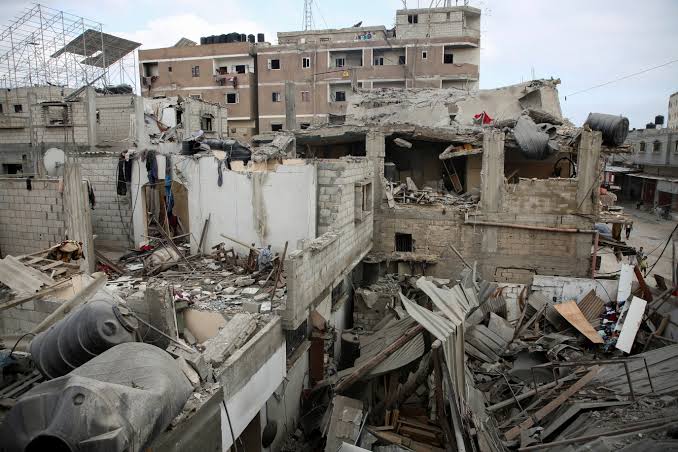
According to the report, physical damage to infrastructure amounts to $35.2 billion, while economic and social losses are estimated at $22.7 billion. Large parts of Gaza — including schools, hospitals, and other civilian facilities — have been reduced to rubble following Israel’s military campaign launched after the October 7, 2023 attack by Hamas. The conflict began with the Hamas attack on Israel, which killed 1,221 people, mostly civilians, and saw 251 hostages taken. In response, Israel’s military offensive has killed more than 72,000 people in Gaza, according to the territory’s health ministry, whose figures are considered reliable by the UN.
The RDNA outlines the immense scale of destruction: nearly 371,888 housing units have been damaged or destroyed, more than half of Gaza’s hospitals are no longer functional, and almost all schools have been affected. Around 1.9 million people — nearly the entire population — have been displaced, many multiple times, while over 60 percent have lost their homes. The report also notes a severe economic collapse, with Gaza’s economy shrinking by 84 percent. Human development indicators have been pushed back by an estimated 77 years, reflecting deep setbacks in living conditions, income, food security, and social inclusion.
Despite a fragile ceasefire in place since October 2025, the UN and EU warn that recovery efforts must proceed alongside ongoing humanitarian assistance. They stress that reconstruction must be Palestinian-led and aligned with governance by the Palestinian Authority, as outlined in a recent UN Security Council resolution.
The report further emphasizes that successful rebuilding depends on key conditions, including a sustained ceasefire, adequate security, unrestricted humanitarian access, and the free movement of people, goods, and construction materials between Gaza and the West Bank.
Without these conditions, the report warns, meaningful recovery and reconstruction will not be possible.