































































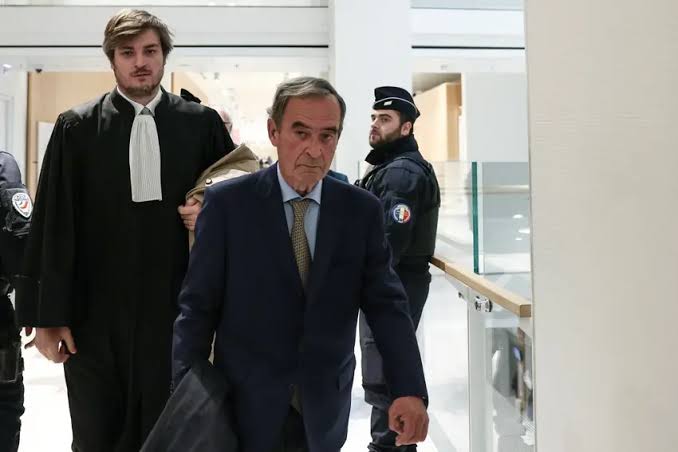
PARIS: A French court has sentenced former CEO Bruno Lafont to six years in prison and fined cement giant Lafarge over $1.3 million for financing militant groups, including the Islamic State, to sustain its operations in war-torn Syria.

The ruling follows a landmark 2022 case in the United States, where Lafarge pleaded guilty to providing material support to designated terrorist organisations and agreed to pay a $778 million fine — the first time a corporation faced such charges. The Paris court found that Lafarge, now part of Holcim, paid nearly 5.6 million euros between 2013 and 2014 through its Syrian subsidiary to jihadist groups and intermediaries. These payments enabled the company to keep its cement plant operational in northern Syria during the height of the conflict.
Presiding judge Isabelle Prevost-Desprez stated that the company’s actions played a significant role in strengthening extremist groups, particularly IS, by contributing to their financial resources. She emphasized that the undisclosed payments reflected the “extreme gravity” of the offence and amounted to a “genuine commercial partnership” with the militant group.
Lafarge had completed construction of its $680 million plant in Jalabiya in 2010, just before the outbreak of the Syrian Civil War. While many multinational firms withdrew from the country in 2012, Lafarge continued operations, evacuating only expatriate staff while local employees remained until IS seized the facility in 2014.
During this period, the company paid intermediaries linked to IS and other armed factions, including Jabhat al-Nusra, to secure raw materials and ensure safe passage for its goods and personnel.
The court also convicted eight former employees on charges of financing terrorism, handing down prison sentences ranging from 18 months to seven years. Syrian intermediary Firas Tlass was sentenced in absentia to seven years, while former deputy managing director Christian Herrault received a five-year sentence. Prosecutors argued that Lafarge’s leadership prioritized profit over ethics and security, describing the decision to maintain operations as “staggering in its cynicism.”
According to France’s national counterterrorism prosecutor’s office, the company funded terrorist organisations with a “single aim: profit.” Holcim, which acquired Lafarge in 2015, has maintained that it had no knowledge of the Syria-related dealings. Meanwhile, a separate legal case investigating allegations of complicity in crimes against humanity is still ongoing.
The so-called “caliphate” declared by the Islamic State was ultimately defeated in 2019 by Kurdish-led Syrian forces backed by US airpower. Investigations into Lafarge’s activities began in France in 2017 following media reports and legal complaints alleging breaches of sanctions and financing of terrorism.