

































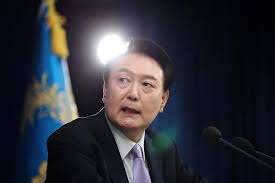
SEOUL, (Reuters): A South Korean court on Friday sentenced former President Yoon Suk Yeol to five years in prison for obstructing authorities’ attempts to arrest him following his failed effort to impose martial law in December 2024.

The Seoul Central District Court found Yoon guilty of ordering the presidential security service to block investigators from executing a court-approved arrest warrant issued as part of a probe into his martial law declaration. The court ruled that the warrant had been lawfully issued and that Yoon unlawfully interfered with its enforcement.
In televised proceedings, the court also convicted Yoon of additional charges, including fabricating official documents and failing to follow the legal procedures required to declare martial law. The verdict marks the first ruling in a series of criminal cases stemming from Yoon’s short-lived attempt to impose emergency rule.
“The defendant abused his enormous influence as president to prevent the execution of legitimate warrants through officials from the Security Service,” the presiding judge said. “This effectively privatized state officials loyal to the Republic of Korea for his personal safety and personal gain.”
Speaking outside the courthouse, Yoon’s lawyer Yoo Jung-hwa said the former president would appeal the decision, describing the ruling as politicised.
Yoon could face even harsher consequences in a separate trial, where he is charged with masterminding an insurrection by declaring martial law without sufficient legal grounds—an offence that carries the death penalty under South Korean law.
Yoon has consistently defended his actions, arguing that the declaration of martial law fell within his presidential authority and was intended to warn against what he described as obstruction of governance by opposition parties. He also denied the obstruction charges addressed in Friday’s ruling.
Prosecutors had sought up to 10 years in prison for the obstruction offences, which stemmed from Yoon barricading himself inside his residential compound in January 2025 and ordering the security service to block investigators. He was ultimately arrested during a second operation involving more than 3,000 police officers, marking the first arrest of a sitting president in South Korea’s history.
Within hours of Yoon’s surprise martial law announcement, parliament—backed by some lawmakers from his own conservative party—voted to overturn the decree. Lawmakers later impeached him, suspending his presidential powers. In April 2025, the Constitutional Court formally removed Yoon from office, ruling that he had violated his constitutional duties.
Although Yoon’s martial law declaration lasted only about six hours, it sent shockwaves through South Korea, Asia’s fourth-largest economy, a key U.S. security ally, and a country long regarded as one of the world’s most resilient democracies.