






































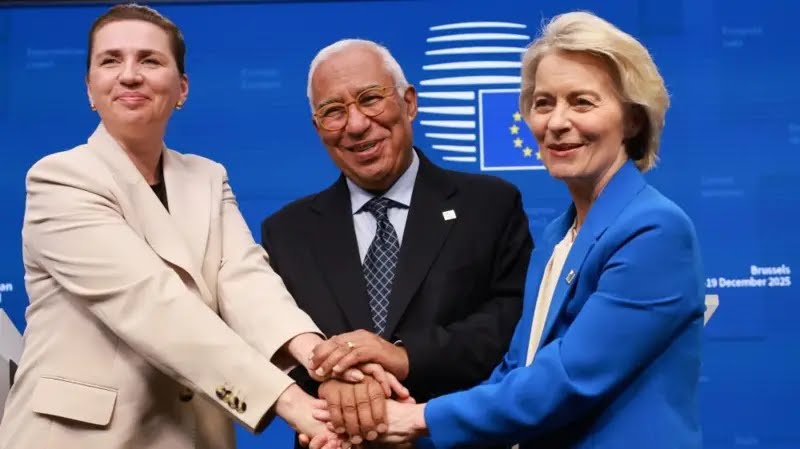
European Union leaders have agreed to provide Ukraine with a €90bn (£79bn; $105bn) loan over the next two years, after failing to reach consensus on using frozen Russian state assets to fund Kyiv’s needs. The late-night deal comes amid warnings that Ukraine could run out of cash by next spring. European Council President António Costa said the loan would only be repaid once Russia pays reparations for its full-scale invasion. “We committed, we delivered,” he said, while Ukrainian Prime Minister Yuliya Svyrydenko welcomed the agreement as “a decisive step for economic resilience”.

EU leaders had considered using around €210bn in Russian assets frozen within the bloc, most of them held in Belgium. However, the proposal collapsed after Belgium’s prime minister refused to support it, citing fears of Russian retaliation and legal risks.
Interest generated from the frozen funds is already being channelled to Ukraine, but Russia has launched legal action against Brussels-based clearing house Euroclear, which holds most of the assets.
Russian President Vladimir Putin accused the EU of attempting “robbery”, while Kirill Dmitriev, Moscow’s envoy in talks with the United States, described the failure to seize the assets as a “fatal blow”.
Belgium’s Prime Minister Bart De Wever rejected that assessment, calling the compromise a “victory for Ukraine, a victory for financial stability and a victory for the EU”, arguing it avoided “chaos and division”.Ukraine is estimated to need about €137bn over the next two years to fund both its military effort and public services. The EU loan is intended to cover roughly two-thirds of that amount.
The €90bn will be raised on capital markets and backed by unused headroom in the EU budget—the gap between member states’ annual contributions and the maximum spending allowed.Ukrainian President Volodymyr Zelensky thanked European leaders for what he called “significant support that truly strengthens our resilience”.
Germany’s Friedrich Merz, a strong advocate of using frozen Russian assets, acknowledged the compromise as a setback but said it still sent “a clear signal from Europe to Putin”.Not all member states backed the deal. Hungary and Slovakia refused to support the compromise, while the Czech Republic declined to guarantee the loan. Hungarian Prime Minister Viktor Orban argued that further funding only prolongs the war, saying Ukraine would never be able to repay the loan.
Slovakia’s Robert Fico took a similar stance, while Czech Prime Minister Andrej Babis said he agreed to the summit conclusions only on the condition that Prague would not guarantee the borrowing. The agreement was reached as US-led talks with Russia continued, spearheaded by President Donald Trump, who has said a solution to the conflict is closer than ever.
Dmitriev is expected to meet Trump envoys Steve Witkoff and Jared Kushner in Miami, while a Ukrainian delegation is also due in the city for parallel talks with US officials. European allies are meanwhile advancing proposals that include a multinational force as part of what they describe as “robust security guarantees” for Ukraine. Putin has criticised Europe’s approach, claiming he has already made compromises in discussions with Trump and insisting that responsibility now lies with Kyiv and its Western backers.
His demands, reflected in an initial US peace plan, include Ukraine ceding significant territory. Polish Prime Minister Donald Tusk said the EU loan strengthened Ukraine’s hand in negotiations, increasing the chances of a peace deal “not on Russian terms”. French President Emmanuel Macron said Europe should consider re-engaging with Putin in the coming weeks, arguing that dialogue was in the interest of both Europeans and Ukrainians.