























































WASHINGTON; In a landmark diplomatic development, the United States announced on Monday the suspension of most Caesar Act sanctions on Syria for 180 days, with exceptions only for certain transactions involving Russia and Iran.

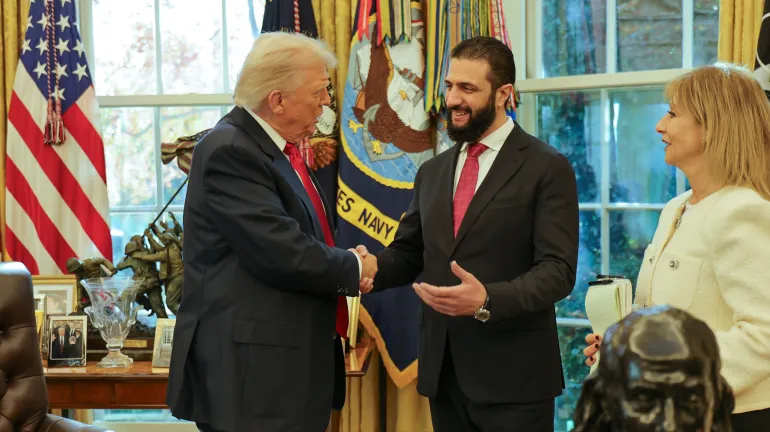
The move follows talks between Syrian President Ahmed al-Sharaa and US President Donald Trump at the White House, marking the first official visit by a Syrian leader to Washington, DC, since Syria’s independence in 1946.
The meeting comes approximately six months after the two leaders first met in Saudi Arabia and just days after the US removed al-Sharaa from a “terrorist” sanctions list. Al-Sharaa assumed power last December after leading a rapid opposition campaign that ousted longtime President Bashar al-Assad.
During the Oval Office meeting, Trump expressed confidence in al-Sharaa’s leadership, stating, “We want to see Syria become a country that’s very successful, and we think this leader can do it.” He highlighted positive relations with Turkey and ongoing collaboration with Israel regarding Syria.
A significant outcome of the talks was the agreement to integrate the Kurdish-led Syrian Democratic Forces into the Syrian army, a move aimed at unifying institutions and strengthening national security. The US also reiterated its support for a potential security agreement between Syria and Israel.
The suspension of sanctions allows the transfer of most civilian-use US-origin goods, software, and technology without a license, but sanctions remain in place for Syria’s worst offenders, including Bashar al-Assad, human rights violators, captagon traffickers, and other destabilizing actors. Transactions involving Russian and Iranian entities remain restricted.
Al-Sharaa and Trump discussed bilateral relations, regional and international issues, and ways to strengthen ties. Syrian Foreign Minister Asaad Hassan al-Shaibani and US Secretary of State Marco Rubio were also present.
Syria, with a population exceeding 25 million, has been heavily impacted by conflict since 2011, displacing over six million citizens. About four million Syrian refugees are currently registered abroad, with Turkey hosting roughly 2.4 million, Lebanon 636,000, and Jordan over 436,400.
The US Treasury described the suspension as a step to “give Syria a chance at greatness,” encouraging reconstruction, stability, and accountability while denying resources to harmful actors. Al-Sharaa, however, had hoped for a permanent lifting of the sanctions, which only Congress can authorize. The current move is largely symbolic but allows Syria some economic relief.
The suspension replaces the May 23 waiver of Caesar Act sanctions and reflects a cautious yet historic thaw in US-Syria relations amid ongoing geopolitical complexities.