












































Web Desk (MNN); As U.S. Secretary of State Marco Rubio prepares to meet his Danish and Greenlandic counterparts next week, Denmark finds itself defending a territory that has been steadily drifting away from Copenhagen for decades and edging closer to full independence.

Greenland has pursued greater self-rule since 1979, and while U.S. President Donald Trump’s threats to seize the Arctic island have prompted strong expressions of European solidarity with Denmark, the crisis has revealed an uncomfortable contradiction. Denmark is mobilising diplomatic and political support to protect a territory whose population increasingly seeks independence, while Greenland’s largest opposition party has even suggested bypassing Copenhagen to negotiate directly with Washington.
“Denmark risks spending enormous diplomatic capital to hold on to Greenland, only to see it walk away later,” said Mikkel Vedby Rasmussen, professor of political science at the University of Copenhagen.
Strategic importance of Greenland
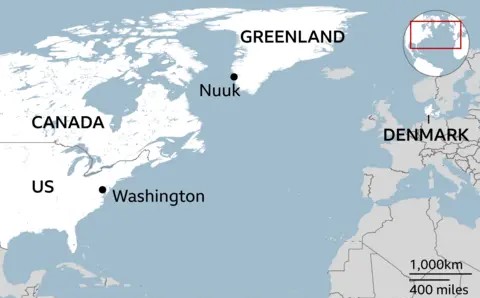
Greenland occupies a pivotal position between Europe and North America and hosts key infrastructure for the United States’ ballistic missile defence system. For Denmark, losing Greenland would significantly weaken its geopolitical relevance in the Arctic region.
However, despite Copenhagen’s efforts, Greenland could still choose independence or pursue a separate arrangement with the United States, leaving Denmark with little to show for years of political and financial investment.
The implications extend beyond Denmark. European allies have lined up behind Copenhagen not only out of solidarity but also out of concern that conceding Greenland could set a precedent encouraging stronger powers to make territorial claims against smaller states, undermining the post-World War II international order.
Denmark’s foreign ministry declined direct comment, referring instead to joint remarks made in December by Danish Prime Minister Mette Frederiksen and Greenlandic Prime Minister Jens-Frederik Nielsen, who stressed that borders and sovereignty are grounded in international law and that Greenland belongs to its people.
Frederiksen recently warned that any U.S. attack on a NATO member would fundamentally disrupt the alliance and its collective security framework.
The ‘Greenland card’ and shifting realities
While the Trump administration insists that all options remain on the table — including purchasing Greenland or using force — Danish analysts note that domestic debate over whether retaining Greenland is worth the cost has been overshadowed by outrage over Washington’s rhetoric.
During the Cold War, Greenland’s strategic value gave Denmark disproportionate influence in Washington, a dynamic often referred to as the “Greenland card,” allowing Copenhagen to maintain relatively low defence spending. However, Greenland’s desire for independence has been growing since autonomy arrangements were expanded in 1979 and formally recognised in a 2009 agreement granting the right to independence through a referendum.
Although all Greenlandic political parties support independence in principle, they differ on timing and method. Trump’s pressure has accelerated this debate, forcing Denmark to commit resources to a relationship whose long-term future is uncertain.
The economic burden
Denmark provides Greenland with an annual block grant of around 4.3 billion Danish crowns, while also covering defence, policing and judicial costs, bringing total yearly spending close to one billion dollars. Greenland’s economy remains fragile, with minimal growth and a significant annual financing gap.
Despite these challenges, some Danish analysts argue the relationship cannot be reduced to financial calculations, citing shared history, cultural ties and moral obligations.
A delicate balancing act
Prime Minister Frederiksen faces a difficult task: maintaining Denmark’s diplomatic credibility and unity with allies while avoiding damage to relations with the United States at a time of rising security threats from Russia. With elections approaching, Greenland has yet to become a central political issue at home, but public debate over Denmark’s future role in the Arctic is growing.