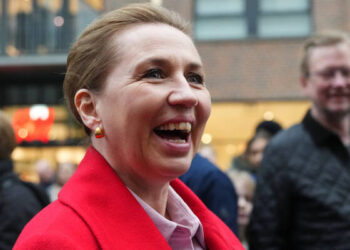










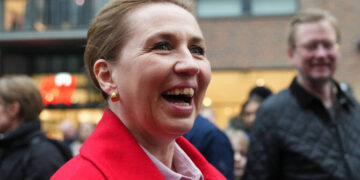























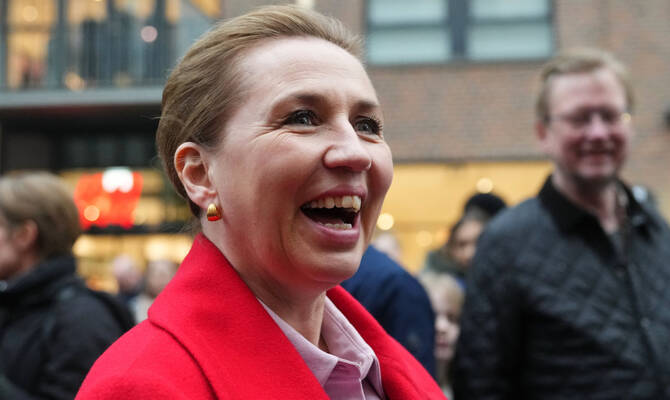
Copenhagen, Denmark: Denmark’s Social Democrats, led by Prime Minister Mette Frederiksen, secured the most seats in Tuesday’s general election but recorded their weakest result in over a century, leaving the left-wing bloc without a parliamentary majority.

With all votes counted in metropolitan Denmark, the left bloc won 84 of 179 seats, while the right captured 77, short of the 90 needed for a majority. Which bloc will ultimately form a government remains uncertain. The centrist Moderate Party, led by Foreign Minister Lars Løkke Rasmussen, emerged as kingmaker with 14 seats, setting the stage for complex coalition negotiations.
Rasmussen expressed support for a cross-bloc alliance, similar to Frederiksen’s historic left-right government in office since 2022.“We must not be divided. We must not be red. We must not be blue. We have to work together,” Rasmussen told supporters. However, Liberal Party leader Troels Lund Poulsen dismissed the possibility of joining a Social Democrat-led government, signaling either a center-right administration or opposition.
Far-Right Gains
Frederiksen, in office since 2019, has been praised for resisting US President Donald Trump’s repeated attempts to annex Greenland. Despite this, the Social Democrats captured only 21.8 percent of votes, down from 27.5 percent in 2022, marking their lowest share since 1903.
Meanwhile, the Green Left surged to become the second-largest left-wing party. Leader Pia Olsen Dyhr emphasized priorities like welfare and the green transition, saying her party would only join government if these goals were addressed. The anti-immigration Danish People’s Party tripled its share to 9.1 percent, with leader Morten Messerschmidt highlighting growing far-right momentum across Europe, referencing France, Hungary, the Netherlands, and the UK.
Greenland and the Faroe Islands
Denmark’s parliament includes four seats from autonomous territories—two from Greenland and two from the Faroe Islands. Greenlandic votes are still pending. Greenlandic Prime Minister Jens-Frederik Nielsen described the election as “the most important in history” for the territory, citing concerns over foreign influence and sovereignty.
While Greenlandic parties broadly support independence, they differ on timing. Domestic issues, including inflation, welfare, agricultural pollution, and immigration, dominated the Danish campaign rather than Arctic geopolitics. Frederiksen has also tightened migration policies, including controversial proposals restricting non-essential healthcare for certain foreign nationals, aiming to curb far-right support.