































































Islamabad: Accountability Lab Pakistan (ALP) hosted a dialogue on Inclusive Governance and Youth Engagement at Rawalpindi Women University (RWU), bringing together students, youth leaders, and senior public sector professionals to discuss the role of young people in shaping accountable and inclusive governance.

Organized under the Integrity Innovation Lab initiative and funded by the National Endowment for Democracy (NED), the dialogue aimed to amplify youth voices and create direct engagement between young citizens and public decision-makers. The session featured a panel discussion followed by an interactive question-and-answer segment, allowing students to share their experiences, concerns, and expectations around governance and civic participation.
The discussion focused on how youth can contribute more actively to policy processes, promote integrity in public institutions, and support accountable governance. Reflecting the Integrity Innovation Lab’s citizen-centered approach, the dialogue encouraged open conversation, active listening, and co-creation between institutions and young people. Panelists represented the development, education, and government sectors and engaged directly with students throughout the session.
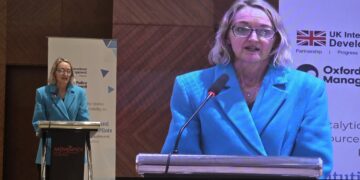
During the discussion, Javeria Masood, a development practitioner from UNDP, highlighted that young people often remain excluded due to structural barriers such as limited awareness of rights and responsibilities, lack of skills, and unemployment. Recalling recent crises including the COVID-19 pandemic and floods, she emphasized the critical role youth played in emergency responses and stressed the need to create enabling environments by simplifying business registration processes and supporting entrepreneurship and startup initiatives.
Ghulam Ali Mallah, Executive Director of the Inter Board Coordination Commission (IBCC), pointed to the gap between rhetoric and action on inclusivity, noting that youth are frequently treated as beneficiaries rather than active partners. He underlined the need to update education systems and policies to ensure flexibility and relevance, promote critical thinking, encourage ethical use of artificial intelligence and information technology, and improve accessibility and transparency in policymaking.
Addressing the participants, Mukhtar Paras, Joint Secretary at the Cabinet Division, emphasized decentralization as a key pillar of inclusive governance. He noted that inclusive systems contribute to stability and sustainable growth, while questioning whether women, who constitute more than half the population, and youth, who make up over 60 percent, are meaningfully represented in policy processes. He called for stronger local governance, greater youth participation in political parties and parliamentary processes, and embedding inclusivity within governance structures.
Panelists collectively stressed the importance of meaningful youth engagement and transparent governance practices, encouraging students to remain informed, proactive, and engaged in civic spaces. The dialogue concluded with remarks by Dr. Baqir Husnain, Director of Quality Enhancement and External Linkages at RWU, who reaffirmed the university’s commitment to strengthening institutional linkages with youth and promoting transparent and accountable governance in Pakistan.