








































































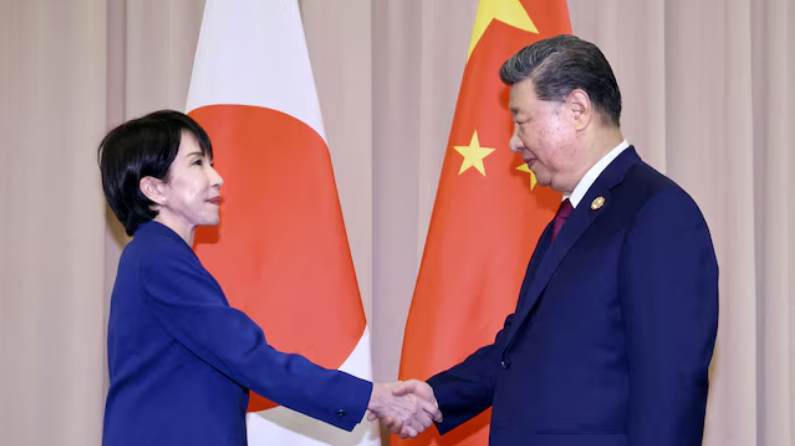
TOKYO (Reuters): Japanese Prime Minister Sanae Takaichi’s thumping election win has blunted domestic opposition to her hawkish security agenda, encouraging plans to press ahead with a defence expansion that China has condemned as a return to militarism.

As the scale of her government’s historic victory became clear on Sunday capturing 352 of the 465 seats in the lower house Takaichi said she would “work flat out to deliver” an agenda that includes building a military strong enough to deter Chinese threats to its islands, including those close to Taiwan.
In November, Takaichi touched off a diplomatic storm with Beijing by suggesting Japan could respond militarily to any Chinese attack on the democratically governed island if it also threatened Japanese territory.
STANDING UP TO CHINA
“I expect to see Japan very forward-leaning on defence policy, such as her statements on a Taiwan contingency,” said Kevin Maher, a former U.S. diplomat now with NMV Consulting in Washington. “One impact could be that President Xi Jinping comes to understand her strong stance,” he added.
China responded furiously to Takaichi’s Taiwan comment, promising to “resolutely prevent the resurgence of Japanese militarism” if Tokyo continued on its “wrong path”. Beijing also imposed a series of economic countermeasures including a boycott on travel to Japan and export restrictions on items such as rare earths it says Tokyo could use in military equipment.
Shingo Yamagami, a senior fellow at the Sasakawa Peace Foundation and a former Japanese ambassador to Australia, said the “hidden agenda” of the Sunday election was China.
“In light of belligerent actions and waves of economic coercion, should Japan acquiesce or stand tall?” he wrote on X. “The Japanese people clearly chose the latter.”
Taiwan’s de facto ambassador to Japan, Lee Yi-yang, was among the first foreign dignitaries to congratulate Takaichi, writing on Facebook that her victory showed Japan was not intimidated by China’s “threats and pressure.”
China’s foreign ministry on Monday again urged Takaichi to withdraw her remarks on Taiwan and said its policy towards Japan would not be changed by one election.
“We urge Japan’s ruling authorities to take seriously, rather than ignore, the concerns of the international community, and to pursue the path of peaceful development instead of repeating the mistakes of militarism,” foreign ministry spokesman Lin Jian said.
Takaichi responded by saying Japan was open to dialogue.
“We will respond calmly and appropriately from the standpoint of Japan’s national interest,” Takaichi said on Monday at her first press conference after the election.